
VANCOUVER, Wash. — November 9, 2026.
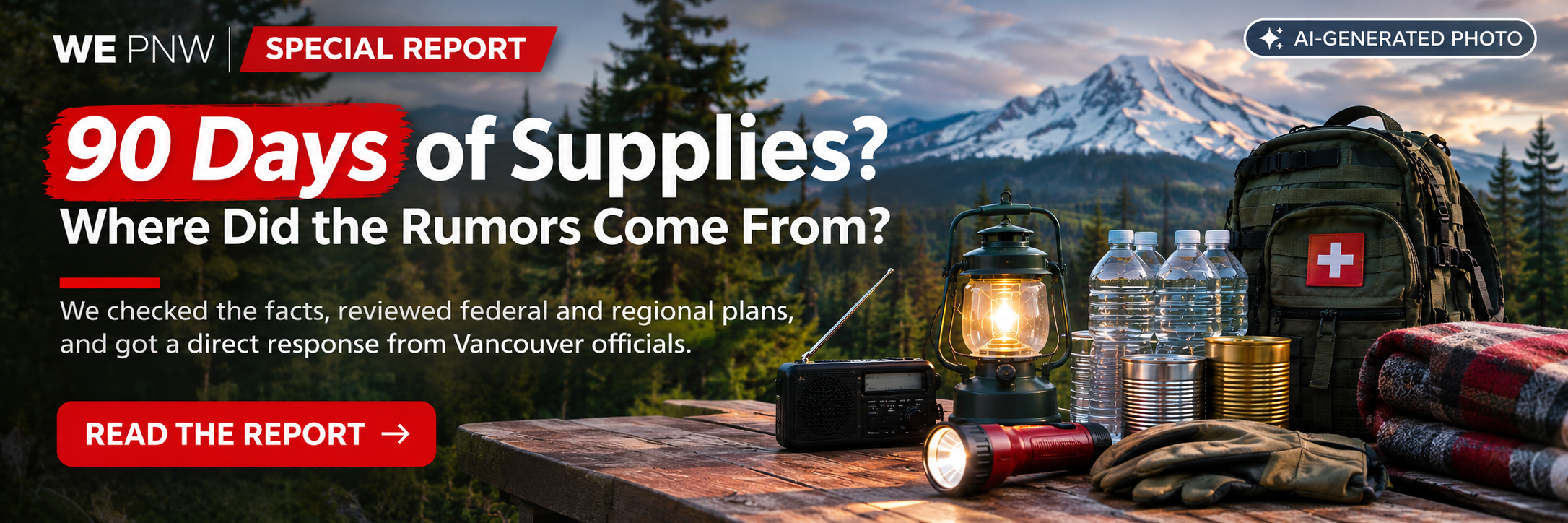
Should American households urgently prepare 90 days of food, water, batteries and other emergency supplies?
The question has circulated online following reports about a new Pentagon initiative designed to make military installations more self-sufficient during major disruptions.
Some online claims have connected the initiative to fears of prolonged power outages and other possible emergencies.
But is there a new warning for the public? And how does it compare with the emergency preparedness advice residents of Oregon and Washington have received for years?
WE PNW reviewed the available documents, examined regional emergency planning history and requested clarification directly from Vancouver officials.
The findings point to an important distinction between military continuity planning and household emergency preparedness.
Where did the 90-day figure come from?
On September 30, 2026, Defense Secretary Pete Hegseth announced FORTRESS America, a program designed to strengthen the ability of American military installations to operate during serious infrastructure and supply-chain disruptions.
The initiative includes independent power generation, strategic reserves, infrastructure protection, cybersecurity and more resilient military supply chains.
On October 25, Fox News Digital reported, citing internal Pentagon documents it had reviewed, that major U.S. military installations were expected to maintain essential operations for at least 90 days without outside support, including electricity, water, fuel and communications.
There is, however, an important qualification.
The publicly released memorandum establishing FORTRESS America does not itself specify a 90-day standard. That figure was reported by Fox News based on internal documents.
The defense publication The War Zone subsequently examined the initiative and noted that several operational details about how the 90-day objective would be achieved remained unclear.
The reporting has been discussed alongside online concerns about possible widespread power outages and household stockpiling.
The precise origin of every circulating claim cannot be established. But one conclusion is clear:
A military base's goal of operating independently for 90 days is not an instruction for American families to stockpile 90 days of groceries.
Cascadia: Why the Pacific Northwest has prepared for years
To understand the region's existing emergency supply guidance, it is necessary to look back more than a decade.
Oregon and Washington face a long-recognized hazard: the Cascadia Subduction Zone, a major earthquake fault system off the Pacific Northwest coast.
A catastrophic earthquake could damage roads, bridges, power grids, water systems and communications networks, making emergency response and delivery of supplies difficult for an extended period.
This concern did not emerge in 2026.
Washington state's first Cascadia earthquake response plan was published in 2013.
That same year, Oregon State University and public- and private-sector partners began the Cascadia Lifelines Program, a research effort focused on making critical infrastructure more resilient to a major earthquake.
In June 2016, state, local, tribal, federal and military agencies participated in Cascadia Rising, a major regional emergency exercise.
The scenario simulated a magnitude 9.0 Cascadia earthquake, a tsunami and widespread damage across the Pacific Northwest.
Emergency officials tested communications, medical response, evacuation planning, transportation, resource distribution and the challenge of reaching communities cut off by damaged infrastructure.
The exercise exposed vulnerabilities that would make it difficult to restore services or deliver aid quickly after a major disaster.
One of its significant consequences was Washington state's decision to encourage households to prepare to be self-sufficient for up to two weeks.
The state updated its earthquake planning in 2017, and the Cascadia Rising exercise series continued in 2022 with additional work focused on transportation and mass-care challenges.
In other words, emergency preparedness guidance for Pacific Northwest households has developed over many years.
These exercises address the consequences of a plausible natural disaster. They are not predictions that an earthquake is about to occur.
What Vancouver told WE PNW
WE PNW contacted the City of Vancouver to ask whether it had issued new guidance recommending 90 days of emergency supplies.
On November 9, Laura Shepard responded in writing.
Asked whether the city had introduced such guidance, the response was direct:
“No, we have not.”
Vancouver recommends that households maintain enough food and water for residents and pets for at least three days.
The city explained that encouraging emergency preparedness is part of its continuing public safety work rather than a response to a newly announced specific threat.
Officials also confirmed that preparedness recommendations for private households differ from the requirements government and military installations use to maintain essential operations.
Why do some agencies recommend three days and others two weeks?
WE PNW reviewed additional public guidance.
The City of Vancouver, in its written response, identified three days as the minimum household food and water recommendation.
The Vancouver Fire Department recommends seven to ten days of nonperishable food and approximately 1 to 1.5 gallons of water per person per day.
CRESA, the Clark Regional Emergency Services Agency, recommends that households ideally maintain two weeks of supplies. It also suggests three to four days of essentials in an evacuation bag and 24 to 36 hours in a vehicle kit.
Washington's Emergency Management Division encourages residents to build toward two weeks of household supplies, including food, water, medications and pet necessities.
Oregon's Department of Emergency Management promotes Be 2 Weeks Ready, a program designed to help households meet essential needs for at least 14 days after a disaster.
These recommendations serve different preparedness needs. Three days can be a starting point, while two weeks provides a larger margin during prolonged disruptions.
None of the regional guidance reviewed by WE PNW establishes a new 90-day stockpiling requirement for households.
What should residents actually keep at home?
Vancouver's Be Ready Vancouver website recommends emergency supplies such as drinking water, shelf-stable food, medications, first-aid materials, flashlights, batteries, chargers, sanitation supplies, important documents, cash and pet necessities.
Its full household kit guidance uses one gallon of water per person per day as a planning measure.
Emergency officials also recommend identifying family meeting places, selecting an out-of-area contact and planning for potential evacuations.
Vancouver encourages residents to sign up for Clark Public Alerts to receive official notifications about emergencies in their area.
Building supplies does not have to involve an immediate, expensive shopping trip. State and local emergency programs encourage households to begin with what they already own and add items gradually.
The bottom line
FORTRESS America is a real military preparedness initiative, and a 90-day independence goal for major installations has been reported by national news organizations.
But that military planning objective is different from household emergency guidance.
The Pacific Northwest has also spent more than a decade preparing for a potential Cascadia earthquake. Washington published its first Cascadia response plan in 2013, major exercises took place in 2016 and 2022, and the state's two-week preparedness guidance reflects lessons from that work.
Most importantly, the City of Vancouver explicitly told WE PNW that it has issued no new recommendation for households to stockpile 90 days of supplies.
That does not mean emergency preparation should be ignored. Families can benefit from having food, water, medications and a plan in place before an earthquake, severe storm or extended utility outage.
But practical preparedness and panic are not the same thing.
Being prepared makes sense. Treating unverified online claims as official emergency warnings does not.
Original WE PNW reporting: Written response from Laura Shepard, City of Vancouver, November 9, 2026.