
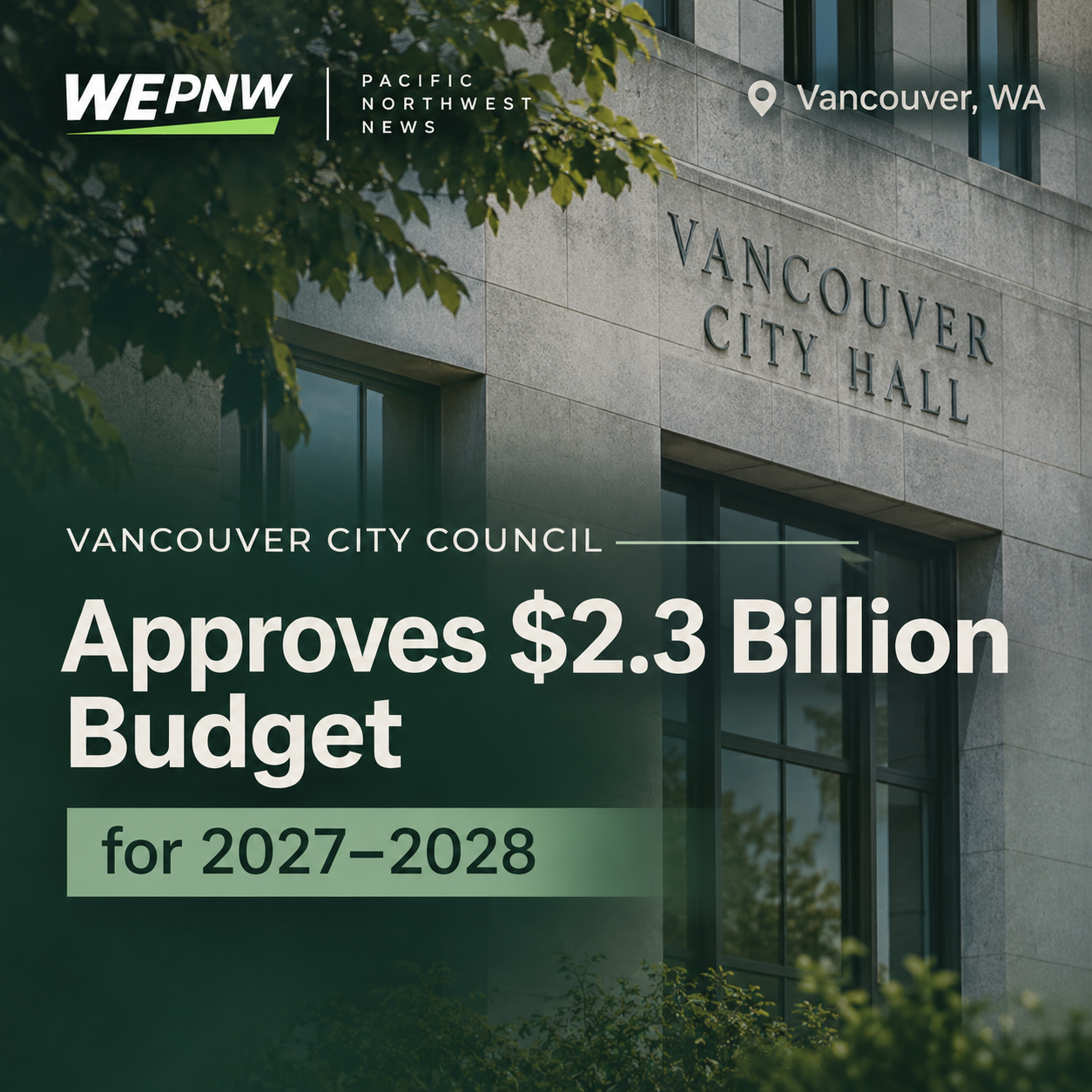
Vancouver City Council unanimously approved its 2027–2028 budget, outlining hundreds of millions of dollars in infrastructure investments, additional police officers, and expanded city services. The plan also includes increases in utility rates, certain taxes, and municipal fees. Here's what the decisions mean for residents and businesses.
VANCOUVER, Washington | November 16, 2026 — WE PNW
By Roman Tretiakov | WE PNW
On Monday, November 16, Vancouver City Council approved one of the city's most significant financial decisions of the year: a $2.3 billion biennial budget for 2027–2028.
The budget passed unanimously following public hearings. Council members also approved related ordinances addressing property taxes, utility rates, and various municipal fees.
For residents, the decisions mean additional investments in public safety and infrastructure, but also higher costs in certain areas. The actual financial impact will vary depending on the type of tax, fee, or service.
$2.3 Billion: Where Will the Money Go?
City Chief Financial Officer Kathryn Shifley presented the budget's key financial figures.
Approximately $1.6 billion is allocated to operating expenses, including public safety, infrastructure maintenance, municipal services, and other ongoing city functions.
Another $543 million is budgeted for direct capital projects. Total capital-related appropriations are higher when associated transfers are included.
Major projects planned for the next two years include:
- Construction of a new city operations center.
- Improvements to Fire Stations 3, 6, and 8.
- Investments in water treatment systems addressing PFAS, a group of persistent chemical compounds.
- Work associated with the Vancouver Arts Hub.
- Improvements to Bagley Park and other public spaces.
A substantial portion of the budget will therefore support both everyday city operations and long-term infrastructure development.
Property Taxes: What Does the 1% Increase Actually Mean?
City Council approved a 1% increase in the city's general property tax levy compared with the previous year.
The city will also use previously banked levy capacity associated with Proposition 2 to help fund fire and emergency services.
However, there is an important distinction.
A 1% increase in the city's overall property tax levy does not mean every homeowner's individual property tax bill will automatically increase by exactly 1%.
Actual property tax bills depend on assessed property values, levy rates imposed by different taxing jurisdictions, and other factors.
The council also approved a $10 million affordable housing property tax levy. According to the budget presentation, this levy will not increase relative to the previous year's amount.
Utility Bills: Rates Set to Rise by Nearly 6%
One of the decisions most likely to affect residents directly involves water, wastewater, and stormwater services.
The council approved utility rate changes that, according to city officials, represent a combined increase of just under 6% over the two-year budget period.
This is a blended figure covering multiple services. It does not mean every individual utility rate will increase by the same percentage.
The council also approved an adjustment to the city's utility tax rate, increasing it from 28.9% to 28.99%.
City officials estimate the adjustment will generate slightly more than $200,000 in additional revenue to support a management analyst position focused on implementing the city's Climate Action Framework.
The actual impact on individual household utility bills will depend on the applicable rates and consumption.
Businesses Will Face Higher Fees, Too
Another approved ordinance affects fire and life safety inspections and operational permits.
Beginning January 1, 2027, applicable fees will increase by 12%.
City officials said the adjustment is intended to bring revenue from the fire inspection program closer to the actual cost of providing those services.
According to the city's chief financial officer, the fees were not increased in 2023, 2024, or 2025.
The city is working toward a target of recovering 90% of program costs through applicable fees, although the newly approved increase will not immediately achieve that target.
For businesses requiring these inspections or permits, the change could result in additional operating expenses.
37 Additional Positions: Vancouver Expands Its Workforce
Despite concerns raised about government spending, the approved budget includes a net increase of 37 full-time-equivalent positions across city departments.
The largest share of those positions is allocated to the Vancouver Police Department, which will receive 23 additional positions.
The budget includes 16 new police officer positions, supported in part by grant funding and dedicated public safety sales tax revenue.
Additional employees are also planned for administrative, financial, communications, and public works functions.
At the same time, the final budget removes positions and expenditures associated with previously discussed annexation initiatives.
The council also included $388,000 for seasonal employees, park maintenance, trash collection, and public restroom upkeep.
Residents Challenge Higher Spending
The budget's adoption was accompanied by criticism during the public hearing.
Several speakers questioned the city's spending priorities, rising financial burdens, and the expansion of administrative staffing.
Vancouver resident Carmen de Leon, who also identified herself as Mello, suggested that the combined impact of various increases could amount to a 7% tax increase.
However, that figure was not established as a uniform tax increase affecting all residents.
The figures presented by city officials apply to different categories, including property tax levies, utility rates, and specific municipal fees. They cannot simply be added together to calculate a single percentage increase in taxes for every Vancouver household.
Another speaker, Kimberly Elbon, criticized the expansion of administrative spending and called for stronger financial accountability and greater transparency.
Despite the objections raised during public testimony, the council unanimously approved the budget and related financial ordinances.
What Will Vancouver Residents Get in Return?
With the $2.3 billion budget approved, the central question is no longer simply how much the city plans to spend, but what residents will receive in return.
City officials plan to direct additional resources toward public safety, fire services, utility infrastructure, and maintenance of municipal facilities.
However, increased spending alone does not guarantee better public services.
The results will ultimately be measured by improvements in police and emergency response, the condition of roads and parks, the reliability of utility systems, and the completion of planned infrastructure projects.
For many Vancouver households, changes to water, wastewater, and stormwater bills may be among the most noticeable financial effects.
For some businesses, higher fire inspection and permit fees will add another expense.
Vancouver's $2.3 billion budget is now approved. The next question is how effectively the city will spend that money — and what taxpayers will receive in return.
WE PNW will continue monitoring the city's budget implementation, utility rate changes, and the progress of major public projects.
Sources
1. Vancouver City Council — Official meeting agenda, November 16, 2026, Items 7–15, covering the biennial budget, property tax levies, utility rates, and municipal fees.
2. Clark/Vancouver Television (CVTV) — Official recording of the November 16, 2026, City Council meeting, including Chief Financial Officer Kathryn Shifley's budget presentation, public testimony, and council votes.
3. City of Vancouver — Staff Reports:
- 220-26 — General Property Tax Levy for 2027.
- 225-26 — Utility Rates.
- 227-26 — Utility Tax for 2027–2028.
- 228-26 — Biennial Operating and Capital Budget.
Staff report numbers are referenced from the official meeting agenda.
Illustration: WE PNW editorial graphic. Not an actual photograph of the City Council meeting.
© 2026 WE PNW