
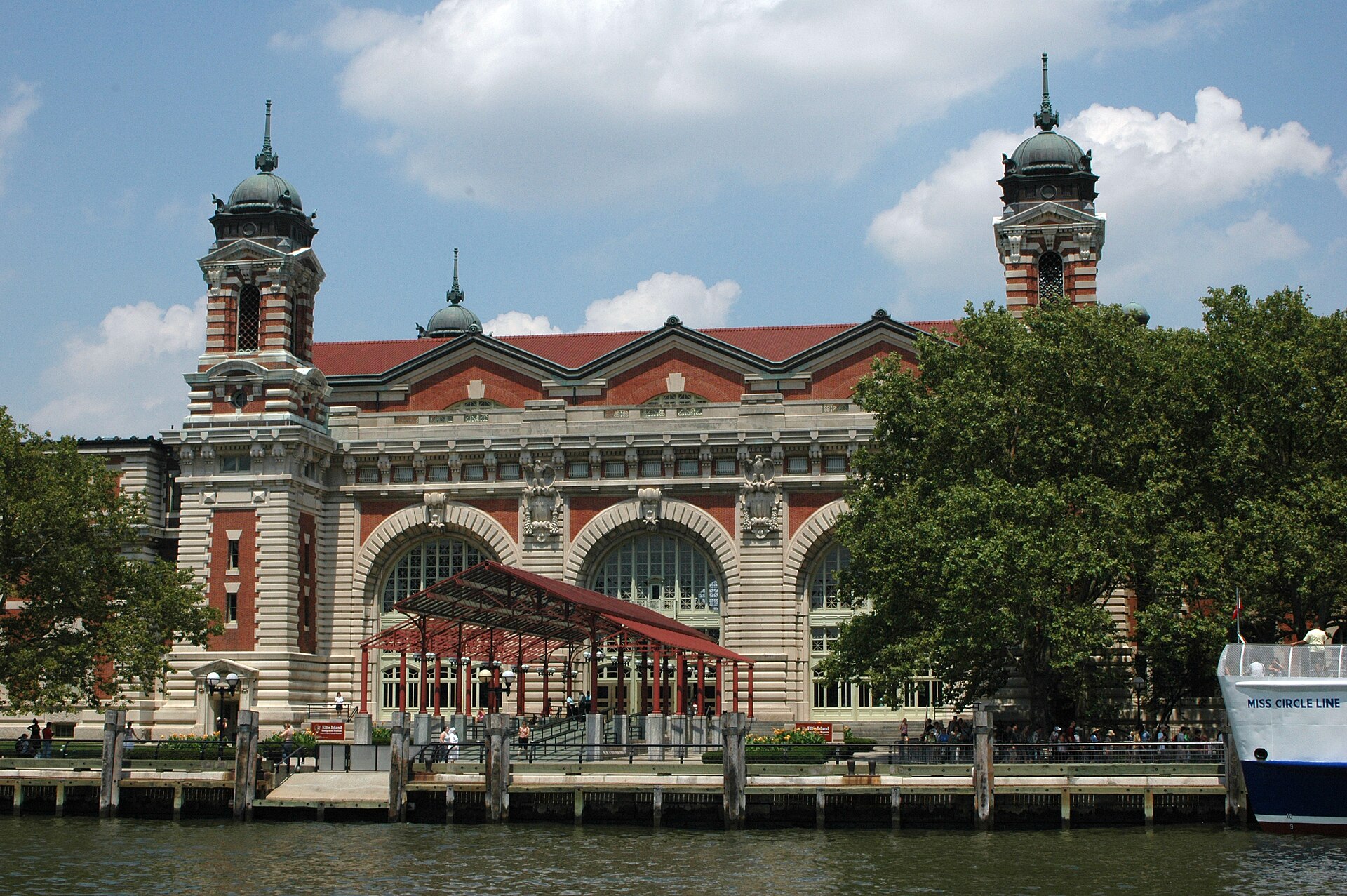
On November 12, 1954, the immigration station on Ellis Island in New York Harbor closed its doors. Over six decades, more than 12 million people passed through the island. Some walked away toward a new life in America. Others, having already seen its shores, learned they would have to return to the world they had left behind.
Imagine someone who has sold nearly everything, said goodbye to family, and boarded a ship bound across the Atlantic Ocean.
They may not speak the language of their destination. They may have no friends or relatives waiting for them. Their possessions fit into a few suitcases.
What they carry in greater abundance is hope.
After a long voyage, New York finally appears on the horizon. And then comes the Statue of Liberty.
For countless passengers, it was a sight they would remember for the rest of their lives.
America was almost within reach.
But seeing America was not the same as being allowed to enter it.
Between the ship and the life they imagined stood a small island.
Ellis Island.
Where Hope Met Uncertainty
Ellis Island sits in New York Harbor, close to the Statue of Liberty, which stands on neighboring Liberty Island.
Together, these two places came to represent an extraordinary chapter of American history.
The Statue of Liberty offered a powerful image of freedom and possibility. Ellis Island was where many newcomers learned whether they would be permitted to pursue those possibilities.
The federal immigration station opened on January 1, 1892.
Its first registered immigrant was Annie Moore, a 17-year-old girl from Ireland who arrived with her two younger brothers.
Over the following decades, more than 12 million people passed through the station.
They came from Italy, Ireland, Germany, Poland, the Russian Empire, Austria-Hungary, and many other parts of the world.
Their reasons for leaving were different.
Some were escaping poverty or hunger. Others were fleeing religious or political persecution. Many were looking for work, stability, and opportunities for their children.
Today, we know that millions of these immigrants and their descendants became part of the fabric of American society.
But the people arriving at Ellis Island knew nothing about the lives that awaited them.
They did not know whether they would find employment, learn English, or feel accepted in their new country.
And before any of those questions could be answered, there was another one.
Would they be allowed to enter?
A Few Hours That Could Change a Lifetime
New arrivals underwent medical examinations and immigration inspections.
Doctors looked for signs of illness. Inspectors reviewed documents and asked questions about family, employment, financial resources, and destinations.
For most immigrants, the process ended successfully.
Approximately 98 percent of those processed at Ellis Island were admitted and allowed to continue their journeys.
But the remaining two percent were not merely a statistic.
They were people who had crossed an ocean only to discover that their journey might end at the water's edge.
Some were detained for further medical examinations. Others faced additional hearings or immigration decisions. Some were denied entry.
Families could be temporarily separated during medical or administrative reviews.
Imagine being close enough to see New York City, yet unable to enter it.
The streets, homes, jobs, and possibilities of an entirely new life were just across the water.
Still, everything depended on an official decision.
Ellis Island was not a place where most immigrants were turned away. The overwhelming majority passed through and continued into the United States.
Yet the stories of those who did not make it beyond the island reveal how fragile the promise of a new beginning could be.
Robert De Niro and the Ghosts of Ellis Island
In 2015, French artist and filmmaker JR directed a short film titled Ellis, starring Robert De Niro.
The screenplay was written by Eric Roth, whose work includes Forrest Gump. Roth's own family history is connected to Ellis Island.
The film was shot inside the island's actual abandoned hospital complex, rather than on a reconstructed movie set.
De Niro portrays an immigrant who seems to return as a ghost to the place where his hope of entering America came to an end.
His character recalls arriving as a young man, facing rejection, and hiding inside the hospital rather than accepting his return. His story is tragic.
The film is a work of fiction, not a documented biography of a particular immigrant. But it draws on the real history of people who were denied entry and on the memories preserved within the island's buildings.
The setting gives the film much of its emotional power.
Empty corridors. Damaged walls. Abandoned hospital rooms.
Across those walls, JR installed enlarged historical photographs of immigrants, creating the impression that people who had disappeared from the world were somehow present again.
In interviews about the film, JR explained that he wanted to bring humanity back to stories too often reduced to numbers and political arguments.
That may be the film's greatest achievement.
After watching Ellis, historical photographs of the immigration station begin to look different.
They no longer show only anonymous crowds in old-fashioned clothing.
They show people who once made the extraordinary decision to leave everything familiar behind for a future they could not predict.
Why America Closed Its Immigration Gateway
In the early twentieth century, Ellis Island was among the busiest immigration facilities in the United States.
During its peak years, thousands of immigrants could pass through the station in a single day.
But American immigration policy was changing.
In 1921, Congress introduced new immigration quotas. The Immigration Act of 1924 imposed even stricter restrictions based on national origin.
Much of the immigration screening process shifted to American consulates overseas.
Ellis Island gradually lost its original role.
During its later decades, the facility was increasingly used to detain people awaiting immigration decisions, including deportation proceedings.
On November 12, 1954, the last detainees were removed from the island.
The final ferry trip took place on November 29, leaving the complex vacant.
The immigration station that had once represented the beginning of American life for millions was now silent.
The Island America Almost Lost
After the station closed, its buildings gradually deteriorated.
Rooms stood empty. Windows were damaged. Corridors that had once been filled with passengers, doctors, inspectors, and immigration officers fell into disrepair.
It seemed that the physical traces of millions of personal stories might slowly disappear.
But Ellis Island was not forgotten.
Following a major restoration, the Ellis Island National Museum of Immigration opened in the main building in 1990.
Today, visitors can walk through the Great Hall, examine historical documents and photographs, and learn about the people who passed through the station.
For some, the museum offers an introduction to American history.
For others, it offers a connection to their own families.
Widely cited historical estimates suggest that roughly 40 percent of Americans can trace at least one branch of their ancestry to immigrants who passed through Ellis Island.
The scale is difficult to comprehend.
Descendants of those who once stood in line with suitcases now live throughout the United States.
They build homes, start businesses, teach in schools, work in hospitals, serve in the military, and raise families of their own.
Many have never visited the island where their family's American story began.
Seventy-Two Years Later
America is once again debating immigration.
Borders, laws, security, admission policies, the right to remain, and the responsibilities of government remain subjects of intense disagreement.
These questions were complicated a century ago. They are complicated today.
But something fundamental has changed very little.
A person leaving their country is still leaving behind a familiar life.
They may know where they are going, but they rarely know what truly awaits them.
That is why Ellis Island does not feel like a story belonging entirely to the past.
It reminds us that immigration is not only a matter of laws, statistics, and government decisions.
It is also a collection of individual lives.
Some people leave in search of work. Others leave for their children. Some seek freedom. Others are escaping circumstances in which they can no longer live.
None can be certain that the life awaiting them will resemble the one they imagined.
On November 12, 1954, Ellis Island ceased operating as an immigration station.
But the stories of the people who passed through it continued.
And perhaps the most remarkable part of its history is that those millions of newcomers could not have imagined the roles their children and grandchildren would one day play in American society.
They did not know what America would become a hundred years later. They simply hoped there would be a place for them in it.