
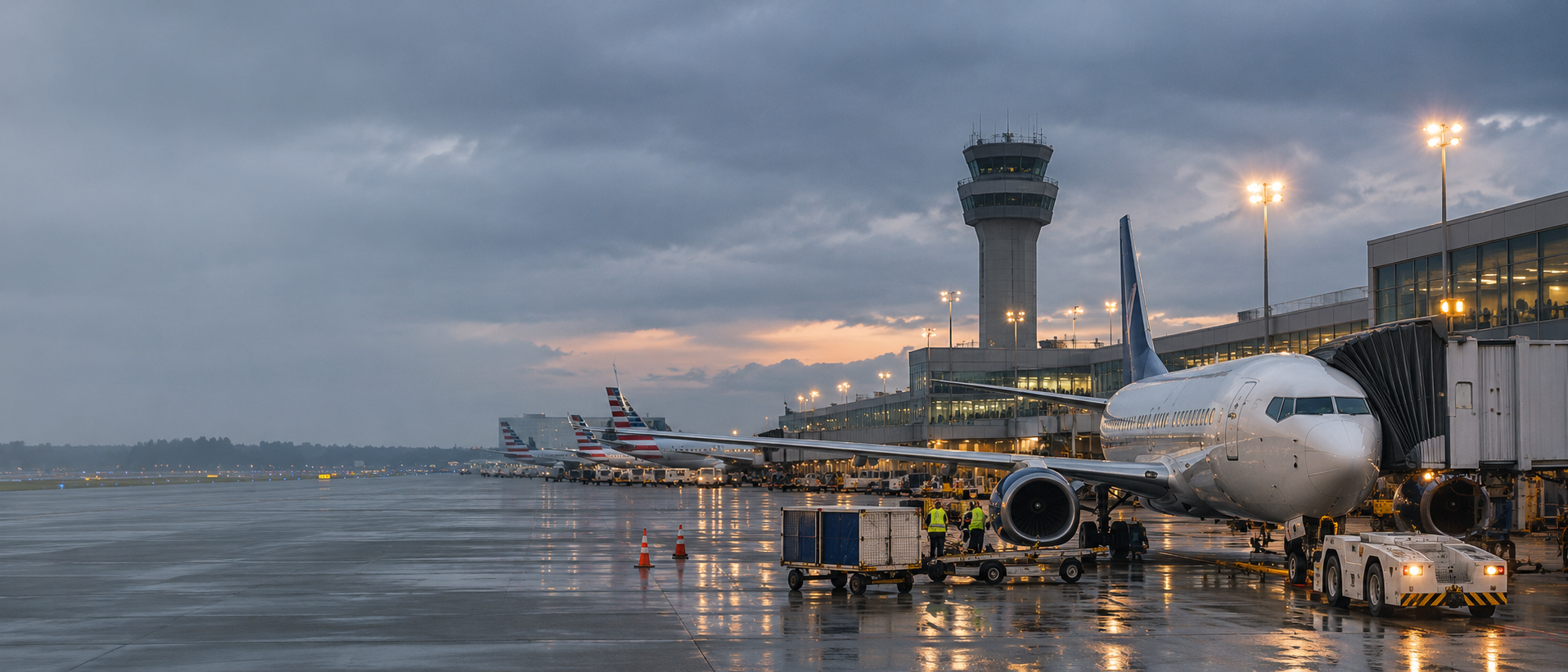
A nationwide ground stop lasted more than four hours after communications problems disrupted the U.S. air traffic control system. Hundreds of flights were diverted or returned to their departure airports, including disruptions affecting Portland International Airport. The restrictions have been lifted, but delays and cancellations continue.
PORTLAND, Ore. / UNITED STATES | November 13, 2026 — WE PNW
A major communications failure disrupted air travel across the United States on Friday, November 13, prompting the Federal Aviation Administration (FAA) to temporarily halt flight departures nationwide.
The FAA imposed the ground stop as a safety precaution after problems affected the communication systems used by regional air traffic control centers.
The nationwide restriction began at approximately 3:54 p.m. Eastern Time, or 12:54 p.m. Pacific.
At 8:15 p.m. Eastern (5:15 p.m. Pacific), the FAA lifted the ground stop, allowing departures to resume.
However, airlines warned that recovering from the disruption would take considerably longer.
What happened to the air traffic control system?
The problems affected communications within the network of 22 regional Air Route Traffic Control Centers responsible for coordinating flights between airports across the United States.
As communications became unreliable, the FAA temporarily suspended new departures.
Aircraft already in the air were not ordered to land immediately.
Many continued toward their destinations, while others returned to their departure airports or were diverted to alternate locations.
International operations were handled separately.
White House officials explain the preliminary cause
Transportation Secretary Sean Duffy and Homeland Security Secretary Markwayne Mullin addressed the disruption during an official White House briefing Friday evening.
Duffy pointed to aging air traffic control technology, including outdated switches, routers and telecommunications infrastructure.
According to Duffy, equipment became overloaded with data, resulting in inconsistent communications and forcing the FAA to suspend departures as a precaution.
Administration officials also discussed problems involving the integration of newer technology with older infrastructure.
Those statements represent the administration's preliminary explanation. The final technical cause remains under investigation.
Duffy urged Congress to provide additional funding for a nationwide modernization of air traffic control equipment, warning that similar failures could happen again.
How many flights were affected?
Aviation analytics company Cirium reported that by 7:05 p.m. Eastern:
- 827 flights had been diverted or returned to their departure airports.
- 670 aircraft returned to the airports where their flights originated.
- 157 aircraft were redirected to alternate airports.
Thousands of aircraft were already airborne when the nationwide ground stop was announced.
Flight-tracking data from Flightradar24 showed approximately 3,800 aircraft heading toward U.S. airports shortly before the restrictions began.
That figure represents aircraft already in flight, not canceled departures.
Evening FlightAware reports showed nationwide cancellations approaching 5,000, with roughly 10,000 delays.
These daily figures include disruptions from other causes and should not be interpreted as flights affected exclusively by the FAA communications failure.
Cirium also estimated that approximately 11,000 departures carrying more than 1.5 million passengers had been scheduled after 4 p.m. Eastern, illustrating the potential scale of the disruption.
Portland International Airport affected
Portland International Airport (PDX) was among the airports impacted by the nationwide restrictions.
During the ground stop, airport officials advised passengers that departures were suspended and urged them to contact their airlines directly.
Inbound flights already in the air continued to land.
After the nationwide order was lifted, individual flight operations still depended on aircraft availability, crew scheduling and airlines' ability to restore disrupted timetables.
Travelers departing from PDX may continue experiencing delays or cancellations even after the national ground stop has ended.
Was Microsoft involved? Was this a cyberattack?
The aviation disruption occurred while Microsoft was dealing with a separate global outage affecting Outlook, Teams and other online services.
Microsoft stated that it had no indication its service disruption was connected to the FAA's nationwide ground stop.
Federal officials also reported finding no evidence of a cyberattack or deliberate interference.
The precise technical cause of the aviation outage remains under investigation.
Why this matters
The last comparable nationwide FAA ground stop occurred in January 2023, following a failure of the computer system that delivers critical notices to pilots.
Friday's disruption has renewed concerns about the reliability of aging aviation infrastructure.
The effects extended beyond passenger travel to cargo operations, international routes and professional sports teams.
The central question is how a technical communications problem was able to disrupt flight departures nationwide — and what changes will be necessary to prevent another widespread failure.
What travelers should do
The FAA has authorized departures to resume.
Passengers traveling through Portland International Airport or other U.S. airports should check their individual flight status directly with their airline.
A nationwide return to operations does not guarantee that every flight will depart on its original schedule.
WE PNW will continue monitoring the disruption and its effects on Oregon, Washington and the rest of the United States.
- Flightradar24 — November 13, 2026 flight-tracking data.
- Microsoft — statement regarding the separate Microsoft 365 outage.