
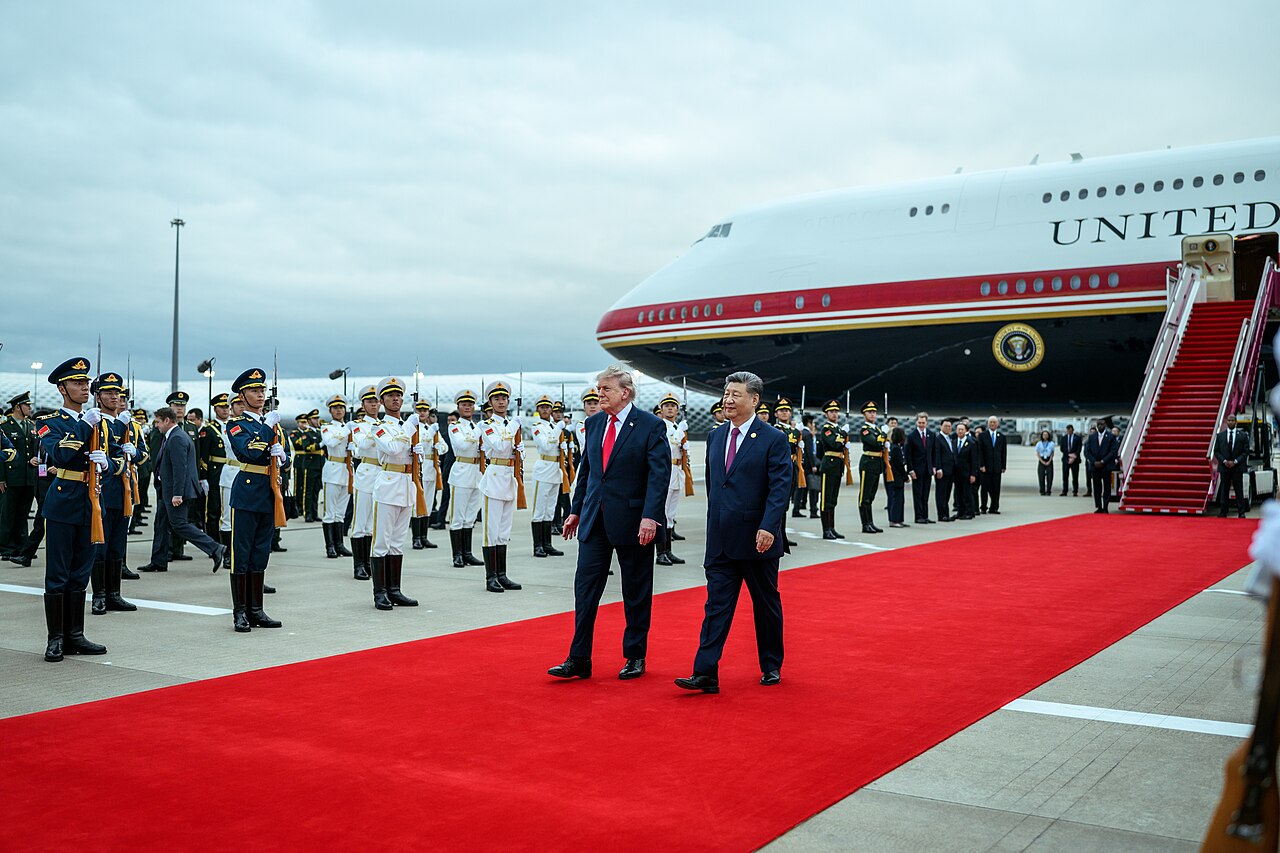
Against this backdrop, questions arise about U.S. interests, the cost of sanctions relief, and Ukraine's future.**
Opinion & Analysis | Roman Tretiakov | WE PNW
November 19, 2026**
On November 18, the official White House account published a photograph of Donald Trump shaking hands with Vladimir Putin at the Asia-Pacific Economic Cooperation (APEC) summit in Shenzhen, China. Chinese President Xi Jinping stood nearby.
On November 19, the U.S. and Russian presidents held a separate meeting lasting approximately 40 minutes. Before the talks, Trump referred to Putin as his friend.
According to the Kremlin, the war against Ukraine was the main subject of their conversation. Russian presidential aide Yuri Ushakov told reporters that Putin left the meeting in an "excellent" mood.
No new agreements on a ceasefire, the withdrawal of Russian troops, or changes in Moscow's position were announced.
However, the significance of these developments extends far beyond the war in Ukraine.
Leaders of countries that shape a substantial share of the global economy, trade, and international security arrived in China. Another major development was the preparation for the first trilateral talks between the leaders of the United States, Russia, and China.
The leaders of three nuclear powers — all permanent members of the United Nations Security Council — were expected to sit at the same negotiating table.
European leaders were not part of this format.
This raises questions not only about the results of the meeting itself but also about how global politics has changed by the end of 2026.
China: Diplomacy on a New Scale
The APEC summit in Shenzhen brings together representatives of 21 economies across the Asia-Pacific region.
Participants include the United States, Russia, China, Japan, South Korea, Canada, Australia, New Zealand, Mexico, Indonesia, Vietnam, Malaysia, Singapore, Thailand, the Philippines, Brunei, Chile, Peru, Papua New Guinea, Hong Kong, and Taiwan, which participates under the name Chinese Taipei.
APEC was originally established as a forum for economic cooperation. Its members account for approximately 60% of global GDP and nearly half of international trade.
However, in November 2026, the economic forum also became a venue for discussions about wars, nuclear weapons, and international security.
Xi Jinping personally welcomed Donald Trump at Shenzhen's airport. The American president received a ceremonial reception.
Vladimir Putin also arrived in China and held separate talks with the Chinese leader.
Trump and Putin subsequently met, while a separate meeting involving the leaders of all three countries was scheduled for November 19.
China hosted the APEC summit.
Just a few years ago, such a political configuration would have been difficult to imagine.
Beijing has moved several steps higher in global diplomacy simply because of the scale of this meeting.
China is hosting the leaders of the United States and Russia while maintaining its own relationship with Moscow and continuing its economic competition with Washington.
It is becoming a place where world leaders come to discuss issues that affect the security of other regions of the planet.
This represents a fundamentally different level of diplomacy from Turkey's mediation in negotiations between Russia and Ukraine.
Ankara has repeatedly provided venues for negotiations and helped facilitate agreements, including the Black Sea Grain Initiative.
But in Shenzhen, the discussion involves the leaders of the world's three largest nuclear powers, addressing several international conflicts and strategic security issues simultaneously.
For China, this is an opportunity to demonstrate not only its economic power but also its ability to host dialogue at the highest political level.
That is why the significance of this meeting cannot be measured solely by the number of agreements signed.
Political influence is also reflected in the ability to determine where major international negotiations take place, who participates, and whose territory becomes the venue.
Putin: International Isolation Has Proved Far From Absolute
Russia is approaching the end of 2026 with enormous military losses.
According to research published on July 1, 2026, by the American Center for Strategic and International Studies (CSIS), Russian forces suffered approximately 1.4 million casualties — including those killed, wounded, and missing — since the beginning of the full-scale invasion of Ukraine.
Of those, researchers estimate that between 400,000 and 450,000 were killed.
These figures are based on analytical estimates rather than official Russian statistics.
At the same time, sanctions continue to restrict Russian banks, technology exports, energy transactions, and international trade.
On March 17, 2023, the International Criminal Court issued an arrest warrant for Vladimir Putin over alleged war crimes involving the unlawful deportation and transfer of Ukrainian children.
Yet in November 2026, Putin is in China among the leaders of the world's largest economies.
The president of the United States and the president of China are attending the same summit.
The American president publicly calls him a friend.
Moscow's political isolation has not resulted in Russia's exclusion from high-level international negotiations.
Russia's leadership also retains significant instruments of influence.
First and foremost, it possesses one of the world's two largest nuclear arsenals.
Russia also maintains strategic relations with China, which remains Moscow's most important trading partner.
Another important relationship is with Iran, with which Russia signed a comprehensive strategic partnership treaty.
Thus, enormous military losses have not eliminated Russia's diplomatic influence.
The picture is contradictory: Russia continues to pay an enormous human price for the war, while its president participates in discussions of global security alongside the leaders of the United States and China.
Japan Supports Ukraine but Also Talks to Putin
Japan's participation deserves particular attention.
On September 22, Prime Minister Sanae Takaichi met Ukrainian President Volodymyr Zelenskyy in New York.
According to an official statement from the Japanese government, Takaichi described Russia's aggression against Ukraine as a serious violation of the foundations of the international order.
She confirmed that Japan would continue supporting Ukraine and participating in international sanctions against Russia.
But on November 18, during the APEC summit in Shenzhen, Takaichi held an approximately 30-minute meeting with Vladimir Putin.
These were the first direct talks between the leaders of Japan and Russia in seven years.
According to the Japanese side, the discussion covered the detention of a Japanese journalist in Russia, the situation facing Japanese companies, and other bilateral issues.
The two sides agreed to maintain communication.
No changes to Japan's position regarding the war against Ukraine were announced.
The situation illustrates how increasingly complex international diplomacy has become.
Japan supports Ukraine, maintains sanctions against Russia, and simultaneously restores direct high-level contacts with Moscow.
Canada and Australia also continue supporting Ukraine despite their leaders participating in the same international forum as Putin.
Following the summit's group photograph, a debate even emerged in Australia over Prime Minister Anthony Albanese's presence alongside the Russian president.
Australian officials explained that participation in an APEC protocol photograph did not indicate any change in the country's political position.
Shenzhen has become a venue where countries with substantially different views on Russia's war are present at the same time.
The United States, Iran, and Russia's Strategic Partnership
On February 28, 2026, the United States and Israel launched a military operation against Iran.
In the following months, the armed confrontation involved missile and air strikes, retaliatory actions by Tehran, attempts to secure a ceasefire, and renewed escalations.
The conflict significantly affected international trade, transportation through the Persian Gulf, and global energy markets.
On November 18, U.S. Central Command expanded restrictions under the maritime blockade of Iranian ports.
American forces can now take measures against vessels receiving Iranian cargo through transfers at sea, even if those vessels have not entered Iranian ports themselves.
Washington continues to exert economic and military pressure on Tehran.
At the same time, the American president travels to China, where Iran is among the announced subjects for discussions with Putin and Xi Jinping.
Russia, meanwhile, maintains a strategic relationship with Iran.
In January 2025, Moscow and Tehran signed a 20-year comprehensive strategic partnership agreement covering political, economic, and defense cooperation.
In March 2026, The Washington Post, citing three officials familiar with intelligence information, reported that Russia had provided Iran with data on the locations of American warships and aircraft in the Middle East.
In April, Reuters also reported on a Ukrainian intelligence assessment alleging that Russian satellites were used to monitor military facilities and critical infrastructure in the region, while Moscow and Tehran were believed to be cooperating in cyberspace.
Against this background, the meeting in China takes on additional significance.
The United States is engaged in an armed confrontation with Iran while discussing regional security with leaders of countries that maintain close relations with Tehran.
What exactly does Washington intend to obtain from Russia regarding the conflict with Iran?
Is Moscow prepared to change the nature of its cooperation with Tehran?
And what conditions might be discussed in exchange for Russian participation in diplomatic efforts to resolve the conflict?
There are still no public answers to these questions.
Russian Diesel and American Sanctions
Decisions made by the Trump administration shortly before the trip to China deserve particular attention.
On October 9, Donald Trump announced an agreement with Vladimir Putin regarding supplies of Russian diesel fuel.
According to the American president, Russia was expected to immediately supply more than 300,000 metric tons of diesel, followed by another 500,000 metric tons in November, with additional increases in supply afterward.
That same day, the U.S. Treasury Department's Office of Foreign Assets Control (OFAC) issued General License No. 135.
The document authorized transactions related to the sale, delivery, offloading, and importation of Russian-origin diesel fuel, including imports into the United States, through April 7, 2027.
In effect, the American administration opened an additional opportunity for trade in Russian fuel.
However, on November 18, The Washington Post published an investigation tracking the tankers that had been expected to deliver Russian diesel to the United States.
Nearly six weeks after the agreement was announced, none of the expected tankers had arrived at American ports.
Two vessels changed course toward Brazil and Egypt.
A third, the Agioi Fanendes, remained in the Atlantic Ocean without reaching the American coast.
Meanwhile, the American public had not been provided with details of completed purchases, actual fuel payments, or the companies involved.
There is no confirmation that the U.S. government paid for diesel that was never delivered.
But the sanctions authorization had already been issued.
What Happened to the Graham Act?
On September 18, 2026, Donald Trump signed the Lindsey O. Graham Sanctioning Russia and Iran Act of 2026.
The law provided for additional sanctions and trade restrictions, including substantial tariffs affecting Russia and countries involved in trading Russian energy products.
On October 16, the president signed Executive Order 14436, waiving the application of a substantial portion of the sanctions and increased tariffs provided for under the law.
The White House explained the decision as necessary to preserve opportunities for negotiations aimed at ending the war in Ukraine and to protect U.S. national security interests.
Legally, the law remains in effect.
But a significant portion of its sanctions mechanisms are not being applied as a result of the president's decision.
Previously imposed restrictions against Russia were not automatically lifted.
Thus, within one week, the Trump administration made two important decisions.
October 9 — it authorized additional transactions involving Russian diesel fuel.
October 16 — it granted broad waivers from new sanctions requirements under the Graham Act.
These were separate legal decisions based on different grounds, but both changed the conditions of economic pressure on Russia.
This raises a question about the tangible results of American policy.
Trump has repeatedly presented his ability to negotiate favorable deals as one of the main strengths of his political approach.
But how should an agreement be evaluated when the promised fuel has not reached American ports, the terms of commercial contracts have not been disclosed, and sanctions relief has already taken effect?
What did America get?
Did it secure guaranteed deliveries, lower fuel prices, additional commitments from Moscow, or concessions on other issues?
Answers from the American administration could help explain the economic logic behind these decisions.
Anchorage and Shenzhen: Two Meetings, Different Scales
On August 15, 2025, Donald Trump and Vladimir Putin met at an American military base in Anchorage, Alaska.
The main subject of those talks was the war against Ukraine.
The meeting included a ceremonial reception for the Russian president, official photographs, and statements about the prospects for a peaceful settlement.
However, no ceasefire agreement was reached.
The talks lasted nearly three hours, after which Trump acknowledged that no final agreement had been achieved.
Several days later, Zelenskyy and European leaders arrived in Washington to discuss the next steps and security guarantees.
The war continued.
On October 22, 2025, the U.S. Treasury Department imposed new sanctions on the Russian oil companies Rosneft and Lukoil, citing Moscow's lack of serious commitment to ending the war.
The Anchorage meeting therefore did not bring an end to the fighting.
But Shenzhen differs from Anchorage in both scale and political configuration.
The Alaska meeting involved bilateral talks between the American and Russian presidents.
In China, representatives of 21 economies have gathered, while a separate trilateral format includes Xi Jinping's direct participation.
The announced agenda is also considerably broader.
It includes nuclear weapons, Ukraine, Iran, international security, and economic relations among major powers.
In February 2026, the New START treaty expired — the last major agreement limiting strategic nuclear weapons held by the United States and Russia.
Trump has repeatedly expressed interest in negotiating a new agreement that would include China.
Beijing, however, has pointed out that its nuclear arsenal is considerably smaller than those of the United States and Russia and has rejected proposals for equal limitations.
Now the leaders of all three countries have an opportunity to discuss the issue directly.
The potential scale of the consequences of the meeting in China is significantly broader than that of the talks in Alaska.
The discussion could extend beyond a single armed conflict to the principles of strategic security and relations among the world's major powers.
And What About Ukraine?
On November 19, Donald Trump and Vladimir Putin held a separate meeting in Shenzhen.
According to Russian presidential aide Yuri Ushakov, the war against Ukraine was the main subject of their conversation.
Representatives of both delegations also participated. This was not a private, strictly one-on-one discussion between the two presidents.
The Russian side did not announce any change in its territorial demands.
Nor was there any announcement that Moscow had agreed to a ceasefire or to withdraw its forces from occupied Ukrainian territories.
The Ukrainian delegation did not participate in the meeting.
On November 18, Volodymyr Zelenskyy stated that American representatives were expected to brief Kyiv on Trump's talks in China during upcoming meetings in Berlin.
The Ukrainian president emphasized that matters concerning Ukraine must be decided with Ukraine's participation, and matters concerning Europe must involve European countries.
This exposes a substantial problem.
Ukraine is a direct party to the war, yet it was not present at the talks between the American and Russian presidents in China.
European countries continue to finance Ukraine's defense, supply weapons, maintain sanctions, and discuss security guarantees.
But European representatives are also absent from the separate negotiating format involving the United States, Russia, and China.
Ukraine's interests remain a subject of international negotiations, while Ukraine itself is not involved in every format in which its future is discussed.
At the same time, negotiations aimed at ending the war continue through other channels, including American mediation and the participation of European countries.
There are therefore several parallel diplomatic processes.
One involves Ukraine, the United States, and European partners.
Another takes place between Washington and Moscow.
And a third is taking shape in China, where the United States, Russia, and China are preparing to discuss international security in a considerably broader format.
Europe: A Seat at the Table or Waiting for the Results?
One of the most notable aspects of the summit in China is the absence of European leaders from the central trilateral format.
The European Union is not a member of APEC, so its absence from the forum's membership is expected.
But a separate meeting of the leaders of the United States, Russia, and China goes beyond the usual economic agenda of the Asia-Pacific region.
The issues being discussed directly affect the security of European countries.
Russia's war against Ukraine continues on the European continent.
Russian and American nuclear weapons remain a major factor in European security.
Energy crises and sanctions policies directly affect European economies.
Yet in Shenzhen, these matters are being discussed primarily by the leaders of three powers.
Europe remains a major economic and political center with its own instruments of influence. But its representatives are not part of this format.
In this respect, comparing Europe's position with China's is particularly revealing.
European countries are directly confronting the consequences of Russia's war against Ukraine.
China is geographically far from the European battlefield, yet it is on Chinese territory that world leaders are holding negotiations whose agenda includes the Ukrainian question.
For Beijing, this demonstrates its ability to influence the international diplomatic agenda.
For Europe, it raises the question of whether its diplomatic capabilities match its economic weight and importance to international security.
And All of This Against a Backdrop of Major Disruptions in the United States
As the American president prepared for his trip to China, the United States experienced one of the most notable weeks of technological disruptions in 2026.
On November 12, a major outage affected Microsoft 365 services, including Outlook and Teams.
On November 13, a technical failure in the Federal Aviation Administration's telecommunications infrastructure triggered a nationwide ground stop.
According to official FAA information, restrictions were in effect from approximately 3:30 p.m. to 8:15 p.m. Eastern Time.
Airlines canceled approximately 12,462 flights that day, although the agency clarified that not all cancellations were directly caused by the ground stop.
On November 16, a technological failure at JPMorgan Chase disrupted the processing of banking transactions and transfers, creating delays that also affected customers of other financial institutions.
That same day, United Airlines experienced an internal systems outage that affected aircraft departures.
On November 17, disruptions affected Apple services, including iCloud, the App Store, and Apple Music.
Also on November 17, reports emerged of a temporary disruption to the National Security Agency's classified internal network, NSANet.
The causes of these incidents differed. No evidence has been presented establishing a common cause or coordinated attack.
Nevertheless, the scale of the disruptions highlights vulnerabilities in critical technological systems on which everyday life, financial transactions, transportation, and government institutions depend.
Against this backdrop of domestic problems, the American president is participating in negotiations concerning global security, weapons, international trade, and armed conflicts.
What Has Changed by the End of 2026?
Global politics is gradually taking on a new configuration.
Russia continues its war against Ukraine, suffers enormous military losses, and remains under sanctions.
Yet Vladimir Putin participates in talks with the president of the United States and the president of China.
Washington's sanctions policy toward Russia is also changing.
The new restrictions under the Graham Act were adopted by Congress, but the application of a substantial portion was waived by presidential decision.
Russian diesel fuel was given additional access to commercial transactions, but the announced deliveries to the United States have not taken place.
At the same time, Moscow maintains strategic relations with China and Iran.
China is hosting leaders of countries possessing the world's largest nuclear arsenals and capable of exerting decisive influence on global security.
European countries, which have a direct interest in ending Russian aggression, are not participating in this narrow negotiating format.
Japan openly supports Ukraine while simultaneously holding its own talks with Putin.
Canada and Australia also continue supporting Kyiv while participating in an international forum attended by the Russian president.
All of this illustrates how complex international relations have become as 2026 draws to a close.
What interests of the United States are being advanced through this diplomatic arrangement?
Trump approaches international politics largely through the categories of agreements, economic terms, and reciprocal concessions.
However, at the time this article was prepared, the publicly confirmed results of negotiations with Russia remained considerably more limited than the expectations announced.
The American administration has already granted certain sanctions exemptions.
But the war in Ukraine has not ended.
The announced diesel agreement has not yet resulted in confirmed fuel deliveries to the United States.
A resolution to the conflict with Iran also remains out of reach.
Meanwhile, Putin is once again among the leaders of the world's major powers, and China is becoming a venue for negotiations that extend far beyond regional politics.
This balance of forces represents the principal political outcome of the summit in China so far.
In August 2025, Anchorage demonstrated that the American president was prepared to meet Putin personally to discuss Russia's war against Ukraine.
In November 2026, Shenzhen presents a different picture.
Russia, the United States, and China are preparing to discuss international security in a separate format, while countries directly affected by the consequences of these decisions remain outside the negotiating room.
This is the central shift we are observing by the end of 2026: global diplomacy is increasingly concentrated around states possessing sufficient military, economic, and political power to determine not only the substance of negotiations but also who gets to participate in them.
And while Anchorage was primarily a meeting between two presidents, Shenzhen is becoming a symbol of a much broader transformation in the architecture of international politics.
Roman Tretiakov
WE PNW — Independent News & Analysis
Sources
The Summit in China
- Reuters — Trump and Putin meet ahead of planned trilateral talks with Xi Jinping, November 18–19, 2026
- Reuters — Ukraine was the main topic of Trump-Putin talks
- Associated Press — Agenda for the trilateral summit
- APEC — Official list of 21 member economies
Russia, Japan, and Ukraine
- CSIS — Russian military losses and the consequences of the war, July 2026
- Prime Minister of Japan — Takaichi's meeting with Zelenskyy, September 22, 2026
- The Japan Times — Japanese prime minister meets Putin in China
- President of Ukraine — Zelenskyy's statement, November 18, 2026
- International Criminal Court — Arrest warrant for Vladimir Putin
Sanctions and Diesel
- U.S. Treasury, OFAC — General License No. 135, October 9, 2026
- White House — Executive Order 14436, October 16, 2026
- U.S. Congress — Graham Act, Public Law 119-111
- The Washington Post — Russian diesel tankers have not reached the United States
Iran
- Congressional Research Service — U.S. Conflict with Iran, September 2026
- Reuters — U.S. expands maritime blockade of Iran, November 18
- The Washington Post — Reports of Russian intelligence assistance to Iran
- Reuters — Alleged Russian-Iranian intelligence cooperation
Anchorage and Technological Disruptions
- Associated Press — Trump-Putin summit in Alaska, August 2025
- FAA — Nationwide ground stop, November 13
- Reuters — JPMorgan Chase banking outage, November 16
- Associated Press — Apple and other technology outages
- CBS News — Disruption to the NSA's internal network, November 17