
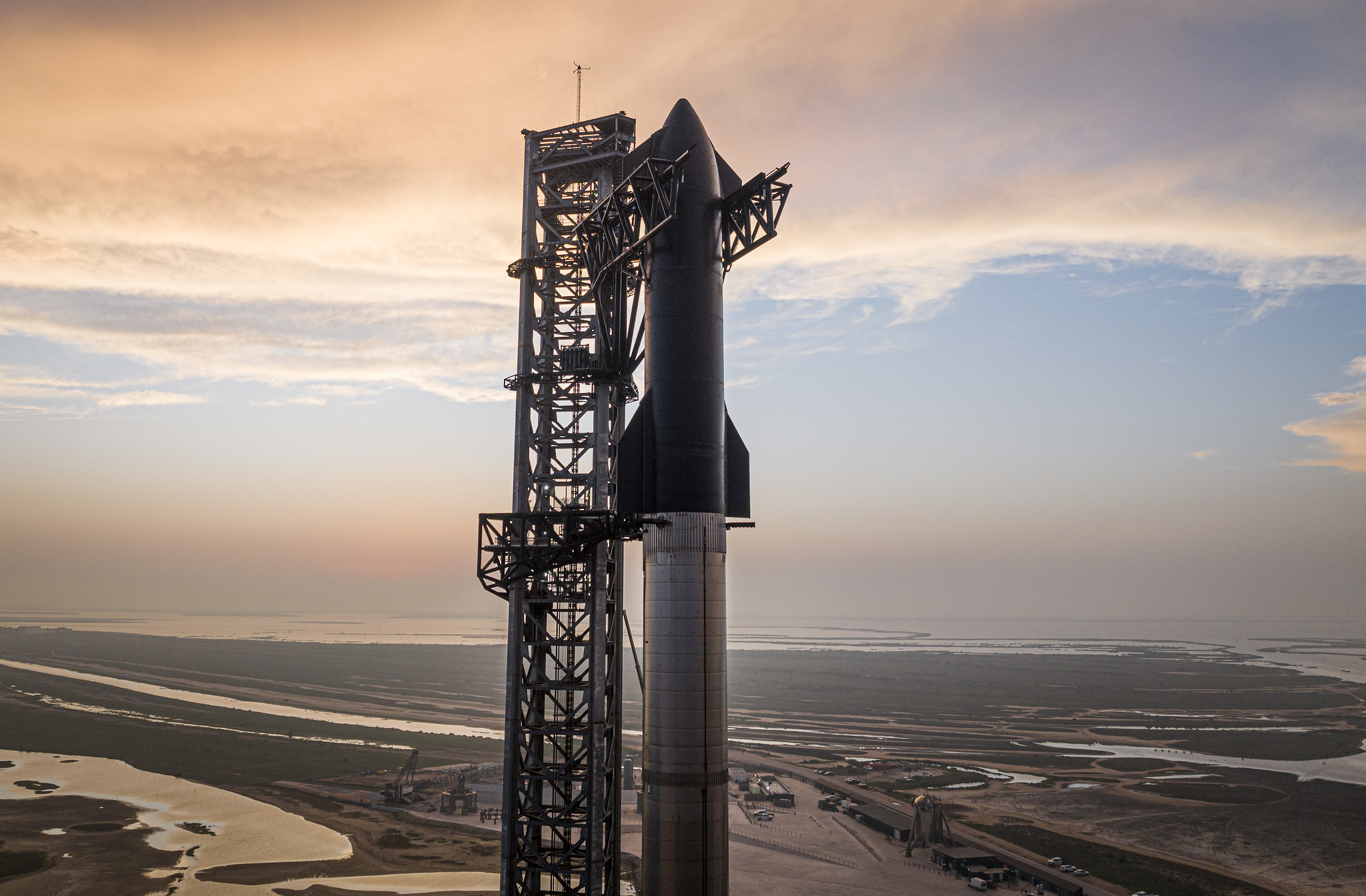
Imagine a spacecraft as tall as a 17-story building. It spends nearly a full day in space, circles Earth 14 times, survives a fiery descent through the atmosphere, and returns to the very place where its journey began. But instead of landing on the ground, two enormous mechanical arms catch it in midair. On November 14, SpaceX turned that extraordinary engineering concept into reality.
STARBASE, Texas | November 15, 2026 | WE PNW
Elon Musk's SpaceX has reached a major milestone in the development of reusable spacecraft.
During Starship's 15th test flight, the spacecraft returned from orbit directly to its launch tower, where it was caught by two massive mechanical arms.
The footage looks like a scene from a science fiction movie.
An enormous spacecraft descends from the sky, slows down, rotates into a vertical position, and approaches a towering steel structure. Seconds later, it settles between two mechanical arms that support its weight.
No landing legs. No parachutes. No ocean splashdown.
The spacecraft returns almost exactly where its journey began.
However, the mission was not a complete success. While SpaceX successfully recovered the Starship spacecraft, its Super Heavy booster was lost during an attempted return.
The flight demonstrated both the extraordinary potential of the technology and the challenges that remain.
14 Orbits Around Earth and Nearly a Full Day in Space
Starship launched on November 13, 2026, from SpaceX's Starbase facility in South Texas.
Standing more than 120 meters (394 feet) tall when fully assembled, the Starship and Super Heavy system is among the largest and most powerful rockets ever developed.
After liftoff, the two stages separated.
The Super Heavy booster began its return sequence, while the Starship spacecraft continued toward Earth orbit.
The spacecraft carried 26 next-generation Starlink V3 satellites, which were deployed during the mission.
Then came the longest phase of the flight.
Over approximately 22.5 hours, Starship completed 14 orbits around Earth.
Throughout the mission, SpaceX engineers monitored the spacecraft's systems, flight performance, and thermal protection.
Particular attention was paid to the heat shield, designed to protect the vehicle from extreme temperatures during atmospheric reentry.
On November 14, Starship began its journey home.
The spacecraft left orbit, entered Earth's atmosphere, and endured intense heating as it descended toward the Texas coast.
During the final phase, its engines fired to slow the descent. The spacecraft rotated into a vertical position and approached the launch tower.
The final seconds became the defining moment of the mission.
Starship slowly descended between the giant mechanical arms of the Mechazilla tower.
For the first time, SpaceX successfully caught a Starship spacecraft returning from orbit.
Why Catch a Spacecraft With a Tower?
SpaceX is attempting to fundamentally change the economics of spaceflight.
Launching spacecraft remains an expensive and technically demanding process. A significant portion of the cost comes from manufacturing rockets, preparing launch facilities, maintaining equipment, and replacing hardware after missions.
When a rocket can only be used once, much of that investment is lost after a single flight.
SpaceX is developing a different model.
Its goal is to build a fully reusable transportation system in which both the booster and the spacecraft can return to Earth, undergo maintenance, and launch again.
That is why the company developed Mechazilla.
The massive launch tower is equipped with two movable steel arms, informally nicknamed chopsticks.
Instead of landing on traditional legs, the returning vehicle must approach the tower with extraordinary precision, reduce its speed, and position itself between the arms.
The mechanical structure then takes the vehicle's weight.
This approach could eliminate the need for heavy landing legs and allow spacecraft to return directly to launch infrastructure.
But the engineering challenge is enormous.
The spacecraft must survive atmospheric reentry, maintain control of its engines and guidance systems, and execute an extremely precise maneuver near a massive steel tower.
Even a small error could destroy the vehicle or damage the launch complex.
On November 14, SpaceX demonstrated that this approach could work not only for a rocket booster but also for a spacecraft returning from orbit.
Still, a successful catch does not mean Starship is ready for routine reuse.
Engineers must inspect the returned vehicle, evaluate its condition, determine how much maintenance it requires, and eventually demonstrate that it can safely fly again.
What Happened to the Super Heavy Booster?
SpaceX had an even more ambitious objective for Flight 15.
The company planned to return both parts of the rocket system to the launch site: first the Super Heavy booster, followed nearly a day later by Starship itself.
But the first part of that plan failed.
After separating from Starship, Super Heavy began its return maneuver.
During the descent, the booster encountered conditions outside the parameters required for a safe tower catch.
Its guidance and control system detected the deviation and canceled the planned return to the launch site.
Instead, the booster was directed toward a designated safety area over the Gulf of Mexico, where its flight was terminated.
The booster was lost.
Early information raised questions about a possible guidance or navigation problem. SpaceX later clarified that the guidance system had operated as intended by detecting the unsafe conditions and preventing the booster from approaching the tower.
Preliminary flight data also pointed to a possible propellant-related issue that may have affected the return maneuver.
The final cause of the booster loss had not been established at the time of publication.
SpaceX engineers are continuing to analyze flight telemetry to determine exactly what happened.
The mission therefore delivered two very different results: a historic recovery of the Starship spacecraft and the loss of its Super Heavy booster.
What Does This Mean for the Space Industry?
The successful return of Starship is more than an impressive engineering demonstration.
It represents another step toward a transportation system that could dramatically increase the frequency of space launches.
SpaceX has already demonstrated the value of reusable rocket technology through its Falcon 9 program, whose first-stage boosters routinely return to Earth and fly again.
But Starship is designed for missions on a much larger scale.
The system is intended to carry substantial payloads into orbit, deploy future generations of satellites, support space infrastructure, and eventually transport people and equipment beyond Earth.
One of the potential advantages of full reusability is a significant reduction in launch costs.
If a spacecraft can return, be serviced, and fly again, the need to manufacture an entirely new vehicle for each mission could be reduced.
However, demonstrating a successful landing is only one part of that challenge.
SpaceX still needs to prove that recovered spacecraft can withstand repeated flights, that maintenance costs remain manageable, and that launches can be conducted frequently and safely.
Those questions will determine whether Starship can move from an experimental program to a practical transportation system.
The Next Destination: The Moon — and Eventually Mars
Starship is being developed for much more than satellite launches.
NASA has selected a modified version of Starship for its Artemis lunar exploration program.
Under that program, Starship is intended to serve as a lunar lander, transporting astronauts from lunar orbit to the Moon's surface.
Before such missions can take place, SpaceX must overcome additional technical challenges, including transferring propellant in orbit, operating spacecraft for extended periods, and meeting strict crew safety requirements.
Elon Musk has also described Starship as a central component of his long-term ambition to send humans to Mars.
SpaceX envisions large reusable spacecraft transporting people, equipment, and construction materials to destinations beyond Earth orbit.
For now, those plans remain long-term objectives rather than demonstrated operational capabilities.
But successfully returning a spacecraft from orbit to its launch tower represents an important step toward that vision.
A Moment That Could Change the History of Spaceflight
On November 14, 2026, SpaceX engineers watched years of development culminate in a remarkable achievement.
A spacecraft that had launched from Texas the previous day completed 14 orbits around Earth, deployed 26 satellites, and returned to the same launch complex.
Despite the loss of the Super Heavy booster, the successful recovery of Starship marked a historic milestone.
There was a time when humanity was still learning how to reach orbit.
Then we learned how to bring spacecraft safely back to Earth.
Later came reusable rocket boosters capable of landing vertically and flying again.
Now an enormous spacecraft has returned from orbit directly to its launch complex, where giant mechanical arms caught it in midair.
Perhaps one day such returns will become routine. But on November 14, 2026, the world witnessed something unprecedented: a Starship spacecraft completing an orbital mission in the mechanical arms of its own launch tower.
WE PNW | Science & Technology
Photo: SpaceX / Official SpaceX Photos, Flickr. Archive image, April 2023. Licensed under CC BY-NC 2.0.
Sources: SpaceX, Reuters, Associated Press, Space.com.