
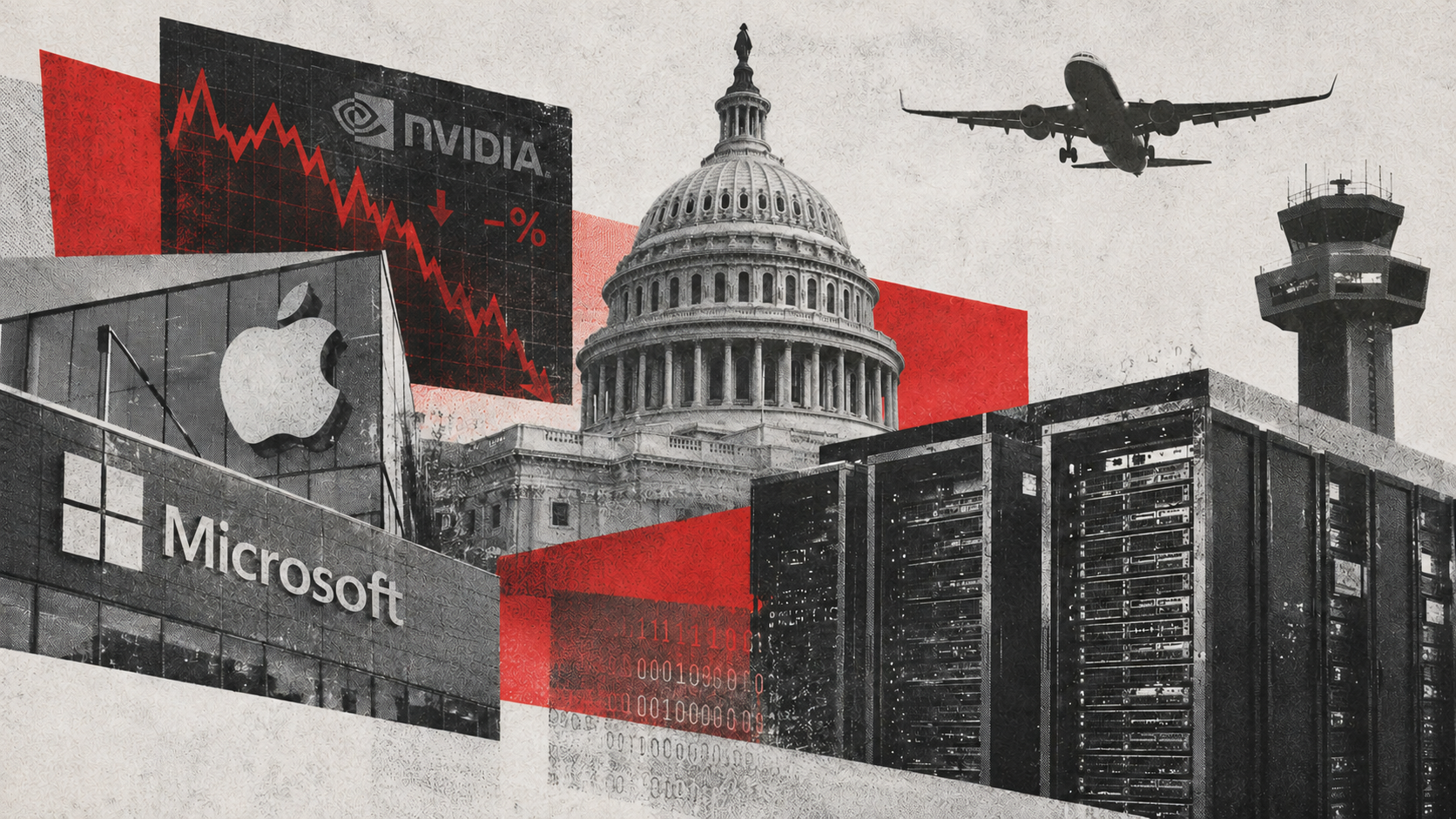
Too Many Coincidences? A Wave of Major U.S. Technology Outages — From Apple to the NSA’s Classified Network
In just a few days, major technology disruptions affected U.S. air travel, banking transactions, Microsoft, Apple, and even the National Security Agency’s classified internal network. Meanwhile, Nvidia shares lost a substantial portion of their value, and Cisco monitoring recorded hundreds of network incidents worldwide. What is happening to the digital infrastructure modern society depends on — and why have so many major events occurred within such a short period?
UNITED STATES | November 17, 2026 — WE PNW
First, Microsoft's corporate email services experienced significant disruptions. Then, a technical malfunction forced the Federal Aviation Administration to temporarily ground departing flights across the United States.
After the weekend, reports emerged of delayed banking transactions and problems with United Airlines' operational systems.
On November 17, Apple and the National Security Agency (NSA), one of the world's most security-sensitive intelligence organizations, joined the list.
At the same time, financial markets were experiencing turmoil of their own. Nvidia, a company that has become synonymous with the rapid expansion of artificial intelligence, had lost approximately $1.9 trillion in market valuation compared with its October levels.
These events were different in nature. Some involved software failures, others network infrastructure, while Nvidia's decline reflected corporate uncertainty and investor sentiment.
Yet their concentration within a matter of days raises a broader question: How resilient is the technological foundation on which almost everything now depends — from ordinary bank transfers to national security?
Timeline: What Happened Over Eight Days
Tuesday, November 10 — AT&T Network Problems Reach International Infrastructure
U.S. telecommunications company AT&T experienced network disruptions whose effects were observed beyond the United States.
According to Cisco ThousandEyes monitoring, problems affected networks and providers connected to AT&T across several regions, including North America, Europe, and Asia.
Disruptions were detected at multiple U.S. network nodes. The separate periods of instability totaled approximately 50 minutes within a two-hour window.
Importantly, this does not mean entire countries lost internet access. The problems involved network routes, connections, and dependent providers affected by disruptions within AT&T's infrastructure.
Nevertheless, the incident demonstrated how far the consequences of a technical failure at a major telecommunications operator can extend.
Thursday, November 12 — Major Microsoft Outage
Microsoft 365 users experienced significant disruptions affecting Outlook, Exchange Online, and other enterprise services.
Some organizations temporarily lost access to email, workplace applications, and essential communication tools.
The problems affected users outside the United States, including government institutions.
According to Cisco ThousandEyes, the disruptions lasted approximately 20 hours. They were linked to changes in Microsoft's network infrastructure and subsequent system configuration.
The incident illustrated how a technical failure within a global platform can simultaneously disrupt operations across numerous organizations that depend on the same digital tools.
Friday, November 13 — FAA Grounds Departing Flights Nationwide
One of the week's most serious incidents was a nationwide ground stop ordered by the Federal Aviation Administration.
At approximately 3:30 p.m. Eastern Time, the FAA temporarily halted departing flights because of instability in telecommunications infrastructure used by air traffic controllers.
Air traffic began recovering after 8:15 p.m.
According to official FAA data, airlines canceled approximately 12,462 flights that Friday. The agency clarified that not every cancellation was directly attributable to the technical incident.
Investigators identified problems involving aging network infrastructure that struggled under an unusually heavy volume of connection requests.
The FAA reported approximately 1,000 connection attempts every four to five seconds.
The consequences continued through the weekend, affecting passengers, airports, airlines, and industries dependent on aviation.
Monday, November 16 — Banking Transaction Disruptions
Following the weekend, customers of several major U.S. banks reported delayed payments, transaction-processing difficulties, and problems with online banking services.
Financial institutions mentioned in user complaints included JPMorgan Chase, Bank of America, Wells Fargo, U.S. Bank, and Truist.
There were also reports involving transfers through Zelle.
JPMorgan Chase attributed the disruption to a software error that affected internal hardware systems and slowed transaction processing.
The bank said customers retained access to their accounts and funds, although some transactions took longer than usual.
Chase reported finding no evidence of a cyberattack.
The incident raised renewed questions about the interdependence of financial institutions, payment networks, and the technological platforms that process enormous volumes of transactions every day.
Monday, November 16 — United Airlines Experiences Technical Difficulties
That same day, United Airlines reported problems with systems used to prepare aircraft for departure.
The malfunction affected applications used by flight crews, including communication tools and systems that provide final operational information before takeoff.
The disruption lasted approximately one to one and a half hours.
Aircraft already in flight continued operating. According to the airline, United Express regional flights were unaffected.
United said it found no indications of a cyberattack or any connection between its technical difficulties and the FAA outage on November 13.
Nevertheless, two notable aviation technology incidents within four days drew additional attention to the resilience of the industry's infrastructure.
Tuesday, November 17 — Widespread Apple Service Disruptions
On Tuesday morning, Apple users began reporting problems with the App Store, iCloud, Apple Music, AppleCare, and several other services.
Complaints also involved Apple Pay, account authentication, and access to cloud-based features.
Some Apple retail locations experienced difficulties processing purchases.
The company acknowledged the disruptions and attributed them to an internal system update. Later reports indicated that a substantial portion of the affected services had been restored.
The incident highlighted how closely interconnected cloud storage, digital marketplaces, authentication tools, and payment functions have become within a single technology ecosystem.
Tuesday, November 17 — NSA's Classified Network Goes Down
Perhaps the most unexpected report of the day involved NSA Net, the classified internal communications network used by the National Security Agency.
CNN, citing people familiar with the situation, reported that the disruption was serious enough for agency leadership to modify employee arrival schedules at NSA headquarters in Fort Meade, Maryland.
The objective was to reduce the number of simultaneous connections to the affected network.
According to CBS News, some operations were temporarily redirected to other agency facilities.
The NSA subsequently confirmed a temporary degradation affecting certain internal systems during scheduled maintenance.
The agency emphasized that mission-critical capabilities remained operational.
No public evidence of an external cyberattack was presented.
For an organization specializing in signals intelligence, government communications security, and threat analysis, problems affecting its own classified infrastructure inevitably attract particular attention.
Nvidia: Nearly $2 Trillion in Lost Market Valuation
Alongside the technical disruptions, the American technology sector was experiencing significant turbulence in financial markets.
One of the most striking developments was the sharp decline in Nvidia's share price.
The company, which has become a symbol of the global artificial intelligence boom, faced additional uncertainty following a corporate leadership crisis involving the departure of CEO Jensen Huang and disputes over the company's future direction.
However, Nvidia's stock decline had begun before those events.
Investors were also concerned about the enormous amounts technology companies were spending on artificial intelligence, the potential return on those investments, and restrictions on exports of advanced semiconductors.
According to Reuters, Nvidia's market capitalization fell from approximately $5.8 trillion in early October to about $3.9 trillion by November 13.
That represents a decline of nearly $1.9 trillion in market valuation over several weeks.
This does not mean the company directly lost that amount in cash. Market capitalization reflects the combined market value of its outstanding shares.
On November 16, Nvidia shares fell by approximately another 4%.
A falling stock price is not a technology outage. Nor is there verified evidence connecting Nvidia's market decline to the technical problems affecting Microsoft, Apple, the FAA, or the NSA.
Still, the developments added another unsettling element to an already turbulent week for the technology sector.
An industry attracting hundreds of billions of dollars in investment was simultaneously facing questions about infrastructure reliability, the economic returns of emerging technologies, and the stability of some of its largest companies.
Hundreds of Network Incidents Recorded Worldwide
Cisco ThousandEyes, a Cisco division that monitors network and cloud infrastructure performance, reported hundreds of network incidents during the same period.
Between November 9 and November 15, its monitoring systems recorded:
- 419 network incidents worldwide.
- 282 incidents in the United States.
- A 21% increase in recorded U.S. incidents compared with the previous week.
- A 31% increase in incidents affecting U.S. public cloud networks.
At the same time, the total number of recorded network incidents worldwide decreased by 7% compared with the previous week.
These figures require careful interpretation.
Cisco tracks specific categories of network disruptions. Its statistics do not represent a complete accounting of every technical failure affecting banks, airlines, government agencies, or technology platforms.
Nevertheless, the data offer a broader perspective: problems involving digital infrastructure extend far beyond the handful of major incidents that dominate news headlines.
They occur continuously, across different countries and at multiple levels of the global network.
What Do These Incidents Have in Common?
Most of the events already have preliminary or official technical explanations.
Microsoft identified problems following changes to network infrastructure.
The FAA reported instability within its telecommunications systems.
JPMorgan Chase pointed to a software error.
United Airlines described a malfunction involving operational applications.
Apple attributed its service disruptions to an internal update.
The NSA confirmed problems during scheduled technical maintenance.
Representatives of several companies and government agencies said they had found no indications of cyberattacks.
However, those statements do not mean that comprehensive public investigations have established every circumstance surrounding every incident.
Nor has verified evidence emerged showing that the events were part of a single coordinated operation.
Yet there is a broader issue connecting these stories.
Modern governments, banks, airlines, and technology companies are becoming increasingly dependent on complex information systems.
In some circumstances, a configuration error, unsuccessful update, or failure of a relatively small component can create consequences affecting millions of people.
And as organizations rely on shared cloud platforms, telecommunications networks, software providers, and data-processing systems, the boundaries between supposedly independent infrastructures become less obvious.
This does not establish a common cause for the incidents of November 2026.
But it raises important questions about the resilience of systems that usually remain invisible — until they stop working.
Too Many Coincidences?
Just a few days.
A global Microsoft platform. The federal aviation system. Major American banks. United Airlines. Apple's digital ecosystem. The National Security Agency's classified network.
At the same time, international network disruptions and turmoil in financial markets, where one of the world's largest technology companies lost nearly two trillion dollars in market valuation compared with its October level.
Some technical causes have already been identified. Other circumstances may require further investigation.
As of November 17, no publicly verified evidence establishes a single cause connecting all these events.
But the unanswered questions remain.
Why are technologically sophisticated and enormously expensive systems still vulnerable to failures that can spread so widely?
How reliable are the backup mechanisms designed to prevent isolated problems from becoming large-scale disruptions?
And can governments and major corporations ensure the resilience of digital infrastructure in a world where almost every industry depends on the uninterrupted flow of information?
Are we witnessing an ordinary coincidence of unrelated technical failures? The consequences of accumulated weaknesses in modern digital infrastructure? Or signs of vulnerabilities whose true scale we have yet to understand?
And perhaps the most troubling question is this:
What happens if several critical systems really do fail at the same time — and their backup mechanisms cannot keep up?
By Roman Tretiakov | WE PNW
Sources
- Cisco ThousandEyes / Network World — Weekly network outage statistics and analysis of AT&T and Microsoft disruptions.
- Federal Aviation Administration (FAA) — Official information and explanation of the nationwide ground stop.
https://www.faa.gov/newsroom/nationwide-ground-stop-questions-and-answers
- Associated Press — Reporting on major technology disruptions involving Microsoft, Apple, and banking services.
https://apnews.com/article/ff097d2a0bec767baf38a1bd8eff5829
- Reuters — United Airlines technology disruption, November 16.
- CBS News — Disruption involving the NSA's classified internal network.
https://www.cbsnews.com/news/nsa-network-down-classified-fort-meade/
- Reuters — NSA's official statement on the November 17 network disruption.
- Reuters — Nvidia's market performance and investor expectations.