
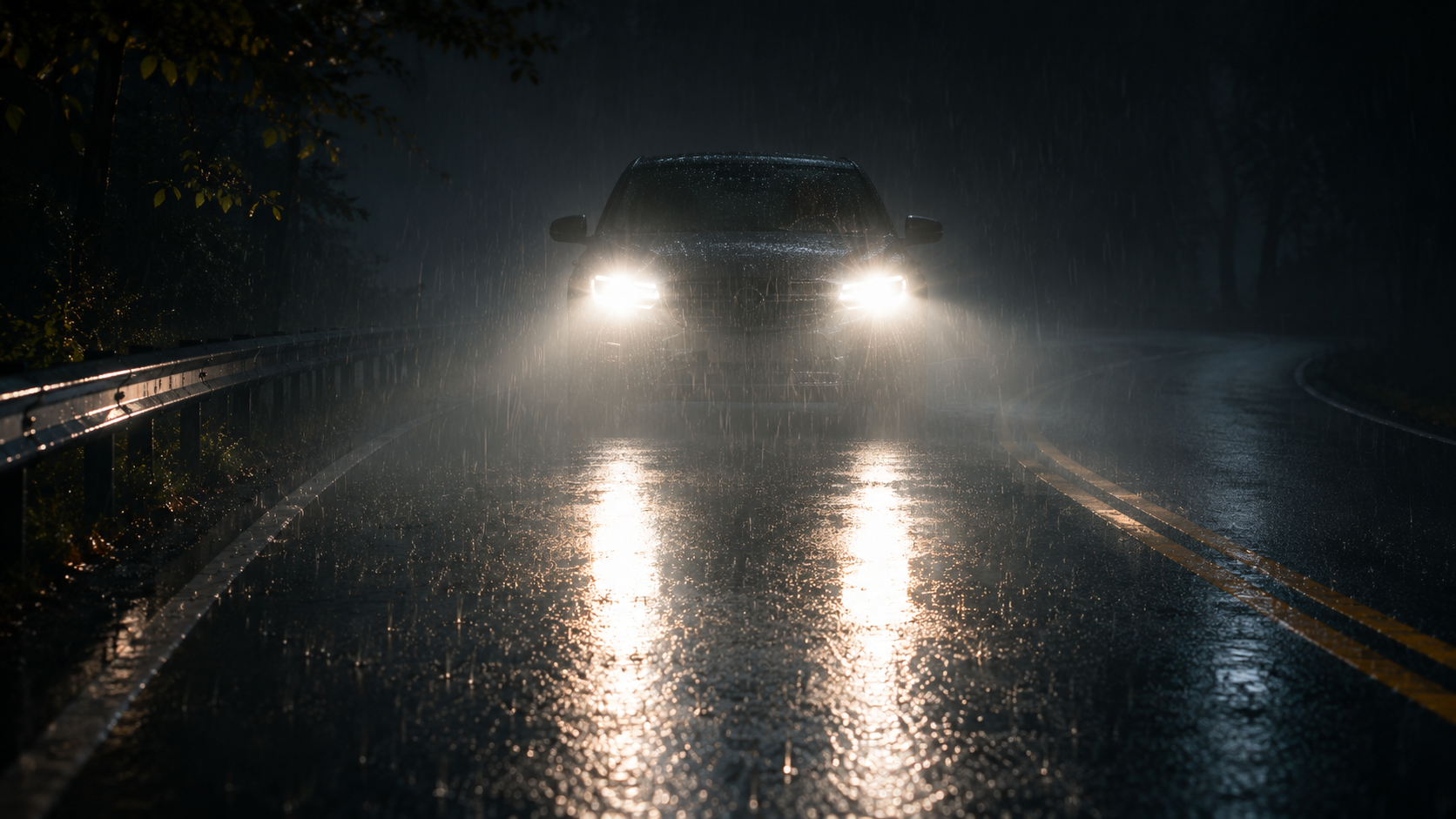
An oncoming car approaches at night, and for a moment the road beyond its headlights becomes difficult to see. Complaints about headlight glare have become a recurring issue for American drivers. A new proposal in Congress seeks to address it. The question is whether setting another brightness limit is enough.
What Marie Gluesenkamp Perez is proposing
On March 3, 2026, Rep. Marie Gluesenkamp Perez, who represents Washington's 3rd Congressional District, introduced H.R. 7772 — the LIGHT Safety Act, short for Limiting Intense Glare for Highway and Two-lane Safety Act. Rep. Ted Lieu is also listed as a cosponsor.
The bill has just two sections. If enacted, it would require the Transportation Secretary, through the National Highway Traffic Safety Administration (NHTSA), to issue a final regulation within one year of enactment establishing a maximum allowable brightness standard for low-beam headlights.
The maximum could be expressed in lumens or another appropriate photometric measurement chosen by NHTSA. Crucially, the bill itself contains no numerical limit.
As of November 21, 2026, H.R. 7772 has not become law. Its last listed legislative action was a March 4 referral to the House Subcommittee on Highways and Transit.
Why this is more complicated than one number
The claim that American headlights have no federal brightness restrictions is incorrect.
The existing Federal Motor Vehicle Safety Standard No. 108 (49 CFR § 571.108) sets minimum and maximum luminous-intensity requirements at specified points in a headlight's beam. Among the measurements it uses are candelas, a measure of light intensity in a given direction.
Lumens measure total luminous flux, while candelas capture intensity in a particular direction. Glare also depends on beam shape and aiming, the mounting height of headlights, and the relative position of oncoming vehicles.
That leads to a legitimate question: Would a new overall brightness limit adequately protect drivers facing oncoming lights? Not necessarily. But it is also important to read the proposal carefully: it does not force NHTSA to use lumens alone. Its allowance for another appropriate photometric measure gives engineers flexibility.
Drivers complain. What do crash statistics show?
A March 24, 2026 AAA survey found that six in ten drivers consider headlight glare a problem after dark. Among those who experience it, 73% believe it has worsened over the past decade. That is evidence of motorists' concerns and reported experiences — not a measurement of the share of crashes caused by headlights.
A separate Insurance Institute for Highway Safety (IIHS) study published in 2025 examined police-reported nighttime crashes across 11 states. Headlight glare was recorded as a factor in only 0.1% to 0.2% of those crashes, with little change over the period analyzed.
These findings do not necessarily contradict each other. One measures what drivers experience; the other measures what police recorded as contributing to crashes. A brief loss of visibility or a frightening near miss may never appear in a crash report.
NHTSA is already looking at broader changes
On October 6, 2026, NHTSA announced a separate process to modernize federal vehicle-lighting standards. The review includes glare, LED lighting, mounting height, beam aiming, and performance testing.
That process is not the result of an enacted LIGHT Safety Act; the bill remains pending. In 2022, NHTSA also permitted adaptive driving-beam headlights, which can change their light pattern to improve visibility without unnecessarily glaring other road users.
The regulatory toolkit therefore includes more than dimming headlights. It also includes controlling where light goes and how lighting responds to traffic.
What does this mean for car owners?
Nothing new is legally required today under H.R. 7772. The proposal creates no immediate penalties, LED-headlight ban, or requirement to replace equipment on cars already on the road.
Future federal rules could affect the design, testing, and certification of vehicle lighting. Whether they would apply to older vehicles, and at what cost, is not established. Claims that drivers will have to retrofit their cars would be premature.
For now, motorists can take straightforward precautions: keep windshields and headlamp lenses clean, have headlights correctly aimed, and avoid replacement bulbs or assemblies incompatible with the vehicle's design.
Opinion: regulate glare, not just a headline brightness number
Gluesenkamp Perez is highlighting a problem that many drivers experience. The fact that police rarely identify glare as a crash factor does not make that experience imaginary or unimportant.
But a sound goal does not automatically make for sound regulation. A final standard that focuses only on a headline brightness figure while neglecting beam geometry, mounting height, and proper aim could be incomplete. One informed by engineering and real-world testing could do substantially more.
For Oregon and Washington motorists, the desired outcome is practical: see the road clearly without blinding someone coming the other way. That — rather than the bill's appealing name — should be the test of its value.
Roman Tretiakov | WE PNW
Original sources and research
- Official text of H.R. 7772
- Congress.gov — H.R. 7772 status
- FMVSS No. 108 — existing federal lighting standard
- AAA — March 2026 headlight glare survey
- IIHS — headlight glare crash study
- NHTSA — October 2026 lighting standards review
- NHTSA — 2022 adaptive driving-beam rule