On November 26, 2026, the United States celebrates Thanksgiving, one of the most significant holidays in American culture.
People of different nationalities, religions, political beliefs, and personal circumstances will gather around Thanksgiving tables. For some, the tradition has been passed down through generations. For others, it became part of their lives after moving to America.
Yet behind the familiar image of a holiday dinner lies a remarkable history.
Thanksgiving became an annual national tradition not during a period of American prosperity, but at one of the most difficult moments in the nation's history.
Gratitude in a Time of War
On October 3, 1863, in the midst of the Civil War, President Abraham Lincoln issued a proclamation calling upon Americans to observe the last Thursday of November as a day of thanksgiving.
The nation was divided. Families were losing loved ones, millions faced uncertainty, and the war was still approximately eighteen months from its conclusion.
Lincoln called upon Americans to give thanks to God, remember those who had suffered, and pray for the healing of the nation and the restoration of peace and unity.
At the heart of his proclamation was an idea that transcends its historical circumstances: gratitude does not have to be the result of prosperity.
By then, the tradition of thanksgiving already had deep roots. In 1789, George Washington proclaimed a national day of thanksgiving and prayer. It was Lincoln's proclamation, however, that established the foundation for the annual national observance.
Even an Economic Crisis Could Not End the Tradition
In 1939, America was still recovering from the Great Depression.
President Franklin D. Roosevelt moved Thanksgiving one week earlier, hoping to extend the Christmas shopping season and stimulate the economy.
The decision generated considerable controversy, with different states observing the holiday on different dates.
On December 26, 1941, Roosevelt signed legislation establishing Thanksgiving as the fourth Thursday of November.
Remarkably, this occurred less than three weeks after the attack on Pearl Harbor and America's entry into World War II.
Once again, the nation faced a historic challenge. And once again, the tradition of giving thanks endured.
Thanksgiving Thousands of Miles from Home
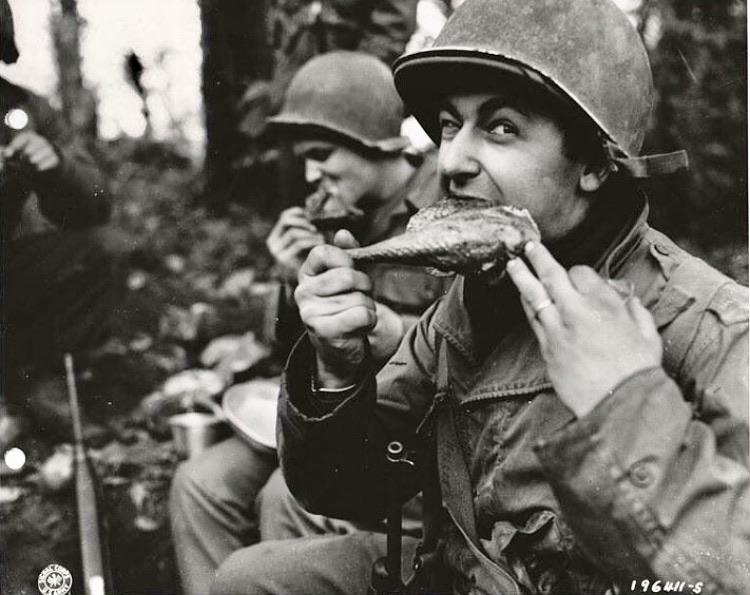
(November 1944. American service members celebrate Thanksgiving in Western Europe during World War II. Archival photograph: United States Army, public domain, via [Wikimedia Commons](https://commons.wikimedia.org/wiki/File:Cpl._Leo_Kaller_celebrating_Thanksgiving_while_helping_to_liberate_Western_Europe_in_November_1944.jpg).)
The Smithsonian's National Museum of American History preserves a Thanksgiving menu from the aircraft carrier USS Randolph, dated November 1944.
Despite the ongoing war, American service members were served traditional turkey, cranberry sauce, and other holiday dishes.
That same year, American soldiers celebrated Thanksgiving in liberated Luxembourg. Local residents and service members shared food and spent time together.
For those stationed thousands of miles from home, Thanksgiving offered a connection to their families, their culture, and the peaceful lives they hoped to return to.
Wars ended, generations returned home, and the country changed. Yet the holiday lived on.
One Nation, Many Histories
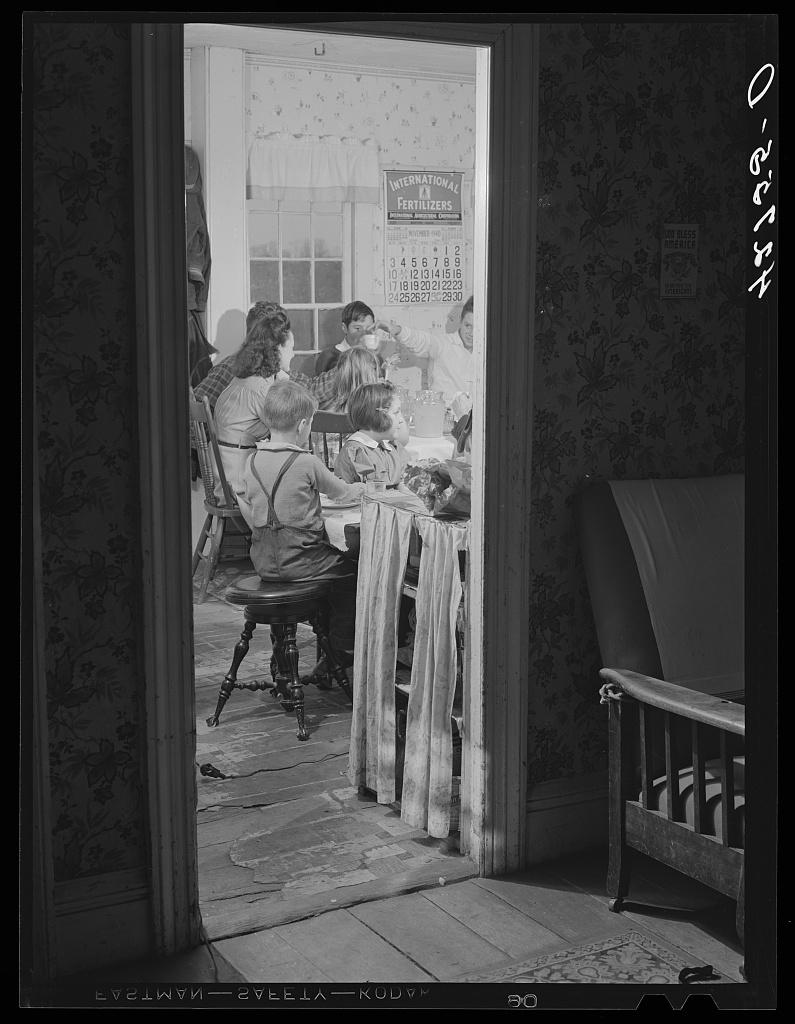
(November 1940. The Crouch family gathers for Thanksgiving dinner in Ledyard, Connecticut. Photograph by Jack Delano / [Library of Congress](https://www.loc.gov/item/2017793113/), FSA/OWI Collection. Public domain.)
The history of Thanksgiving extends beyond European settlers and American presidents.
Indigenous peoples of North America practiced traditions of giving thanks long before the United States was established. Perspectives on the modern holiday vary among Native American communities, reflecting, in part, the historical consequences of colonization.
Modern America brings together people whose histories are remarkably different.
Over the centuries, people have arrived from Europe, Asia, Africa, Latin America, and other parts of the world, bringing their own languages, religious beliefs, family traditions, and cultural heritage.
Thanksgiving gradually became part of the lives of new generations of Americans, complementing rather than necessarily replacing their own cultural traditions.
Being born in the United States or having American ancestry is not a prerequisite for embracing this holiday.
Gratitude belongs to no single nationality.
Thanksgiving in 2026
This year, America marks the 250th anniversary of its independence.
Over two and a half centuries, the nation has experienced wars, economic crises, social conflicts, scientific discoveries, technological revolutions, and profound cultural transformations.
American society continues to face significant challenges. At the same time, new ideas emerge, businesses are built, opportunities are created, families grow, and millions of people pursue their dreams.
In Washington and Oregon, as throughout the country, Thanksgiving offers an opportunity to step away from the demands of everyday life and remember what truly matters.
Not everyone has achieved their goals. Not everyone has had a successful year. Every person has experienced different circumstances, challenges, victories, and hopes.
But gratitude is not measured by wealth, accomplishments, or the absence of hardship.
Perhaps that is precisely why Thanksgiving has survived so many historical upheavals and remained meaningful to generations of Americans.
Happy Thanksgiving, America!
For some, America is their birthplace. For others, it is the country that became their new home. It is home to people whose families have lived on this land for centuries and to those who are just beginning their lives here.
We do not need to share the same past to build a common future.
Regardless of our origins, nationality, or how long we have lived here, we all have reasons to give thanks for this land and this country, and to thank God.
Happy Thanksgiving!
God bless America.
Roman Tretiakov, Editor | WE PNW