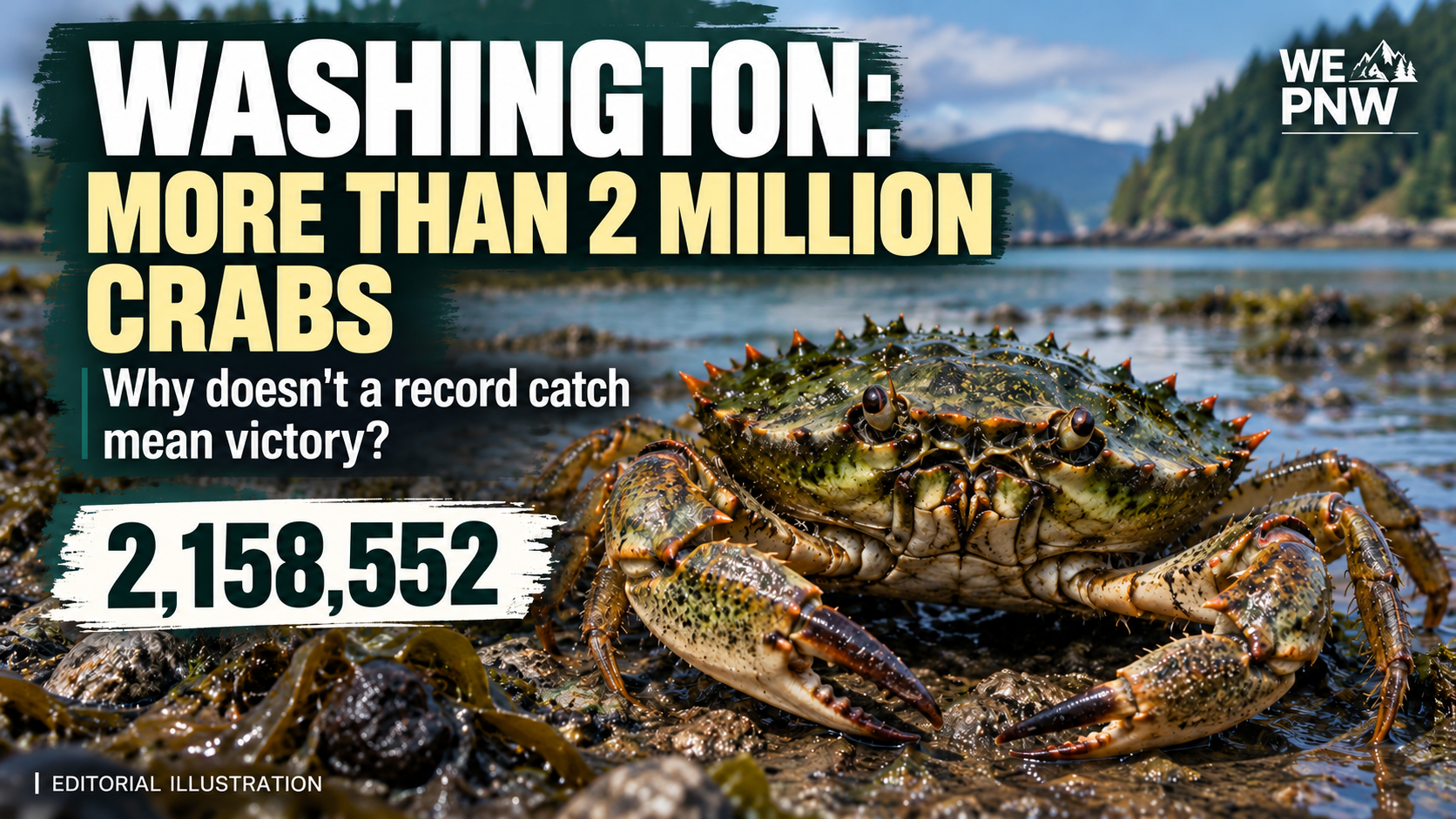
More than two million crabs in a single year. It's a difficult number to picture, but that's how many invasive European green crabs were removed from Washington's marine waters during a massive statewide effort to control their spread.
At first glance, the figure sounds like a conservation success. Researchers, tribal crews, shellfish growers and volunteers have spent months setting traps, checking catches and removing invasive animals from sensitive coastal habitats. Yet in some places, the more crabs they catch, the more concerned scientists become.
According to the Washington Department of Fish and Wildlife's annual report, crews removed 2,158,552 European green crabs between July 1, 2025, and June 30, 2026. The previous fiscal year's total was 1,143,037.
In other words, Washington removed more crabs in those twelve months than during the previous four fiscal years of its emergency response combined.
But a record catch is not the same as a declining population. In some locations, crews are finding more crabs even without increasing the number of times they check their traps.
That is why scientists remain concerned.
How a Small Crab Became a Major Coastal Threat
The European green crab, Carcinus maenas, is a small shore crab native to the eastern Atlantic. It was first documented in Washington state in 1998 and has since established populations in several coastal bays.
Despite its name, the crab isn't necessarily green. Its shell can be olive, brown or reddish. A more reliable identifying feature is the five spines on each side of its shell, just behind the eyes.
The threat isn't that these crabs attack people. It comes from what they eat, how they reproduce and how successfully they adapt to new environments.
European green crabs prey on clams, mussels, small crustaceans and other marine organisms. Their feeding and digging behavior can also damage eelgrass beds, which provide important habitat for young fish and other aquatic species.
That matters economically as well as environmentally.
Washington's coastal communities depend on oyster farming, shellfish harvesting and healthy estuaries. The arrival of another aggressive predator creates additional pressure on industries that have long been part of the region's economy.
Scientists are also concerned about competition with native species, including juvenile Dungeness crabs, an important part of the Pacific Northwest's commercial fishing industry.
The green crab is not the only challenge facing coastal ecosystems, but its spread adds another threat to environments already affected by changing ocean temperatures, water conditions and human activity.
Where Were the Crabs Caught?
Almost nine out of every ten crabs removed during the reporting year came from one location: Willapa Bay, on Washington's southwest coast.
Crews removed 1,932,571 green crabs from the bay, compared with 967,168 the previous fiscal year.
Willapa Bay is known for its oyster farms, tidal flats and coastal habitats, making the growing crab population especially concerning.
Neighboring Grays Harbor accounted for another 192,370 removals, while North Puget Sound recorded 18,476.
Closer to Oregon, crews also removed green crabs from the Columbia River estuary.
The Columbia River management area recorded 320 removals, up from 51 the year before.
That is a small number compared with Willapa Bay, but it shows why monitoring remains important along Washington's southern coastline.
The distinction in geography matters. These findings concern the coastal estuary near the Pacific Ocean, not a mass infestation along the urban waterfront in Vancouver, Washington, farther upstream.
Why a Record Catch Isn't Necessarily a Victory
A larger catch doesn't automatically tell scientists how many crabs remain in the water.
Installing additional traps, expanding the number of monitored locations or checking equipment more frequently can all increase the number removed. To understand whether a population is actually growing or declining, researchers must compare catches with the effort required to obtain them.
Willapa Bay offers a particularly concerning example.
According to WDFW, the number of trap checks there fell slightly from 74,877 in the previous fiscal year to 73,960. Yet the total number of crabs caught nearly doubled.
In the Long Beach North area alone, crews removed approximately 1.6 million green crabs.
The state report identifies substantial population increases in parts of Willapa Bay. Those results cannot be explained simply by a larger trapping effort.
Environmental conditions may also be contributing to the spread.
Young European green crabs can survive more successfully under certain warmer marine conditions. Researchers believe unusually warm conditions during the winter of 2025 may have helped a new generation thrive.
The picture is not equally bleak across Washington.
Some monitored areas have recorded stable or declining catch rates, suggesting that sustained trapping may be helping control local populations.
The statewide figures therefore do not mean that every bay is experiencing the same population boom. But researchers have not declared any established population eradicated.
A Fight That Has Already Cost Millions
Washington's response to the invasive crab began expanding rapidly after January 2022, when then-Gov. Jay Inslee declared an emergency over its spread.
The effort now involves state and federal agencies, tribal governments, scientific organizations, shellfish growers and volunteers.
Trapping is only one part of the work. Crews must repeatedly survey coastlines, document catches, monitor newly detected populations and return to sites where numbers appear to be declining.
Even a successful season in one location does not prevent crabs from arriving again.
According to KUOW, state and federal agencies spent at least $8 million fighting European green crabs during the 2025–2026 fiscal year.
And the huge catch raises another practical question: what happens to millions of removed crabs?
Turning them into a commercially viable seafood product has proved difficult. European green crabs are much smaller than Dungeness crabs, and separating their meat from the shells is labor-intensive.
Some of the catch is finding a different use.
In Raymond, Washington, Tidal Grow Agriscience processes removed crabs and used bait into an organic liquid fertilizer called Pacific Gro. Instead of sending all that material to landfills, the partnership puts some of it to agricultural use.
It doesn't solve the invasion, but it provides a productive outlet for part of the enormous catch.
What Should You Do if You Find One?
Washington officials are asking residents and visitors to help identify new locations where the invasive species may be spreading.
There is one important rule: do not kill a crab simply because you suspect it is a European green crab.
Several native species can look similar, and mistaken identification can cause additional harm to local wildlife.
Instead, photograph the crab, record its location and report the sighting to wildlife specialists.
Reports can be submitted through the Washington Invasive Species Council or WDFW's official reporting system.
New sightings are particularly valuable in areas where the species has not previously been detected. Early discovery can give researchers a better chance to contain an infestation before it becomes established.
What Happens Next?
Washington has adopted a long-term European green crab management plan covering 2025 through 2031.
The strategy calls for continued trapping, monitoring and protection of coastal areas where the species has not yet established significant populations.
Completely eliminating European green crabs from the state's coastline in the near future is unlikely. But reducing their numbers in vulnerable locations can still protect native species, coastal habitats and economically important shellfish resources.
The latest report shows just how difficult that work has become.
More than two million crabs were removed in twelve months, yet populations continue to grow in some of the most heavily affected areas. Scientists still do not know the total number remaining in the wild or how rapidly those populations may recover after intensive trapping.
For Washington's coastal communities, this is about much more than an unfamiliar marine animal.
The outcome will affect oyster farms, native fisheries, nearshore ecosystems and the people whose livelihoods depend on healthy coastal waters.