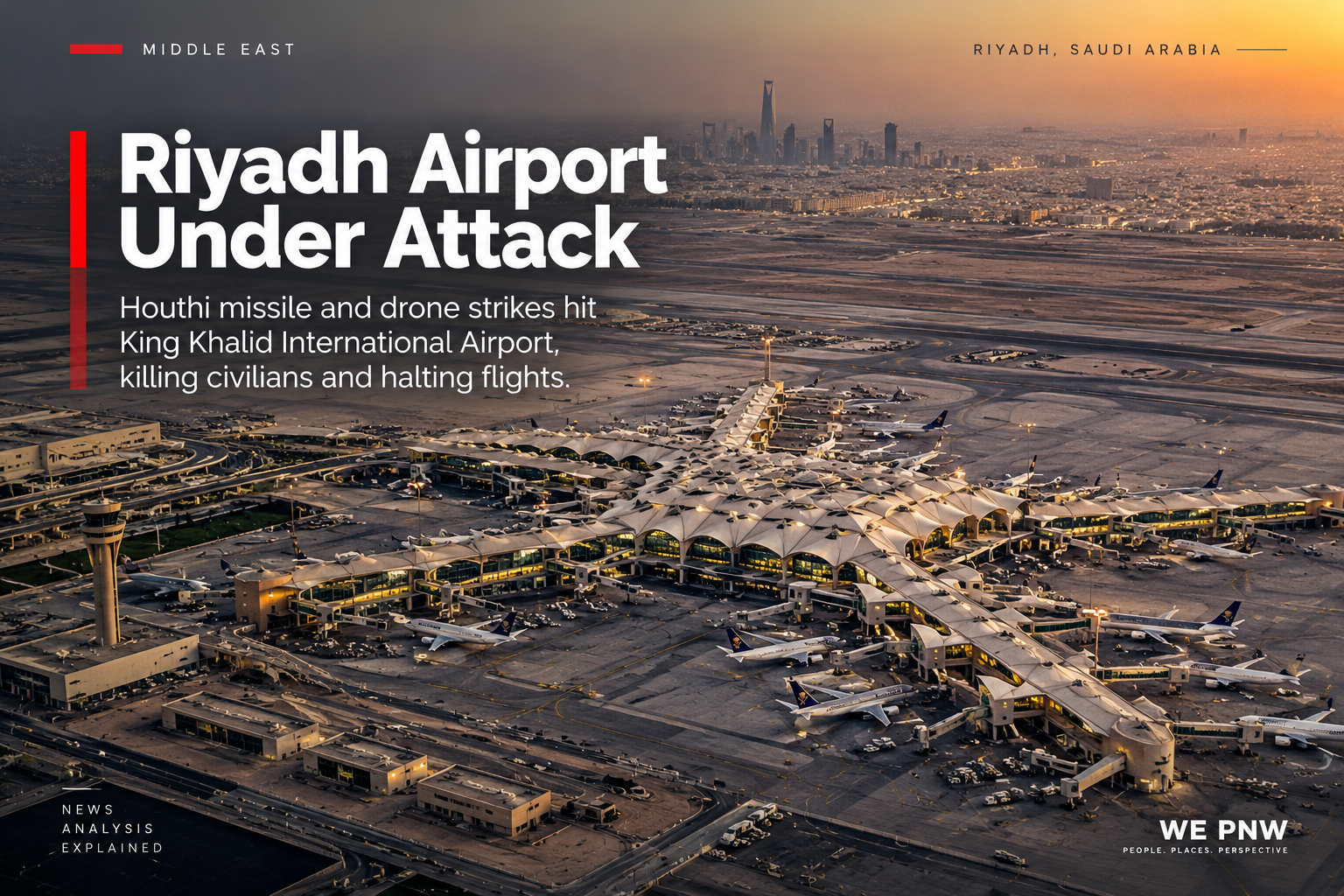
A series of attacks on King Khalid International Airport in Riyadh has pushed Yemen’s war back into global headlines.
For anyone who does not follow Middle East politics every day, the story can feel sudden: Who are the Houthis? Why are missiles and drones hitting Saudi Arabia? And where does Iran fit into all of this?
The answer is that this is not a new war. It is a new and far more dangerous phase of a conflict that has been running for more than a decade.
What happened
On Saturday, October 10, Riyadh’s main international airport was hit in a major attack.
Associated Press reported at least 13 people killed and more than 300 wounded. Reuters initially reported 12 deaths as casualty figures continued to be updated. Saudi authorities said the assault involved missiles and drones, and the Houthis claimed responsibility.
The airport was struck again the following day. A Pakistani national was killed and 11 others were wounded when a projectile hit a passenger terminal. According to AP, the airport had been attacked several times within five days.
Flights were suspended, diverted or cancelled. Reuters reported that authorities extended the airport closure through Saturday as continued attacks emptied much of the airspace over the Saudi capital.
This is no longer only a battlefield story from Yemen. A major civilian aviation hub in the capital of Saudi Arabia has become part of the conflict.
The United Nations condemned the attacks
UN Secretary-General António Guterres strongly condemned the lethal attack on King Khalid International Airport and said attacks against civilians and civilian infrastructure violate international law and must stop immediately.
On October 12, the UN again said it strongly condemned continued Houthi attacks on Saudi Arabia, particularly attacks targeting civilian infrastructure and airports.
That distinction matters. These attacks are not being treated internationally as just another exchange in a regional war. They involve civilian infrastructure and large numbers of civilian casualties.
Who are the Houthis?
The Houthis, also known as Ansar Allah, are an armed movement from Yemen that controls the capital, Sanaa, and much of the country’s north.
They are commonly described as Iran-aligned or Iran-backed.
That does not mean they are simply a branch of the Iranian military. They have their own leadership, domestic political base and goals. But Iran has provided political, technological and military support over the years, helping the movement develop far more advanced capabilities.
The Houthis have evolved from a local insurgent movement into a force capable of launching long-range missiles and drones at targets far beyond Yemen.
Where did this conflict begin?
The roots of the current war go back to 2014, when the Houthis seized Sanaa and pushed aside Yemen’s internationally recognized leadership.
In 2015, Saudi Arabia led a military coalition that intervened on behalf of Yemen’s recognized government.
From that point, Yemen’s internal conflict became part of a wider regional struggle.
In simplified terms:
- the Houthis control much of northern Yemen;
- Yemen’s internationally recognized government is backed by Saudi Arabia and other partners;
- Iran supports the Houthis;
- anti-Houthi forces themselves are divided into competing factions.
This is not a simple war between two neat sides. It is a layered conflict with multiple actors and overlapping interests.
Why is Saudi Arabia becoming more involved again?
One major reason is Bab el-Mandeb, the narrow strait between Yemen and Africa.
It is one of the world’s most important shipping routes, connecting the Indian Ocean, Red Sea and Suez Canal.
Fighting along Yemen’s western coast and around Bab el-Mandeb has intensified again in recent months. Reuters has described Yemen as an increasingly dangerous new front as Saudi Arabia becomes more deeply involved in backing government forces against the Houthis.
For Riyadh, this is about more than Yemen. It is also about protecting its borders, oil infrastructure and strategic shipping routes.
Why are the Houthis attacking Saudi Arabia?
From the Houthi perspective, strikes on Saudi Arabia are retaliation for Riyadh’s role in the war and its support for forces fighting them inside Yemen.
But the consequences extend far beyond military targets.
When missiles and drones hit airports, cities and critical infrastructure, civilians are placed directly at risk.
That is why the UN has specifically condemned Houthi attacks on Saudi airports and urged the movement to stop them.
Why can’t Saudi Arabia simply shoot everything down?
Saudi Arabia operates some of the most expensive air-defense systems in the region.
Still, authorities have launched an investigation into how the Riyadh attack penetrated those defenses.
According to AP, early assessments suggest the Houthis may have used a combination of drones, cruise missiles and ballistic missiles, creating multiple simultaneous threats and potentially overwhelming defensive systems.
That is one of the most worrying parts of the story: even heavily defended civilian infrastructure can remain vulnerable to coordinated attacks.
Why this matters to ordinary people
The consequences are already reaching well beyond the battlefield.
The FAA has warned U.S. airlines to exercise caution when flying to or over Saudi Arabia because of military activity and aviation safety risks.
International airlines have cancelled or redirected flights. Organizers of major Riyadh events say they will proceed, although flight disruption is complicating travel for some participants.
The conflict is already affecting:
- air travel;
- international business;
- investment events;
- tourism;
- logistics;
- public confidence in regional security.
Why oil matters
Oil prices rose by nearly $2 a barrel on October 12. Reuters linked the increase partly to attacks on Saudi Arabia and concerns about energy infrastructure and shipping routes.
Saudi Arabia remains one of the world’s largest oil producers and exporters.
If attacks continue and begin regularly affecting oil facilities, ports or shipping routes, the consequences could spread far beyond the Middle East through higher fuel, transportation and consumer prices.
Where does Iran fit in?
Iran is a central part of the wider regional picture.
It supports the Houthis and is also engaged in a broader confrontation with the United States and Israel.
The current escalation in Yemen is happening inside that much larger conflict, which raises the risk that local fighting could turn into additional regional fronts.
At the same time, Tehran has publicly offered to mediate.
That creates an unusual dynamic: the country associated with strengthening Houthi military capabilities is also presenting itself as a possible diplomatic intermediary.
And what about the United States?
The United States has not announced direct entry into this new phase of the Yemen war.
Washington continues to provide intelligence and security support to Saudi Arabia, while President Donald Trump said he was considering possible U.S. strikes against the Houthis.
Direct U.S. strikes against the Houthis would significantly raise the risk of further regional escalation.
What is happening now?
As of October 12:
- Houthi missile and drone attacks on Saudi Arabia are continuing;
- Saudi Arabia and Saudi-backed forces continue operations against the Houthis in Yemen;
- Riyadh’s airport remains closed, with flights cancelled or diverted;
- the United Nations is demanding an end to attacks on civilian infrastructure;
- the United States has not entered direct combat;
- there is no durable ceasefire in place.
Bottom line
What is happening between the Houthis and Saudi Arabia is not a sudden new war.
It is a sharp return of Yemen’s long-running conflict — now spilling much more directly beyond Yemen’s borders.
The difference today is that the Houthis possess far more sophisticated missile and drone capabilities than they did a decade ago, while international airports, oil infrastructure and major shipping routes are increasingly exposed.
After the deadly strikes on Riyadh’s airport, this is once again a conflict with consequences far beyond Yemen.