
By Roman Tretiakov
WE PNW | Opinion / Author's Column | November 21, 2026
RUSSIA
Seven Years for a Few Price Tags
Imagine an ordinary grocery store. People are buying bread, milk and food for their families. Among them is a young woman who decides to replace several price tags with small paper messages opposing the war.
She threatens no one. She does not call for violence. She expresses what she thinks.
In November 2023, a Russian court sentences her to seven years in prison.
This is not fiction.
Her name is Alexandra Skochilenko, an artist from St. Petersburg. In March 2022, she substituted small anti-war messages for supermarket price labels, drawing attention to Russia's war in Ukraine.
The Russian authorities classified her actions as the public dissemination of information about the armed forces that they deemed knowingly false. On November 16, 2023, Judge Oksana Demyasheva of St. Petersburg's Vasileostrovsky District Court sentenced Skochilenko to seven years in a penal colony.
Alexandra was released on August 1, 2024, as part of an international prisoner exchange.
Why did it take negotiations between governments to free an artist who placed anti-war notes in a supermarket?
And what does that tell us about the judicial system that sentenced her to seven years?
Source: Mediazona — Skochilenko's sentencing
Traditional Values. But Where Is Justice?
On November 9, 2022, Vladimir Putin signed Decree No. 809, setting out Russia's state policy on preserving and strengthening traditional spiritual and moral values.
Paragraph five lists life, human dignity, human rights and freedoms, humanism, compassion and justice among those values.
Justice.
Human rights and freedoms.
Dignity.
These are not demands from Western politicians or an opposition manifesto. They appear in an official document signed by Russia's president.
There is also the Constitution of the Russian Federation.
Article 46 guarantees judicial protection of rights and freedoms. Article 120 states that judges are independent and subject to the Constitution and federal law.
On paper, therefore, the state recognizes the right to protection, dignity and fair justice.
But how do these principles work when the person in the dock publicly disagrees with the state's own policies?
When an anti-war message leads to a prison sentence?
When a journalist is added to a foreign-agents register?
When a comment online becomes the basis for a criminal case?
This is where a judicial system faces its defining test: can it protect an individual not only from another individual, but from the state itself?
Source: Presidential Decree No. 809
Source: Constitution of the Russian Federation
'This Law Prohibits Nothing'
I remember when Russia began adopting its foreign-agents legislation. I was still living in the country, working with people and involved in civic and political life.
The public was told it was simply a transparency measure concerning foreign funding.
The state supposedly just wanted to know who received money from overseas and how they spent it.
On April 5, 2013, Vladimir Putin said the legislation prohibited nothing, restricted nothing and closed nothing down.
He compared it with the U.S. Foreign Agents Registration Act, known as FARA, enacted in 1938.
But the Russian system changed.
At first the rules applied to nonprofit organizations. Later, restrictions expanded to media outlets, journalists, public figures and private individuals.
In 2022, Federal Law No. 255-FZ introduced a much broader concept of foreign influence.
Receiving money from abroad was no longer a prerequisite for being designated a 'foreign agent.' The statute can encompass other forms of influence, including persuasion.
Where does genuine foreign influence end and an individual's independent opinion begin?
In April 2022, journalist Yuri Dud was placed on the foreign-agents register. In court, the grounds discussed included his use of material from Meduza and The Insider in interviews and advertising revenue from YouTube.
Dud challenged the Justice Ministry's decision, but Russian courts rejected his challenge.
Using other journalists' reporting or earning advertising income does not in itself establish that someone is acting on instructions from a foreign government.
By contrast, the American FARA framework, which Russian officials invoked, generally requires a defined agency relationship with a foreign principal — for example, actions at that principal's request, direction or under its control.
That legal distinction matters. The European Court of Human Rights has also scrutinized Russia's broad approach.
On October 22, 2024, the court delivered its judgment in Kobaliya and Others v. Russia.
It found violations involving freedom of expression, freedom of association and the right to respect for private life.
The court concluded that the foreign-agents regime was applied excessively broadly and unpredictably, serving punishment and intimidation rather than simply transparency or national security.
Eleven years after the assurance that the legislation restricted nothing, an international court reached a very different conclusion about its operation.
Did those who drafted the rules understand the system they were creating — or was that the point from the beginning?
Source: RAPSI — Putin's April 5, 2013 comments
Source: Federal Law No. 255-FZ
Source: European Court of Human Rights — Kobaliya and Others v. Russia
The War That Turned Words Into Criminal Cases
Russia launched its full-scale invasion of Ukraine on February 24, 2022.
On March 4, new criminal and administrative provisions took effect, creating penalties for publishing information about the armed forces deemed false by the authorities and for publicly 'discrediting' them.
Officials justified the measures as a means of combating disinformation and protecting the military.
But what happens when a state waging war also acquires legal tools to punish its citizens for publicly disagreeing with that war?
Words can become grounds for criminal prosecution.
A 'No to War' sign. A social-media post. A comment under a news article. A child's drawing.
Those acts are not legally identical, and not every one automatically constitutes a crime. But documented cases show how severe the consequences of expressing an anti-war position can become.
Fifteen Years on a City Billboard
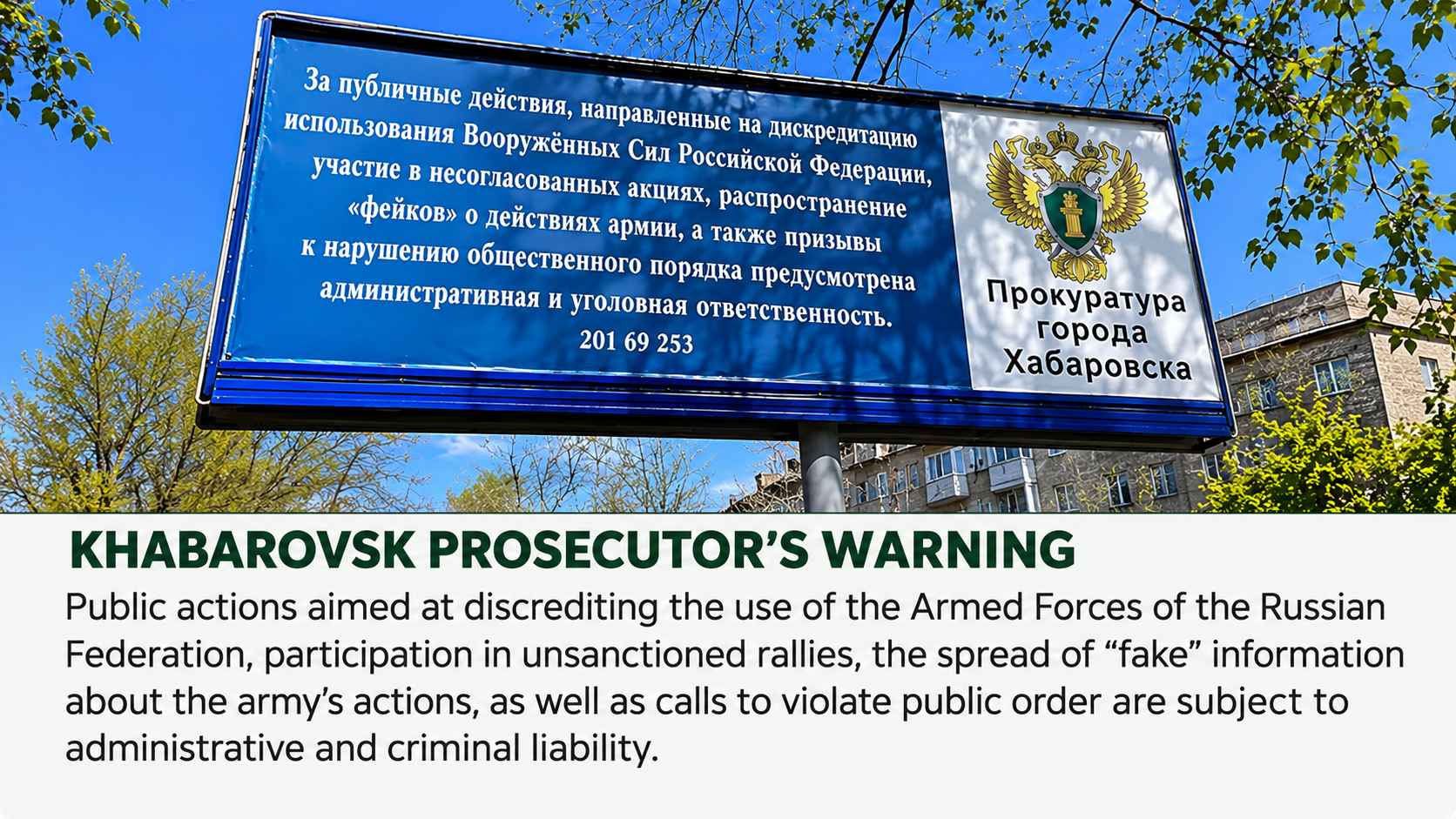
I remember a billboard in Khabarovsk.
It stood near Kim Yu Chen Street and Amursky Boulevard, along an ordinary city street used by pedestrians every day.
It was an enormous warning issued by the Khabarovsk City Prosecutor's Office.
Against a blue background, official text described administrative and criminal liability for what Russian law calls discrediting the armed forces or spreading knowingly false information about their use.
It listed administrative fines starting at 30,000 rubles for individuals and reaching one million rubles for legal entities.
It also warned of criminal penalties, including imprisonment of up to 15 years.
To be precise, the maximum 15-year term applied to certain offenses involving the dissemination of knowingly false information about the armed forces; it was not an automatic punishment for any anti-war slogan. But what was this — an attempt to intimidate people who opposed the war in Ukraine?
For anyone walking along the street, the message was unmistakably large and official.
I kept a photograph of that billboard.
To me, it became evidence of how new restrictions on speech entered ordinary life in Russia.
The warning was not in a courtroom or a specialist legal journal. It hung over an everyday street, among apartment buildings, trees, cars and pedestrians.
The state was not merely passing new laws. It was telling citizens in public what consequences certain expressions could bring.
Where is the line between informing people about the law and creating a climate in which they fear expressing their own views?
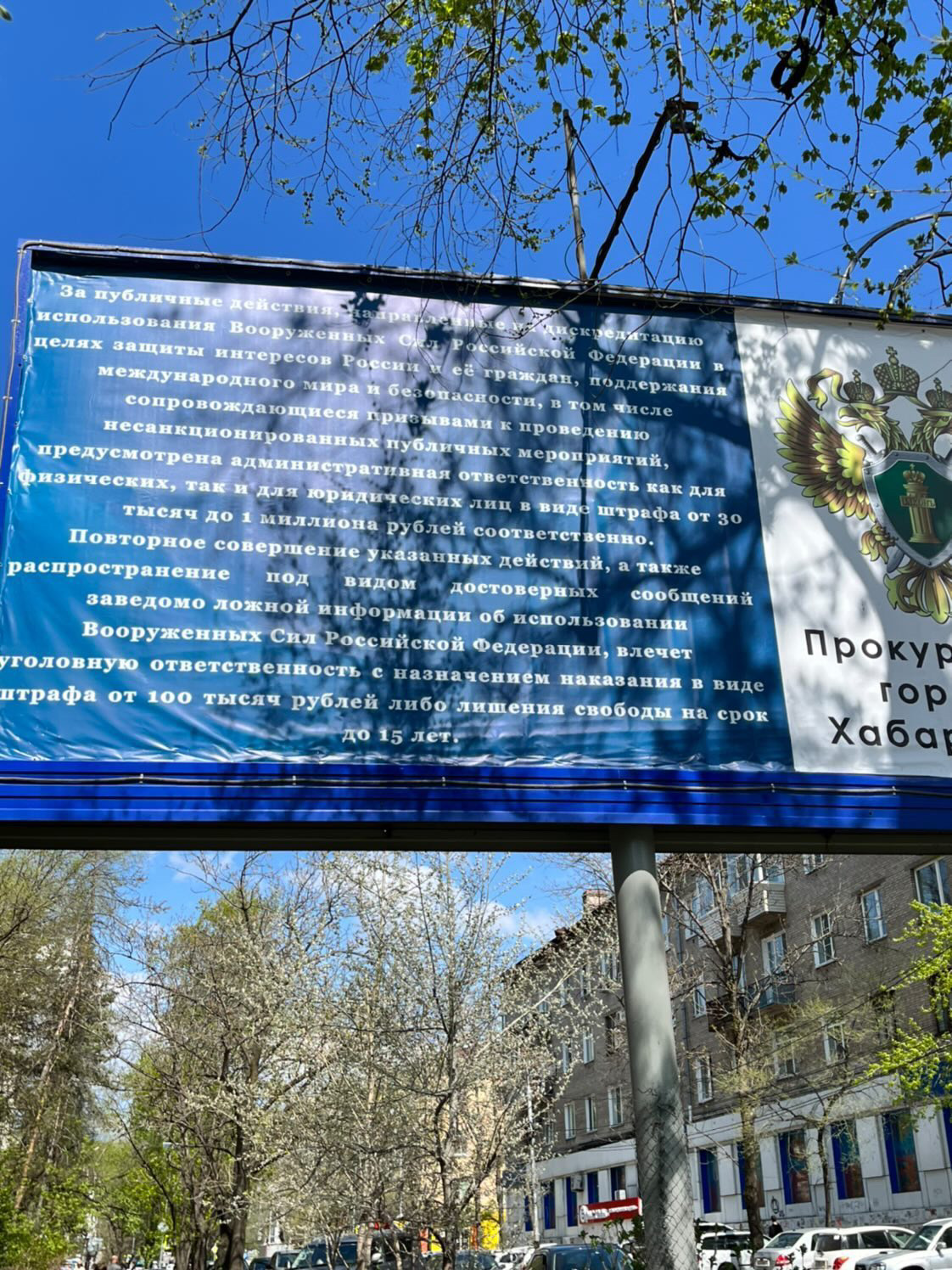
Archival photograph: A Khabarovsk City Prosecutor's Office warning about administrative and criminal penalties relating to public actions and statements about Russia's armed forces. Kim Yu Chen Street / Amursky Boulevard area, Khabarovsk, Russia. Photo: Roman Tretiakov / WE PNW. © Roman Tretiakov.
English translation of the Russian-language billboard (translated by WE PNW):
Public actions aimed at discrediting the use of the Armed Forces of the Russian Federation for the purpose of protecting the interests of the Russian Federation and its citizens and maintaining international peace and security, including calls to hold unauthorized public events, are subject to administrative liability. Fines range from 30,000 rubles for individuals to one million rubles for legal entities, respectively. Repeated commission of the specified acts, as well as the dissemination, presented as reliable reports, of knowingly false information about the use of the Armed Forces of the Russian Federation, entails criminal liability, ranging from fines starting at 100,000 rubles to imprisonment for up to 15 years.
Editor's note: The notice combines several distinct administrative and criminal provisions. A maximum sentence of 15 years does not apply automatically to every anti-war statement.
In the same city, journalist Sergei Mingazov died on July 2, 2026. He had worked with Forbes, Kommersant and Vedomosti. He was prosecuted over reposts about events in Bucha, Ukraine. In 2025 he received a fine that was subsequently increased to 2.5 million rubles, before his case was sent for retrial. Mingazov was seriously ill with cancer. His defense sought to suspend the proceedings to allow treatment, but the effort was unsuccessful. The criminal case was terminated after his death in July 2026. Cancer was the reported cause of death; there is no established basis for saying the prosecution caused the disease.
Source: Forbes — criminal case against Mingazov dismissed after his death
Source: Novaya Gazeta — Mingazov's illness and prosecution
A Schoolgirl's Drawing and Her Father's Imprisonment
In April 2022, sixth-grader Masha Moskalyova drew an anti-war picture in the town of Yefremov in Russia's Tula region.
Her family subsequently attracted the attention of law enforcement.
Her father, Alexei Moskalyov, was later prosecuted for repeatedly 'discrediting' the Russian military.
The formal criminal charge concerned his own social-media posts, not his daughter's drawing. But the family's encounter with the authorities began after the controversy surrounding her drawing.
On March 28, 2023, a court sentenced him to two years in prison. His term was later reduced to one year and ten months.
He was released on October 15, 2024.
A child made a drawing. Her father was imprisoned over his own anti-war posts. The family endured an investigation, trial and separation.
Those were real consequences for real people caught up in the workings of the state.
Source: Associated Press — Alexei Moskalyov's release
Maria Mekhedova: A Pediatrician, Online Comments and Criminal Prosecution
Another case unfolded in Blagoveshchensk, in Russia's Amur region.
Maria Mekhedova is a pediatrician.
In December 2022, she was fined 30,000 rubles in an administrative case for 'discrediting' the Russian armed forces. According to published accounts, the case involved anti-war comments and Instagram posts.
She was subsequently charged in a separate criminal case with publicly justifying terrorism, in connection with comments about the death of pro-war blogger Vladlen Tatarsky.
Mekhedova was placed under house arrest and faced restrictions on her professional life.
On October 1, 2024, a court gave her a three-year suspended prison sentence and a 500,000-ruble fine.
The Memorial political-prisoner support project considers the criminal prosecution politically motivated and disputes the underlying allegation.
Her story matters beyond the legal specifics.
It shows how public expression can alter the life of someone whose ordinary profession has little to do with politics.
A doctor treats children. She expresses her opinion. Then she finds herself facing administrative and criminal proceedings.
What happens to trust between people when political disagreements may lead to complaints to law enforcement?
What happens to a society when individuals begin to fear not only state institutions but also acquaintances, colleagues and neighbors?
Those questions matter as much as the numbers of the criminal-code provisions.
Source: Memorial — public record of Maria Mekhedova's case
When Charges Almost Always End in Convictions
The stories of Skochilenko, Moskalyov and Mekhedova do not exist in a statistical vacuum.
Human rights monitoring helps show the scale of politically motivated prosecutions.
In February 2026, the Political Prisoners. Memorial project released a report on four years of full-scale war and related repression.
As of February 18, 2026, researchers documented:
- 4,029 people subjected to politically motivated criminal prosecution connected to the war in Russia and in Russian-occupied Ukrainian territories.
- 2,730 sentences handed down.
- 2,302 custodial sentences.
- Zero acquittals in this monitored sample.
- 3,059 people deprived of liberty at the time of the research.
The sample does not consist only of Russian citizens who spoke against the war. It also includes Ukrainian civilians and service members prosecuted in war-related cases.
Nevertheless, not one acquittal among thousands of documented outcomes demands serious examination.
OVD-Info provides separate data. Its analysis of official judicial statistics found that in 2023, 115 sentences were issued under Criminal Code Articles 207.3 and 280.3, concerning war-related 'false information' and repeated 'discrediting' of the military, with no acquittals.
According to OVD-Info, Russian courts issued 229 verdicts in politically motivated cases over war-related expression in 2025, including 118 involving actual imprisonment.
Fewer new prosecutions over anti-war speech were recorded than in earlier years, but that did not mean criminal liability for publicly stated opinions had disappeared.
How Often Do Russian Courts Acquit Anyone?
According to published Judicial Department figures for 2025, courts of first instance convicted 457,962 people and acquitted 1,565.
Among those two categories of outcomes alone, the acquittal share was approximately 0.34%.
That figure does not automatically prove all other verdicts were unjust: the criminal justice system includes guilty pleas, special procedures and cases terminated on various grounds.
But another question emerges: why is acquittal such a rare outcome of criminal prosecution?
And what happens to judicial independence when a case touches the political interests of the state?
Source: Memorial — February 2026 war-related prosecution statistics
Source: OVD-Info — repression in Russia in 2025
Source: Pravo.ru — Russian judicial statistics for 2025
People Who Did Not Want to Take Part in the War
Another group must not be forgotten: service members who left their units without authorization, refused orders or faced desertion charges.
According to a Mediazona investigation, by the end of May 2025 Russian military courts had registered cases involving 20,662 people under provisions dealing with unauthorized absence, desertion and disobeying orders.
Verdicts had already been delivered concerning 17,721 defendants.
Most cases involved unauthorized absence under Article 337 of the Criminal Code. Another 1,369 cases were registered under the failure-to-obey-orders provision, and 1,010 involved desertion.
Not everyone in these proceedings opposed the war for political, moral or religious reasons. Health problems, family circumstances, commanders' conduct, conditions of service and principled opposition to the war may all have played roles.
It would therefore be misleading to label every defendant an anti-war protester.
But the volume of cases shows that the consequences of wartime policy reached not only civilian activists and journalists but thousands of service members.
How many of these people were acquitted specifically because a court upheld their right to refuse participation in war on grounds of conscience?
Reliable, comparable nationwide data for that narrower category have not been established.
Source: Mediazona — more than 20,000 military absence and refusal cases
A Judge Is Supposed to Protect the Individual
There is a question more fundamental than the wording of any particular law.
Why does the court not always become a safeguard against possible state abuse?
Russian judges take a judicial oath. Article 8 of the Law on the Status of Judges requires them to administer justice according to the law, impartially and fairly.
Judicial independence means the judge must not act as another representative of the prosecution.
A judge must examine evidence, hear the defense, review the legality of government action and reach a reasoned decision.
Consider Alexandra Skochilenko's case again.
On November 16, 2023, Judge Oksana Demyasheva sentenced her to seven years.
The next day, a judicial qualifications panel in St. Petersburg recommended Demyasheva for the position of deputy chair of the Kalininsky District Court.
In June 2024, the Russian president signed the decree appointing her.
Thus, the judge received a promotion following a high-profile conviction.
The timing does not establish that the promotion rewarded the Skochilenko verdict. But it raises legitimate questions about how judges are evaluated and what accountability exists for decisions challenged by human rights advocates.
Another judge, Margarita Kotova, is also worth examining.
On March 22, 2022, Kotova sentenced Alexei Navalny to nine years on fraud and contempt-of-court charges. She later moved from Moscow's Lefortovsky District Court to the Moscow City Court.
Both judges have appeared in European Union sanctions decisions relating to human rights violations.
How independent are the processes used to appoint and promote judges handling politically sensitive cases? And who evaluates the consequences of those judgments?
Source: Demyasheva's appointment
Source: Interfax — Navalny's March 2022 sentence
Source: European Union sanctions acts
Thousands of Judges and Tens of Thousands of Cases
On February 17, 2025, Novaya Gazeta Europe published a large investigation of Russian judicial practice.
Its journalists analyzed politically sensitive criminal and administrative proceedings over several years.
The research identified 1,205 judges who heard criminal cases the investigators classified as political and 9,724 judges who ruled on administrative cases under provisions categorized as political.
These groups may overlap.
The researchers also identified 281 judges who received such administrative cases unusually often.
According to the journalists, those patterns could suggest deliberate assignment of certain cases to particular judges. The statistical pattern alone does not prove misconduct by any specific judge.
The research also showed variation in individual judges' practices: some imposed minimum penalties, others terminated cases and still others handed down harsher decisions.
This matters. Questions about judicial independence do not mean that every judge behaves the same way.
But an unusual concentration of politically sensitive cases among particular judges raises a need to examine how assignments are made and what influences judicial decisions.
Source: Novaya Gazeta Europe — Faces of Repression investigation
Sergei Furgal: Who Scrutinizes the Evidence in High-Profile Cases?
The case of former Khabarovsk governor Sergei Furgal differs from those prosecuted for anti-war speech.
He faced allegations of grave crimes, including organizing murders and attempted murders.
That makes high standards of evidence, judicial impartiality and procedural fairness all the more important.
I lived in Khabarovsk and worked in its civic and political life. To me, Furgal's case is not simply another headline from Moscow.
His arrest in July 2020 sparked mass protests in Khabarovsk. Thousands demanded an open and fair hearing.
On February 10, 2023, he was sentenced to 22 years in prison after a jury returned a guilty verdict.
On December 3, 2025, in a second case involving economic charges, the combined prison term was set at 25 years.
Furgal denies wrongdoing.
His defense challenged the prosecution's evidence and the lawfulness of certain procedural actions.
Especially serious questions arose after jurors reported alleged pressure by presiding judge Gennady Tsoy. They said the judge interfered with the jury's work. The defense demanded that these claims be examined.
Higher courts upheld the first conviction.
Under the Russian legal system, therefore, Furgal's guilt was established by a judgment that entered into force. But the existence of a final conviction does not eliminate the public interest in the quality of the evidence or in how allegations about the proceedings were assessed.
A court verdict and public confidence in the fairness of the process are not the same thing.
When a criminal case involving a political figure prompts mass demonstrations, the state has an interest not merely in obtaining a verdict but in answering legitimate questions about the proceedings.
Source: Radio Liberty — jurors' allegations of pressure
Source: Kommersant — December 3, 2025 sentence
Navalny: When a Court Found an Improper Political Purpose
One document is particularly important in understanding the judicial history of Alexei Navalny.
On November 15, 2018, the Grand Chamber of the European Court of Human Rights delivered its judgment in Navalnyy v. Russia.
It found multiple violations of Navalny's rights in connection with arrests and administrative proceedings.
More than that, the court held that two incidents involved an ulterior purpose: the suppression of political pluralism.
This is not merely a journalist's allegation. It is a court's finding about specific events.
Navalny subsequently faced further criminal prosecutions.
In August 2023, he received a 19-year prison sentence in an extremism case.
He died in a penal colony on February 16, 2024.
Russian officials rejected claims that his criminal cases were politically motivated. Yet the European Court's earlier judgments documented violations of his rights.
His experience demonstrates the importance of an independent avenue for reviewing actions by state authorities.
Source: European Court of Human Rights — Navalnyy v. Russia
From the Prosecutor's Office to the Supreme Court
Russia's judicial system cannot be examined without considering its leadership.
Vyacheslav Lebedev led the Supreme Court of the Russian Soviet Republic and then the Russian Federation from 1989 until his death in February 2024.
For decades he was among the most influential figures in the country's judiciary.
Irina Podnosova succeeded him and died in July 2025.
On September 24, 2025, Igor Krasnov was appointed chairman of Russia's Supreme Court.
Before that, he served as prosecutor general, and earlier in his career he worked in the Investigative Committee.
The sequence is striking: investigation, leadership of state prosecution and then leadership of the country's highest court.
Moving from prosecution to the judiciary does not by itself prove a lack of judicial independence.
But it raises an important question about institutional safeguards: can a court preserve sufficient distance from the agencies that bring accusations before it?
According to the Supreme Court, Krasnov was appointed by the Federation Council on the president's nomination.
The chair of the Supreme Court is responsible for the operation of the institution and is not supposed to replace each judge's independent decision-making.
Therefore the issue is not merely the chairman's biography, but the actual mechanisms protecting judges from administrative and political interference.
Source: Supreme Court of Russia — Igor Krasnov's appointment
Prosecutors and Political Careers
The professional careers of officials involved in politically significant proceedings also deserve attention.
Natalia Poklonskaya is one example.
Before 2014, she worked in Ukraine's prosecution service.
After Russia's annexation of Crimea, she headed the prosecutor's office established by Russia on the peninsula.
She later became a member of Russia's State Duma, served as deputy head of Rossotrudnichestvo and then as an adviser to the prosecutor general.
Crimea is internationally recognized as part of Ukraine. The work of Russian state institutions there has therefore been a subject of international legal disputes and sanctions.
Poklonskaya's career illustrates how a legal professional's trajectory can unfold amid dramatic political and territorial change.
However, determining individual legal responsibility requires examining specific actions, powers and decisions, not merely the fact that a person held office.
That standard must apply to every prosecutor and judge. Political disagreement is not itself evidence of personal misconduct.
Otherwise, criticism of unfair justice risks resorting to the very practices it challenges.
Source: Kommersant — Natalia Poklonskaya biography
International Justice: From Strasbourg to the Arrest Warrant for a President
Russia's judiciary cannot be fully separated from international law.
Three institutions must be distinguished: the European Court of Human Rights, the International Criminal Court and the International Court of Justice.
Russia and the European Court of Human Rights
Russia ceased to be a member of the Council of Europe on March 16, 2022.
On September 16, 2022, it ceased to be a party to the European Convention on Human Rights.
That sharply limited Russian citizens' ability to bring new complaints to the European Court over subsequent violations.
The court retained jurisdiction over acts or omissions of Russian authorities that took place before September 16, 2022.
But another change followed.
In June 2022, Russia enacted legislation under which judgments of the European Court that became final after March 15, 2022, would not be enforced by Russian authorities.
The state had not only left the European human rights framework; it had also restricted enforcement of that court's judgments through domestic law.
The Council of Europe's position is that Russia's departure did not erase its international responsibility for violations committed before September 16, 2022.
In practice, however, enforcing those obligations became extremely difficult.
On July 7, 2026, the European Court made another consequential decision: it struck out 879 remaining individual applications against Russia that were not related to armed conflicts.
The judges concluded that continuing to examine those applications was no longer justified under the exceptional circumstances, while preserving a mechanism for restoring them if conditions change.
Conflict-related cases are handled separately. Earlier judgments are not invalidated.
For Russians who cannot obtain relief in national courts, the practical routes to international adjudication have narrowed.
Who can protect an individual when the national system rejects a complaint and the international route is no longer accessible for new violations?
Source: Council of Europe — Russia ceases to be a party to the Convention
Source: European Court of Human Rights — Lebedeva and Others v. Russia, July 7, 2026
Russia and the International Criminal Court
Another institution based in The Hague is the International Criminal Court, or ICC.
Russia signed the Rome Statute in September 2000 but never ratified it.
On November 30, 2016, Moscow formally notified the UN Secretary-General that it did not intend to become a party to the treaty.
Russia was therefore never an ICC state party. Saying it 'withdrew from the ICC' would be legally inaccurate.
But the ICC's jurisdiction over alleged crimes committed on Ukrainian territory rests on separate legal grounds, including Ukraine's acceptance of the court's jurisdiction.
On March 17, 2023, the ICC issued arrest warrants for Vladimir Putin and Russia's children's rights commissioner, Maria Lvova-Belova.
They concern suspected war crimes involving the unlawful deportation and transfer of Ukrainian children from occupied territories.
The ICC said there were reasonable grounds to believe the suspects may bear individual criminal responsibility.
An arrest warrant is not a conviction. The suspects retain the right to a defense and a fair trial.
Yet the principle is important: holding even the highest public office does not automatically remove the question of legal accountability for international crimes.
Source: United Nations — Russia's November 30, 2016 notification
Source: ICC — arrest warrants for Putin and Lvova-Belova
The International Court of Justice: Russia Has Not Left It
One other international court is frequently confused with the ICC: the International Court of Justice, or ICJ, the United Nations' principal judicial organ.
Unlike the ICC, it primarily hears disputes between states rather than criminal charges against individuals.
Russia remains a UN member and a party to the ICJ Statute.
The ICJ has continued proceedings involving Ukraine and Russia under the Genocide Convention. On November 6, 2026, the court issued a procedural order concerning deadlines for written submissions.
So the assertion that Russia has withdrawn from all international courts would be wrong.
Nevertheless, its departure from the European human rights system, its domestic refusal to execute certain European Court judgments and its decision not to join the ICC are documented developments.
They raise questions about the relationship between state power and international legal accountability.
Source: UN Charter, Chapter XIV — International Court of Justice
Source: ICJ — Ukraine v. Russian Federation
Who Is Responsible for Injustice?
When people discuss political repression, they usually name presidents, ministers and law-enforcement chiefs.
But between a political decision and a life turned upside down lies an entire chain of professional acts.
Someone drafts a bill.
Someone votes for it.
Someone files a complaint or writes an official report.
An investigator opens a criminal case.
A prosecutor argues for a conviction.
A judge examines the materials and delivers a verdict.
Other judges then review the decision.
Every participant in that chain holds particular powers, duties and responsibilities.
Some may sincerely believe they are acting properly. Others may agree with their superiors. Still others may feel pressure or fear the professional cost of disagreement.
But individual motives must be evaluated on evidence.
It is not possible to assume every judge knowingly commits injustice, or that every prosecutor participates in unlawful persecution.
Yet neither can any disputed decision be excused merely by saying the official was 'following the law.'
The professional oath exists precisely because justice sometimes requires an independent decision.
If state authorities can bring charges over nearly any unwelcome public statement, the court is supposed to be where those charges face rigorous scrutiny.
Without it, the judiciary risks becoming part of an administrative machinery of punishment rather than an independent arbiter.
Justice Should Not Fear the Individual
For me, this is not an abstract argument about legal terminology.
I lived in Russia and participated in civic and political life. I watched the climate surrounding public expression change.
I remember when new laws were presented as technical measures of control and state protection.
I remember the prosecutor's warning billboard on Kim Yu Chen Street in Khabarovsk.
I remember how public dissent came to be treated differently.
The consequences of legal change reached far beyond accounting requirements for nonprofits or efforts to prevent genuinely dangerous acts.
The stories of Skochilenko, Moskalyov, Mekhedova and many others raise questions not just about statutory language but about the institutions that apply it.
A court is not merely a building, a national emblem or a person in a robe.
Justice should protect the law and the rights of the individual, including when that individual is in conflict with the state.
When people are free to agree with the government but risk fines, prosecution or imprisonment for publicly disagreeing, the boundaries of freedom of expression must be examined.
When a court hears such a case, we must ask whether the defendant has a genuine opportunity to challenge the accusation and obtain an independent judgment.
And when high-profile proceedings attract serious allegations of procedural violations, the public deserves more than a verdict. It deserves credible answers to those allegations.
No country is immune to judicial errors. No judicial system is perfect.
The crucial distinction is whether a system can recognize its mistakes, correct them and protect people from abuses of power.
That is what separates justice from the mere exercise of state coercion.
Is Russia's Lady Justice Blind?
The traditional symbol of justice is a woman with her eyes covered.
The blindfold represents impartiality. The court must not favor someone because of wealth, office, political beliefs or closeness to those in power.
But the blindness of justice must not become an inability to see evidence, circumstances and the human consequences of judicial decisions.
Behind every celebrated or controversial trial lie more than legal documents.
There are people.
A woman who should be able to practice her profession.
An artist who expressed her opposition to war.
A father whose child is waiting for him.
A service member forced to choose between an order and personal conviction.
A person who wants to know that an independent court will examine the accusations against them.
And a judge who once took a professional oath.
The question of Russian justice is therefore not only about Putin, Navalny or Furgal.
It is about whether an ordinary citizen can expect a fair hearing when their views differ from the state's position.
If the law gives those in power a means to punish someone for an opinion, who is supposed to protect that person from the law?
And if the court itself cannot provide that protection, the deepest question is no longer how severe the sentence is.
The question is whether justice remains independent of those demanding punishment.
Roman Tretiakov
WE PNW | Author's Column
This article presents the author's perspective. Accounts of criminal cases, judgments and legislation are drawn from publicly available sources linked throughout. Findings by human rights organizations and assertions by the parties are attributed to their respective sources.