
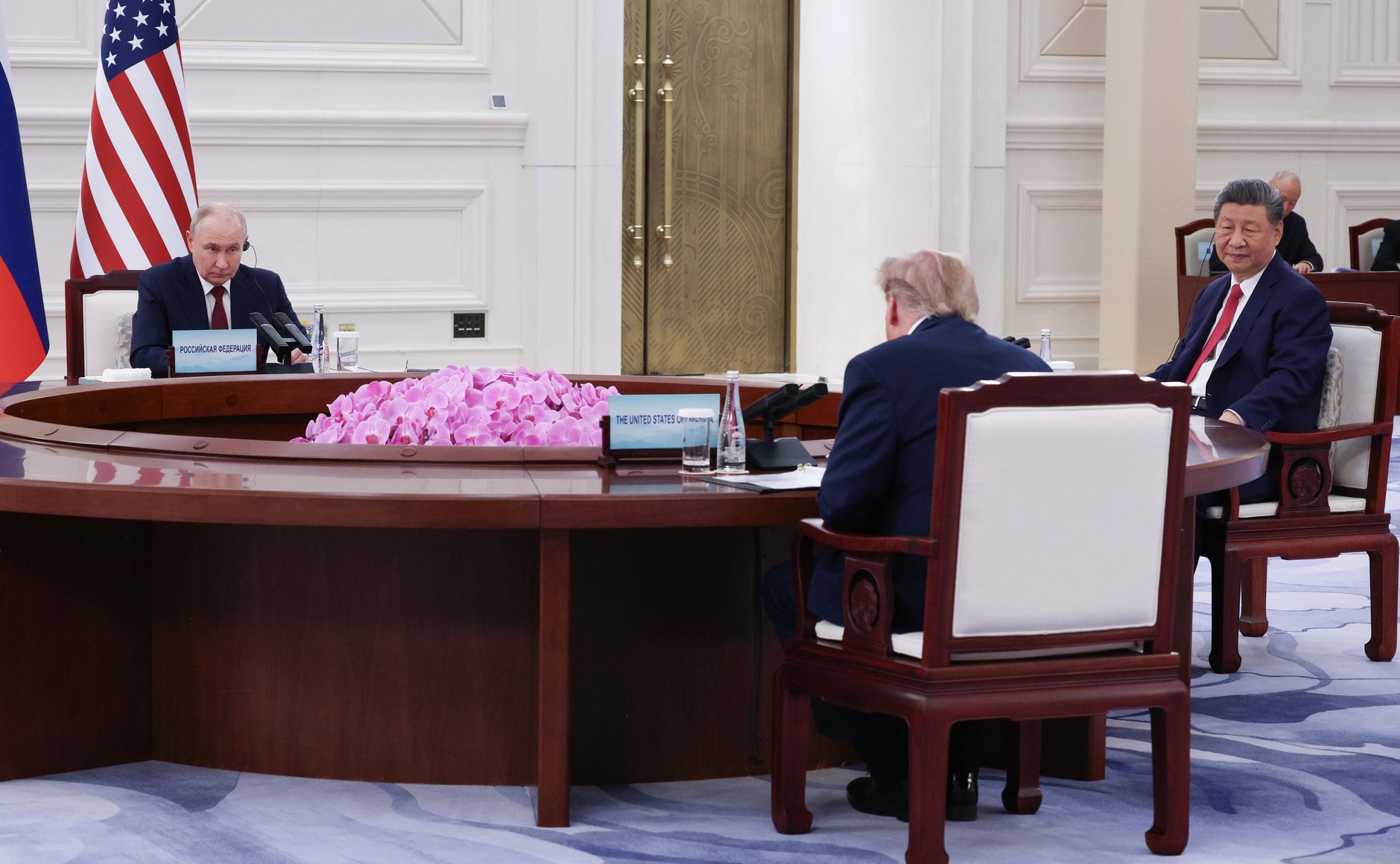
The leaders of the United States, Russia, and China concluded their trilateral talks in Shenzhen and released a joint declaration. The document addresses nuclear security, petroleum supplies, UN reform, and the International Criminal Court. Neither Ukraine nor Iran is mentioned. On the same day, Vladimir Putin threatened retaliatory strikes against Ukraine over attacks on the Crimean Bridge and rejected discussions of a limited ceasefire.
VANCOUVER, Washington | November 19, 2026 — WE PNW
As of 11:00 a.m. PST. This article will be updated as new information becomes available.
On November 19, U.S. President Donald Trump, Russian President Vladimir Putin, and Chinese President Xi Jinping held their first dedicated trilateral talks at the heads-of-state level.
The meeting took place in Shenzhen, China, on the sidelines of the Asia-Pacific Economic Cooperation (APEC) summit. According to the Associated Press, the talks lasted approximately 70 minutes. Anadolu Agency reported a duration of about 80 minutes.
Following the meeting, the White House and China's Ministry of Foreign Affairs published a joint document titled Declaration toward Peace.
The declaration contains four provisions covering United Nations reform, increased petroleum supplies, international criminal justice, and the reduction of nuclear risks.
Neither Ukraine nor Iran is mentioned in the declaration, although both conflicts were discussed by the three leaders.
No new agreement was announced on a ceasefire, the resolution of either conflict, or reductions in nuclear weapons.
The Four Points of the Declaration
1. United Nations Reform
The United States, Russia, and China expressed their intention to reform the United Nations to make the organization more effective in responding to international crises and fulfilling its responsibilities for maintaining international peace and security.
All three countries are permanent members of the UN Security Council and hold veto power.
However, the declaration does not specify what changes are proposed.
It contains no proposals to alter the composition of the Security Council, restrict veto powers, or revise decision-making procedures. No timeline for reform was established.
2. Increased Petroleum Supplies
The second provision addresses global energy markets.
The three countries announced plans to increase petroleum production and supplies, emphasizing the importance of stable global energy flows.
The issue is particularly relevant amid the ongoing conflict with Iran and disruptions to international energy supplies.
Russia remains a major global producer of oil and petroleum products. China is the world's largest oil importer, while the United States has substantial domestic production capacity.
However, the declaration does not establish specific volumes for additional supplies, delivery schedules, prices, or new trading mechanisms.
No additional sanctions decisions directly connected to this provision were announced.
Earlier, on October 9, the Trump administration authorized certain transactions involving Russian diesel fuel. The new trilateral declaration does not link its energy cooperation provisions to that arrangement or confirm that the promised deliveries to the United States have been completed.
What Does This Mean for Oregon and Washington?
According to the U.S. Energy Information Administration (EIA), more than 90% of the petroleum products consumed in Oregon come from refineries in Washington state. Portland's fuel terminals play an important role in regional distribution.
Changes in global petroleum markets can therefore affect transportation costs and diesel prices across the Pacific Northwest.
However, the published declaration provides no basis for determining whether consumer fuel prices in the region will change. It also identifies no new supply routes through the ports of Portland or Vancouver.
3. The International Criminal Court and Immunity of Government Officials
The third provision concerns international criminal justice.
The original English-language declaration states:
“the principle of state consent and respect for immunities of State officials are of paramount importance”
The three countries also agreed that the International Criminal Court (ICC) and similar bodies:
“must not abuse their jurisdiction”
The leaders therefore emphasized state consent, the immunities of public officials, and limits on judicial jurisdiction.
Neither the United States, Russia, nor China is a party to the Rome Statute of the International Criminal Court.
The United States signed the treaty in 2000 but informed the United Nations in 2002 that it did not intend to become a party. Russia signed in 2000 and issued a similar notification in 2016. China never signed the treaty.
Their position reflects longstanding disagreements about the jurisdiction of the ICC over states that have not joined its founding treaty.
However, the Rome Statute allows the Court to exercise jurisdiction under certain conditions, including when a state on whose territory an alleged crime occurred has accepted its authority.
Ukraine exercised this option through separate declarations in 2014 and 2015. Kyiv subsequently ratified the Rome Statute, which entered into force for Ukraine on January 1, 2025.
On March 17, 2023, the ICC issued an arrest warrant for Vladimir Putin over alleged war crimes involving the unlawful deportation and transfer of Ukrainian children.
Article 27 of the Rome Statute establishes that a person's official position as a head of state does not, by itself, exempt that person from criminal responsibility before the Court.
The joint declaration by the United States, Russia, and China does not invalidate the arrest warrant for Putin or change the authority of the International Criminal Court.
4. Nuclear Security
The fourth provision addresses nuclear weapons.
The leaders reaffirmed the principle that a nuclear war cannot be won and must never be fought.
The United States, Russia, and China also expressed their intention to pursue dialogue aimed at reducing nuclear risks and preventing the proliferation of nuclear weapons.
The statement came after the New START treaty expired in February 2026. It was the last major bilateral agreement limiting strategic nuclear weapons held by the United States and Russia.
Donald Trump had previously called for a new agreement that would include China.
Beijing, however, has argued that its nuclear arsenal is considerably smaller than those of the United States and Russia and has opposed identical limits.
The new declaration establishes no limits on nuclear warheads, restrictions on delivery systems, or inspection procedures.
No timetable for a new negotiating process was announced.
Ukraine: Discussed but Excluded From the Declaration
According to China's Ministry of Foreign Affairs, the leaders discussed Russia's war against Ukraine, nuclear nonproliferation, the situation in the Middle East, and the Korean Peninsula.
However, the final document contains no provisions directly addressing the Russia-Ukraine war.
There are no demands for a cessation of hostilities, mechanisms for monitoring a ceasefire, commitments to withdraw Russian troops, or new security guarantees for Ukraine.
The separate meeting between Trump and Putin, held before the trilateral talks, also ended without the public announcement of a new peace agreement.
Ukrainian President Volodymyr Zelenskyy and European leaders did not participate in the talks between the three presidents in Shenzhen.
Meanwhile, U.S. representatives Steve Witkoff and Jared Kushner continued diplomatic contacts with Ukraine and European countries in Berlin.
Kushner said that he and Witkoff had briefed German Chancellor Friedrich Merz on Trump's talks in China.
Trump also stated in an interview with NBC News after the meeting that he did not intend to make decisions about Ukraine's future without the Ukrainian president's participation.
Diplomatic discussions continue through several channels, but the published declaration contains no decisions to end the war.
After the Declaration: Putin's Statements on the Crimean Bridge
On November 19, following the talks in Shenzhen, Vladimir Putin spoke to journalists about Ukrainian strikes on the Crimean Bridge.
According to Reuters, the Russian president said that following the attacks, Moscow would no longer consider an agreement to suspend strikes on energy infrastructure and targets in the Black Sea.
Putin explained that he had previously brought the possibility of such a limited arrangement before Russia's Security Council and instructed officials to examine it further.
However, no publicly confirmed agreement with Ukraine to suspend those strikes had been announced.
Following the attacks on the bridge, Putin stated that Moscow would not negotiate such an arrangement.
He also warned of more painful retaliatory actions by Russia.
Reuters reported that the bridge had been targeted by a third Ukrainian attack within one week on November 19.
Russian officials acknowledged serious damage to the roadway section of the bridge. Putin said the crossing was used exclusively for civilian purposes and was not used to transport military equipment or petroleum products.
Ukraine, by contrast, considers the bridge strategically important to Russian military supply operations on the occupied Crimean Peninsula.
On November 19, the leaders of the United States, Russia, and China released a declaration addressing strategic stability and international security. On the same day, Putin publicly rejected discussions of a limited suspension of strikes and threatened retaliatory action against Ukraine.
The declaration itself contained no commitment requiring Russia to end its military operations.
Iran: Talks Without an Announced Agreement
Iran was also discussed at the summit but was not included in the joint declaration.
The United States remains engaged in an armed confrontation with Tehran. Russia and China maintain significant economic and diplomatic relations with Iran.
Donald Trump had previously identified Iran as one of the subjects of the talks in China.
He also spoke about the need to restore freedom of navigation through the Strait of Hormuz and prevent Iran from acquiring nuclear weapons.
Following the meeting, no agreement was announced requiring Russia or China to take specific action to resolve the conflict.
The declaration's provision on petroleum products addresses the stability of energy supplies but contains no separate plan to reopen the Strait of Hormuz or end hostilities.
How the Leaders Assessed the Talks
Donald Trump described the meeting as historic.
In a telephone interview with NBC News correspondent Gabe Gutierrez, the U.S. president rated it 12 out of 10.
Trump emphasized the importance of his personal relationships with the leaders of Russia and China and said the sides had discussed international security and opportunities for future cooperation.
Xi Jinping described the talks as positive, constructive, and productive. The Chinese leader called for maintaining dialogue between major powers.
Vladimir Putin also spoke positively about the atmosphere of the meeting and emphasized the three countries' shared responsibility for international security.
The Trump administration views the first trilateral dialogue itself, along with the start of discussions on nuclear risks, as a significant diplomatic result.
At the same time, the published declaration contains no specific nuclear disarmament agreement or new commitments to end armed conflicts.
What Changed After the Summit?
On November 19, 2026, the United States, Russia, and China held their first dedicated trilateral talks at the heads-of-state level.
The meeting resulted in a joint document covering four areas: UN reform, global petroleum supplies, international criminal justice, and nuclear security.
The declaration confirms the countries' intention to continue cooperation and maintain strategic stability.
However, it establishes no specific implementation deadlines, new arms-control verification mechanisms, or commitments to end armed conflicts.
Ukraine and Iran were discussed during the meeting but were not included in the final declaration.
On the same day, the Russian president announced that Moscow would no longer consider a limited suspension of strikes on energy infrastructure and targets in the Black Sea.
At the time of publication, Russia's war against Ukraine continues. The armed conflict involving Iran also remains unresolved.
The outcomes of the Shenzhen meeting were the first trilateral summit between the leaders of the United States, Russia, and China, a joint declaration, and stated intentions to continue dialogue.
No specific agreements to end the wars were announced.
Roman Tretiakov
WE PNW — World News