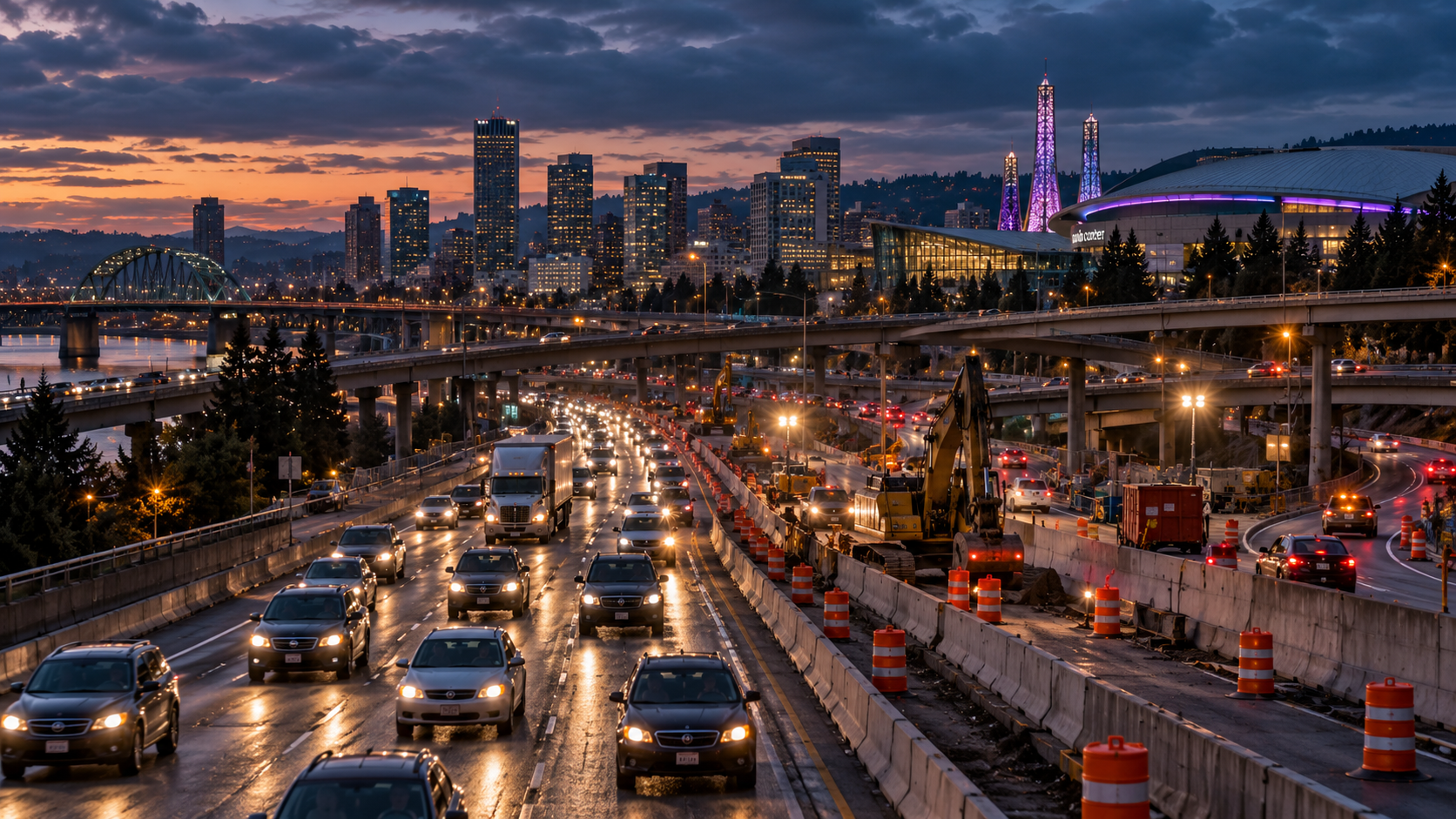
When the southbound lanes of Interstate 5 through Portland’s Rose Quarter closed on September 11, the region was told to prepare for something close to a transportation nightmare.
The closure affected a roughly two-mile stretch between I-405 and I-84, one of the busiest pieces of highway in Oregon. Before the work began, transportation officials warned that travel times could double or even triple, congestion could spill north across the Columbia River into Washington, and neighborhood streets around North and Northeast Portland could absorb much of the displaced traffic. OPB even used the word “carmageddon” in its coverage before the closure began. opb
The warnings were not unreasonable. Crews shut down the southbound freeway around the clock for a five-week repair project. ODOT is replacing pavement that dates back to 1985 and carrying out structural work intended to make the highway more resilient in an earthquake. opb
But several weeks into the closure, one thing is increasingly clear:
The Armageddon never arrived.
That does not mean traffic has been easy.
Commutes near the construction zone have, at times, taken roughly twice as long as normal, and in some cases up to 2.5 times longer. Streets including Greeley Avenue, Martin Luther King Jr. Boulevard, Going Street and Interstate Avenue have taken additional pressure as drivers look for alternatives. opb
What did not happen was the region-wide collapse many people had imagined.
During the first Monday commute after the closure, traffic through Vancouver was largely normal. At Washington State Department of Transportation’s traffic management center, cameras showed vehicles moving across the Interstate Bridge at close to their usual pace. Officials cautioned that one morning could not predict the entire five-week project, but the feared immediate backup deep into Washington did not materialize. opb
Weeks later, the picture remains surprisingly similar.
Portland Bureau of Transportation spokesperson Hannah Schafer told OPB that traffic conditions had stabilized. While volumes remained higher than normal in some areas, they were no longer dramatically worsening.
“This tells us that people have adjusted their routines,” Schafer said, describing drivers as settling into a “new normal.” opb
That may be the real story of the closure.
People adapted.
Some changed the time they commute. Some chose I-205 or I-405. Others worked from home, carpooled, took transit, walked or biked. TriMet reported more than 18,000 rides on the MAX Yellow Line during the first week of the closure, and officials also saw increased transfers at Parkrose Transit Center, where C-TRAN riders from Vancouver can connect to MAX. opb
ODOT spokesperson Rose Gerber said peak-hour travel times on Portland highways are roughly twice normal levels. Congestion and travel times have also increased on neighborhood streets near the Rose Quarter. OPB corrected its description of the closure’s impact on Portland highways in an October 6 evening update.
In other words, Portland and Vancouver have not escaped the disruption.
They have simply learned to live around it.
There have been bad days. There have been long lines of cars, frustrating detours and commutes that lasted far longer than anyone wanted.
And then there is Friday.
Anyone who regularly travels between Portland and Vancouver already knows that Friday traffic has never needed much help becoming unpleasant. During the I-5 closure, some Friday commutes have offered a reminder that “carmageddon” may not have disappeared completely — it simply seems to prefer making occasional appearances rather than moving here permanently.
So perhaps the safest advice for the final stretch of construction is simple:
The region appears to have survived the great I-5 traffic apocalypse. Just keep an eye on Friday.
The work itself is also nearing the finish line.
ODOT says crews remain on schedule to complete construction on October 16, helped by favorable weather and relatively few interruptions to the 24-hour work schedule. Full reopening may stretch into October 17 as crews finish striping the new pavement and reopen ramps in stages. opb
That means the experiment is almost over.
And so far, the lesson is not that closing one of Portland’s most important freeways was painless. It clearly was not.
The more interesting lesson may be that a transportation system is not only concrete, ramps and traffic signals. It is also millions of individual decisions.
Drivers left earlier. Others stayed home. Some took a train. Some changed routes. Some simply accepted a longer commute.
Together, those decisions appear to have prevented the worst predictions from becoming reality.
Portland and Vancouver were told to prepare for chaos.
Instead, the region adapted.
Not without delays.
Not without frustration.
And definitely not without Friday.