Nearly 8,000 Portland K–8 students could have to change schools under the most extensive reorganization proposal now before Portland Public Schools.
Some students would move because their school could close. Others could be assigned to a different campus even if their current school stays open. For families, that means the proposals are not only about buildings. They could change morning routines, transportation, friendships, after-school care and the neighborhood identity built around each school.
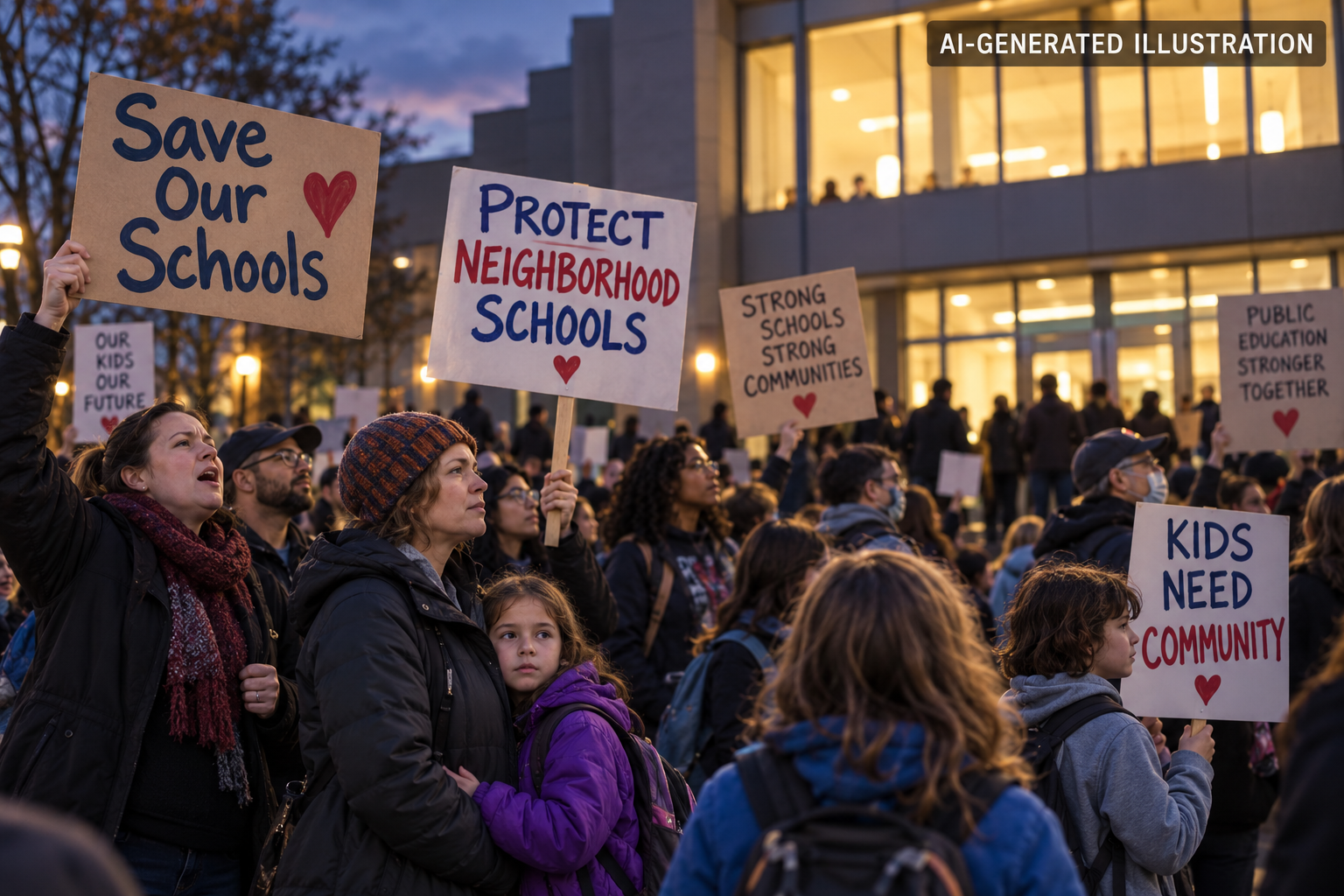
That scale of disruption brought hundreds of parents, students, teachers and staff to Portland Public Schools headquarters on October 6.
The building filled to capacity. Some attendees pushed past security to get inside, and audience interruptions repeatedly disrupted the school board meeting, according to OPB. Families and educators urged the district to reconsider changes they fear could break apart school communities.
Source: OPB, Oct. 7 — https://www.opb.org/article/2026/10/06/portland-public-schools-closure-proposals-rightsizing/
Behind the emotional meeting is a difficult question for Portland: how should a school district respond when enrollment has declined and students are spread unevenly across buildings — while families remain deeply attached to the schools that anchor their neighborhoods?
What PPS is proposing
Portland Public Schools says its current configuration makes consistent staffing, stable programs and efficient use of buildings harder to sustain.
On October 5, the district released two major “rightsizing” proposals.
Scenario A would close 14 schools.
Scenario B would close 11 schools.
Both proposals would also redraw attendance boundaries, relocate some programs and change the grades served at certain campuses. A third option would delay major changes and keep the current configuration for now.
PPS rightsizing overview — https://www.pps.net/about/portland-public-schools-information/rightsize/rightsize
The district has framed the process as an attempt to align schools, programs and resources with where students are today. PPS says the goal is to create a more sustainable system where students have access to stronger and more consistent academic programs.
But many families see the proposals differently. To them, the plan risks turning neighborhood schools into numbers on a map.
The impact goes beyond the closure list
According to district figures reported by OPB, Scenario A would move 7,981 K–8 students to different schools. Scenario B would move 6,988 students.
Those numbers include the broader reorganization, not only students whose schools would close.
Source: OPB — https://www.opb.org/article/2026/10/06/portland-public-schools-closure-proposals-rightsizing/
That distinction matters.
For parents, checking whether their school is on the closure list is only the first step. A school that remains open could still be affected by new attendance boundaries, program moves or grade-level changes. PPS has published school-specific information and maps so families can review how each scenario could affect them.
PPS school-by-school information and maps — https://www.pps.net/about/portland-public-schools-information/rightsize/scenarios
A school remaining open does not necessarily mean a child’s school day will remain the same.
Which schools could close?
Under Scenario A, PPS would close the following schools:
Beach, Buckman, Creston, Irvington, James John, Lewis, Maplewood, Marysville, Peninsula, Rose City Park, Sabin, Stephenson and Woodmere elementary schools, plus Sellwood Middle School.
Under Scenario B, Lewis, Rose City Park and Stephenson would remain open. The other 11 schools would remain on the proposed closure list.
PPS scenarios — https://www.pps.net/about/portland-public-schools-information/rightsize/scenarios
The proposals also include changes beyond closures, including boundary adjustments and program relocations. That is why the total number of affected students is much larger than the enrollment of the schools proposed for closure.
Why families are pushing back
For many parents and educators, the concern is not only whether PPS needs to make changes. It is whether the district is moving too quickly, communicating clearly enough and fully accounting for the human cost of disruption.
A school is not just a building. It is where children form friendships, where parents meet other families, where teachers build trust over time, and where neighborhoods develop a daily rhythm.
When a school closes or boundaries shift, those routines can be broken.
Families at the October 6 meeting questioned whether the district had done enough to earn public trust before proposing changes of this size. Some asked PPS to slow down. Others argued that the district should look more closely at alternatives before closing neighborhood schools.
No final decision has been made
No school closures have been approved under these proposals.
PPS says the superintendent will make a formal recommendation in November. The school board is expected to vote in December. If approved, changes would begin taking effect in fall 2027.
PPS timeline — https://www.pps.net/about/portland-public-schools-information/rightsize/timeline
The district says it will review community feedback before making a recommendation and work with affected school communities on transition support.
For now, families still have time to examine the proposals, ask questions and make their case before the final vote.
The most immediate step for parents is concrete: check the proposed destination school, attendance boundaries and program changes affecting their children, then submit feedback through the PPS scenarios page.
PPS scenarios and feedback — https://www.pps.net/about/portland-public-schools-information/rightsize/scenarios
The December vote will determine whether Portland moves forward with one of the largest school reorganizations in the city’s recent history — or whether the district is forced to rethink the plan.