We usually recognize revolutions only after they have already happened.
Once the Industrial Revolution had transformed cities, factories, labor and wealth, it became obvious how enormous the shift had been. Once the internet became part of everyday life, it became easy to divide history into “before” and “after.”
But during the transition itself, things rarely feel revolutionary.
People still go to work. Companies still hold meetings. Accountants still close the books. Someone opens a restaurant. Someone writes code. Someone sells a house. Daily life continues with enough familiarity that it becomes surprisingly easy to miss the scale of what is changing underneath it.
That may be exactly where we are now.
Artificial intelligence is still commonly discussed as a technology product: a new service, a smarter search engine, a tool that can write an email, generate an image or help with homework. But that framing may already be too small.
What we are really watching is a technology that is beginning to reduce the cost of access to intellectual work.
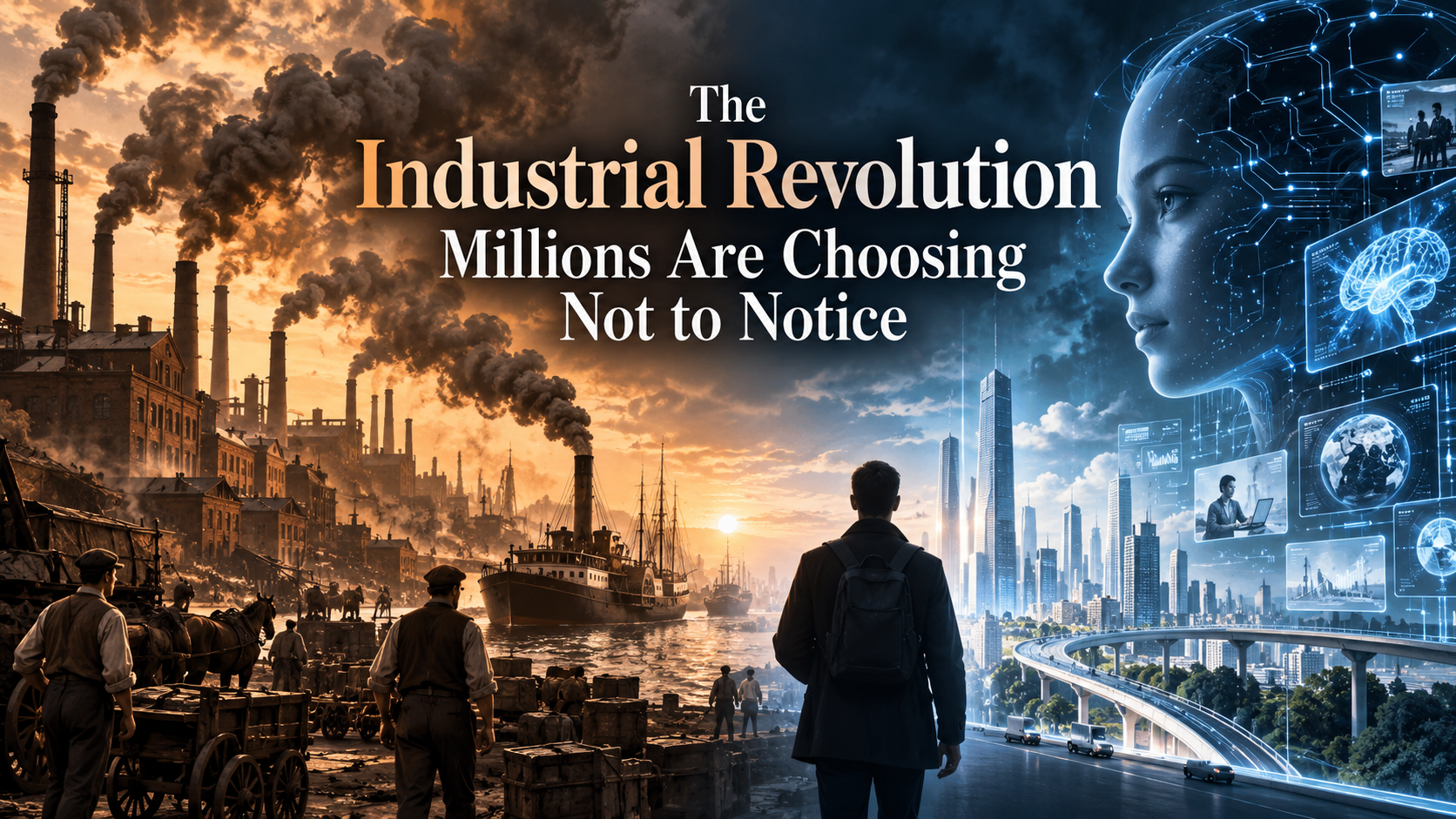
And that is why the scale of the change looks less like the launch of another app and more like the beginning of another industrial revolution.
The original Industrial Revolution allowed machines to multiply physical labor. The internet radically reduced the cost of distributing information. AI is now beginning to reduce the cost of producing intellectual output itself: writing, analysis, software, design, research, automation, marketing, translation, prototypes and decisions.
Work that once required a specialist, or even a small team, can in many cases now be produced in hours instead of weeks, and sometimes in minutes instead of hours.
That does not mean specialists are becoming unnecessary.
In many cases, the opposite is true. A strong professional using AI can become dramatically more capable.
But something more uncomfortable is also happening: the old level of competence is becoming cheaper.
If someone was once paid simply because they could perform a certain technical task, and a machine can now perform a large portion of that task, the market begins to redefine what counts as valuable professional skill.
Software development is one of the clearest examples.
Not long ago, building a simple application, an internal CRM, a small automation system or a basic game almost automatically meant finding a developer. Today, someone without a traditional engineering background can already build a working prototype, and sometimes much more, by using AI as a technical partner.
That does not make that person a software engineer, just as owning a calculator does not make someone a mathematician.
But calculators changed which kinds of arithmetic were worth paying a human to perform.
AI is doing something similar, only across a much wider field.
This is why the question “Will AI replace programmers?” is too simplistic.
The more important question is not whether an entire profession disappears. It is which parts of the work inside that profession stop being worth what they were worth before.
The same process is beginning to appear in marketing, legal work, design, analytics, customer support, translation, education and many other fields.
There is an almost ironic historical example.
In Russia during the 2000s, legal education became extremely popular. The number of people with law degrees increased dramatically.
That did not automatically create an independent judiciary, stronger rule of law or a corruption-free society.
Because widespread access to a profession or an instrument does not guarantee the quality of the result.
The same will be true of AI.
The fact that millions of people now have access to powerful intellectual tools does not mean millions of people will automatically become smarter, more educated or more productive.
But those who learn to use these tools well will gain an enormous advantage.
That is where the paradox begins.
Education has never been more accessible.
When the internet arrived, it seemed that knowledge had finally become almost free. Then YouTube made it possible to spend an evening watching a university lecture, learning how to repair an engine, use Photoshop or understand the basics of personal finance.
AI takes that accessibility one step further.
Now you do not even have to find the perfect tutorial. You can ask a question, ask for a simpler explanation, request another example, generate exercises, test yourself and continue the conversation for as long as you need.
It is something close to having a personal tutor available twenty-four hours a day.
But access to education still does not guarantee education.
You can own a library and never open a book. You can have access to the entire internet and use it only for entertainment. You can have AI and use it only to write a caption for a photograph.
Technology creates possibility. It does not force anyone to use it.
That is why so many people continue to live as if nothing significant is happening.
Businesses continue running old processes. Managers still hire people for tasks that can already be partially automated. Employees manually perform work that could be accelerated several times over. Entrepreneurs think about advertising, sales, customer support and internal operations in much the same way they did five years ago.
Yet almost every business should now be asking a simple question on a regular basis:
What are we doing today that AI could help us do faster, cheaper or better?
How could it help us find customers? How could it reduce repetitive work? How could it accelerate sales, analyze information, improve service or make employees more productive?
The goal does not have to be replacing people.
Sometimes making one person twice as productive is enough to change the economics of a business.
None of this means AI should become a religion.
It makes mistakes.
It can produce incorrect information with great confidence. It can write bad code. It can misread a medical symptom, a legal problem or a financial situation.
Professionals are not disappearing.
A doctor remains a doctor. An engineer remains an engineer. A psychologist remains a psychologist. A developer remains a developer.
But every one of them now has access to a tool capable of increasing the speed and volume of what they can do.
AI will not plant a tree in your yard.
It will not physically repair a broken air conditioner.
It will not milk a cow.
It will not bake bread in place of a baker.
But perhaps that was never the point.
The steam engine did not replace human beings in every form of work either. What it changed was the cost and scale of the processes to which it could be applied.
AI is beginning to do the same thing to intellectual work.
And we are still near the beginning.
There is also another unresolved question: what will all of this cost?
Right now, access to AI can feel almost absurdly cheap compared with the amount of work it can perform. But that economics is not settled.
Models are becoming more capable. Computing power is expensive. Companies are experimenting with pricing, limits and subscription structures. We are already seeing signs that access to the most capable models and deeper levels of reasoning may become more expensive, even while competition pushes prices in the opposite direction.
Will AI be cheaper ten years from now?
Or will the best systems become expensive infrastructure, with meaningful access reserved for companies and individuals willing to pay much more?
Nobody knows.
And anyone who truly does know probably has little incentive to tell the rest of us yet.
What is already clear is that the process has begun.
The technology exists. Millions of people and companies are already using it. Competition is no longer limited to a small group of American laboratories. Chinese developers, open-source projects and open-weight models are putting increasing pressure on the market and making it less likely that powerful intellectual tools will remain the exclusive property of a few corporations.
And once again, the pattern begins to resemble earlier technological revolutions.
At the beginning, there are always people who see opportunity.
There are people who see threat.
And there are enormous numbers of people who simply continue moving by inertia, sometimes for years, until one day they realize that the familiar world is no longer there.
That may be exactly what is happening with artificial intelligence.
We can still argue about how quickly it will develop, which professions will change the most, how expensive the best models will become, and what limits will eventually be placed on the technology.
But it is becoming increasingly difficult to argue with the central fact:
the change has already begun.
And perhaps the greatest danger is not overestimating AI, and not even fearing it too much.
The greater danger is ignoring processes already underway that are comparable in scale to a true industrial revolution — only unfolding on an entirely different level.