
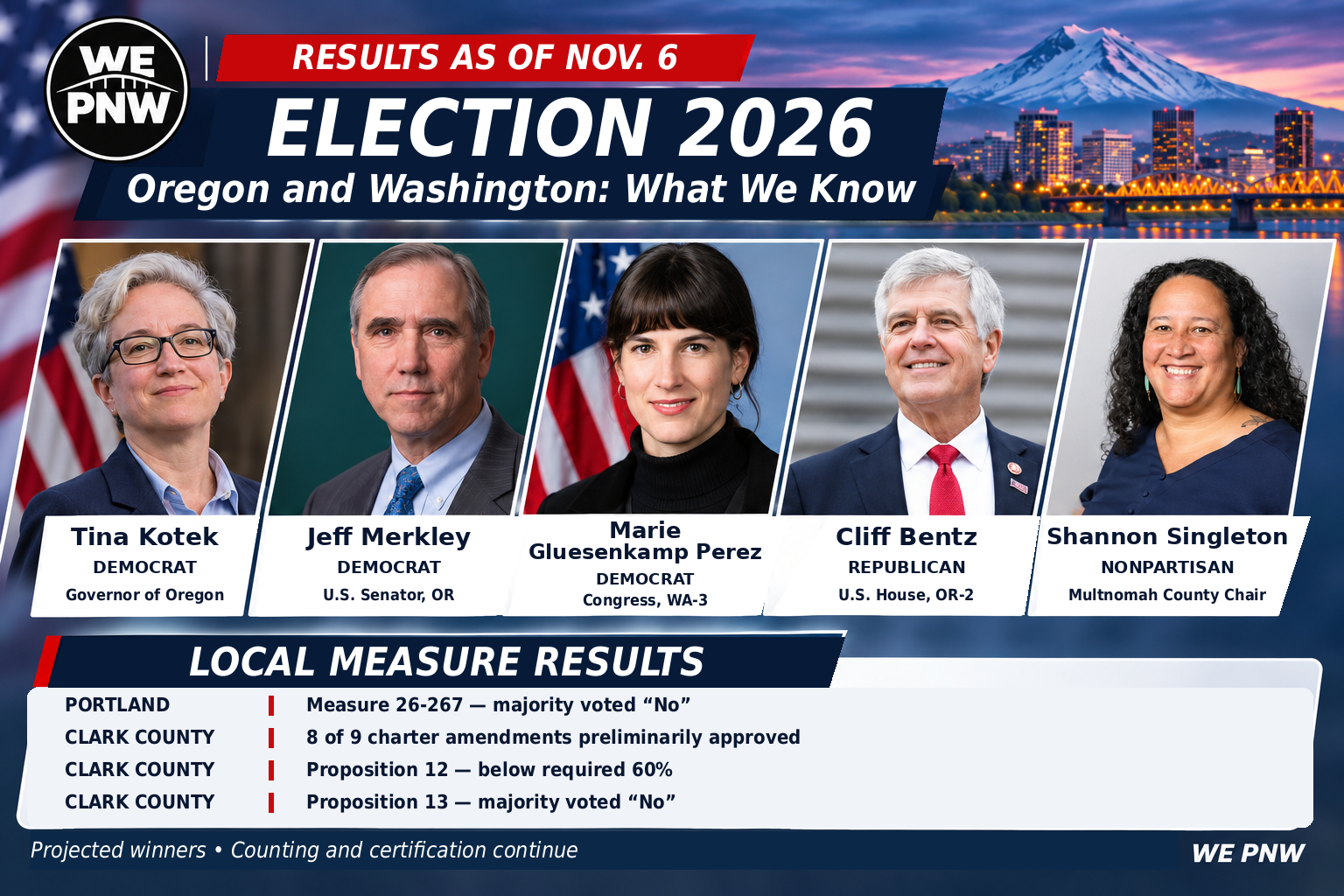
PORTLAND, Ore. / VANCOUVER, Wash. — November 6, 2026.
Three days after the November 3 midterm elections, the political landscape across Oregon and Southwest Washington is becoming clearer.
Many of the region's incumbent elected officials have retained their positions. Democrats won Oregon's gubernatorial and U.S. Senate races, along with Washington's 3rd Congressional District. Republican Cliff Bentz, meanwhile, secured another term representing Oregon's largely rural 2nd Congressional District.
Multnomah County voters also chose a new leader. Shannon Singleton defeated Julia Brim-Edwards in the race for county chair and will replace Jessica Vega Pederson.
Beyond the candidates, voters made decisions on several ballot measures with potentially significant consequences for local government.
In Clark County, preliminary results show voters approving eight of nine proposed amendments to the county's Home Rule Charter. The measures address term limits, government accountability, budgeting procedures, taxation, housing development and independent performance reviews.
Two separate proposals to finance jail improvements and public safety operations appear unlikely to pass.
Portland voters, meanwhile, rejected Measure 26-267, which would have allowed residents to help determine how 2% of the city's annual discretionary budget was spent.
WE PNW examines the election results, the political differences behind several key races, and what the outcomes could mean for residents and businesses across the Pacific Northwest.
Tina Kotek Wins a Second Term as Oregon Governor
Democratic Party | Governor of Oregon
Oregon Gov. Tina Kotek has won reelection, defeating Republican challenger Christine Drazan in a rematch of their 2022 gubernatorial contest.
According to preliminary results reported by Oregon Public Broadcasting, Kotek received approximately 51.9% of the vote, compared with 45.3% for Drazan.
Oregon governors serve four-year terms. Kotek's victory gives her another term leading the state's executive branch.
What the Result Means for Oregon
The race was largely a referendum on the performance of Kotek's administration.
Oregon continues to face several major challenges, including the high cost of housing, homelessness, education outcomes and economic development.
During her campaign, Kotek emphasized expanding housing production, maintaining social services and improving the effectiveness of state government.
Drazan offered a different approach, calling for fewer regulatory barriers, faster housing development and greater scrutiny of government spending.
Kotek's victory signals continuity in Oregon's political leadership, but it does not mean every existing policy will remain unchanged.
During her second term, the governor will have opportunities to propose new budgets, make appointments and advance legislative priorities. Whether those proposals become law will depend on the Oregon Legislature and available funding.
For Portland residents, some of the most important issues to watch will be affordable housing, homelessness services, behavioral health programs and economic development.
Source: Oregon Public Broadcasting — Elections 2026
Jeff Merkley Wins Another Six Years in the U.S. Senate
Democratic Party | U.S. Senator from Oregon
U.S. Sen. Jeff Merkley has secured another six-year term after defeating Republican David Brock Smith.
Merkley is not returning to the Senate after an absence. He has continuously represented Oregon in the chamber since January 2009.
According to official preliminary election results available November 6:
- Jeff Merkley: 994,222 votes, approximately 57.4%.
- David Brock Smith: 684,962 votes, approximately 39.5%.
The remaining votes went to other candidates and write-in choices.
Why This Race Matters
The U.S. Senate plays a central role in federal lawmaking, confirming presidential appointments and considering international treaties.
Merkley's reelection comes as Democrats have secured majorities in both chambers of the incoming Congress.
The new Congress will begin its term in January 2027.
That shift could change committee leadership, legislative priorities and congressional oversight of federal agencies.
For Merkley, the new political balance may create additional opportunities to influence debates over federal spending, healthcare, social programs and other national policies.
However, Democratic control of Congress does not guarantee that every legislative proposal will become law.
President Donald Trump will retain his veto authority, and Senate procedural rules can still create substantial obstacles to passing legislation.
Source: Oregon Secretary of State — Federal Election Results
Marie Gluesenkamp Perez Wins Again in a Congressional District That Backed Trump
Democratic Party | U.S. House of Representatives | Washington's 3rd Congressional District
Democratic Rep. Marie Gluesenkamp Perez has won reelection to the U.S. House of Representatives, defeating Republican challenger John Braun.
Perez first won the seat in 2022, held it in 2024 and has now secured a third two-year term.
According to official preliminary results reported on the morning of November 6:
- Marie Gluesenkamp Perez: 176,744 votes, or 53.62%.
- John Braun: 149,916 votes, or 45.48%.
For Vancouver and Southwest Washington, this is one of the election's most consequential results.
Washington's 3rd Congressional District includes Clark County and other communities across the southwestern part of the state.
The district encompasses urban neighborhoods, growing suburbs, smaller communities and rural areas.
Its political makeup is particularly notable because voters supported Republican Donald Trump in the 2024 presidential election but have repeatedly elected Perez, a Democrat, to Congress.
A District Divided Along Geographic Lines
Voting patterns vary significantly across the district.
In Clark County, Perez received approximately 59.3% of the vote, compared with 39.8% for Braun.
In Lewis County, the outcome was almost the opposite. Braun received approximately 63.1%, while Perez won about 36.3%.
These differences illustrate the political diversity of Southwest Washington.
The voting preferences of Vancouver residents do not necessarily reflect those of smaller communities and rural areas elsewhere in the district.
Why Has Perez Been Able to Win Repeatedly?
Perez is a co-owner of an auto repair business, a background that has helped shape her political identity.
Throughout her congressional career, she has emphasized skilled trades, vocational education, small businesses, manufacturing and the economic concerns of working families.
Although she votes with Democrats on many issues, she has also taken positions that depart from the party's majority.
Her political approach has included appealing to voters who do not necessarily identify with the Democratic Party in presidential elections.
That crossover appeal may help explain her repeated victories in a competitive district.
However, election percentages alone cannot establish precisely why individual voters supported her. A fuller explanation would require additional analysis of voter behavior, campaign issues and turnout.
What Could Change for Southwest Washington?
Perez will continue representing the 3rd Congressional District in Washington, D.C.
For Vancouver and surrounding communities, her work on infrastructure, manufacturing, workforce development, federal funding and small-business policy will remain especially relevant.
The new balance of power in Congress may change the political environment in which she operates.
But reelection does not automatically bring additional federal funding to the district or guarantee the passage of new legislation.
Source: Washington State — Official Preliminary Results, 3rd Congressional District
Cliff Bentz Holds Oregon's Republican Stronghold
Republican Party | U.S. House of Representatives | Oregon's 2nd Congressional District
Republican Rep. Cliff Bentz has won another term in the U.S. House of Representatives.
Bentz represents Oregon's 2nd Congressional District, a vast territory covering much of the state's eastern and southern regions.
Preliminary results show:
- Cliff Bentz: 186,793 votes, approximately 61.6%.
- Chris Beck, Democrat: 116,131 votes, approximately 38.3%.
Bentz will retain his seat for another two-year term.
What His Victory Says About Oregon
The result highlights the political differences within Oregon.
Portland and several other urban communities strongly favor Democratic candidates. In many rural areas of eastern and southern Oregon, Republicans maintain a significant advantage.
Bentz represents a district where agriculture, forestry, water rights, energy policy and access to federal lands are particularly important.
With Republicans set to become the minority party in the incoming House of Representatives, Bentz will have less influence over committee leadership and the overall legislative agenda.
He will nevertheless retain the ability to introduce legislation, participate in congressional debates and advocate for his district's interests.
His victory underscores a fundamental political reality: Oregon is not a politically uniform state.
Source: Oregon Secretary of State — U.S. House Election Results
Shannon Singleton Elected Multnomah County Chair
Nonpartisan Office | Multnomah County Chair
Shannon Singleton has won the race for Multnomah County chair.
Her leading opponent, Julia Brim-Edwards, conceded the election on the evening of November 5.
Following the ranked-choice vote redistribution process, preliminary results showed Singleton receiving approximately 57% of the vote, compared with about 42% for Brim-Edwards.
Sharon Meieran also participated in the race.
Unlike many state and federal contests, the Multnomah County chair election is officially nonpartisan.
Candidates do not appear on the ballot with Democratic or Republican party labels.
However, all three candidates in this race were registered Democrats.
Different Approaches to County Government
The central disagreements in the campaign concerned government management, public spending and the delivery of social services.
Singleton emphasized improving coordination among service providers, reducing duplicated efforts and connecting housing assistance with addiction treatment and other support programs.
Brim-Edwards focused more heavily on management accountability, financial oversight and evaluating the effectiveness of organizations receiving public money.
Meieran advocated broader structural changes to the county's social service system.
As a result, the campaign was less about conventional partisan differences and more about competing approaches to managing public resources.
What Could Change Under Singleton?
Multnomah County oversees major public programs involving healthcare, homelessness, addiction treatment, social services and other essential functions.
The county chair plays a central role in developing its multibillion-dollar budget and directing administrative operations.
Singleton will replace outgoing Chair Jessica Vega Pederson.
Her election creates an opportunity to reconsider spending priorities, improve coordination between departments and change how some county programs are managed.
The extent of those changes will depend on future budget decisions, the Board of County Commissioners and the incoming administration.
Although Brim-Edwards has conceded, the election results have not yet completed official certification.
Source: Oregon Public Broadcasting — Shannon Singleton Wins Multnomah County Chair Race
Portland City Council: Incumbents Positioned to Retain Their Seats
Portland voters selected six members of the City Council, with three seats contested in District 3 and three in District 4.
Preliminary results showed all six incumbents maintaining their leads, and several local news organizations have called the races in their favor.
In District 3, the leading candidates were:
- Steve Novick
- Tiffany Koyama Lane
- Angelita Morillo
In District 4, they were:
- Olivia Clark
- Mitch Green
- Eric Zimmerman
Portland uses ranked-choice voting, a system that allows voters to rank candidates by preference.
During the counting process, votes may be redistributed according to established rules until the winning candidates are determined.
What This Means for City Government
If the results hold, all six incumbent council members will retain their positions.
That would provide continuity in the council's membership, although it would not guarantee that city policies remain unchanged.
The council will continue making decisions on taxes, housing development, transportation, public safety, municipal services and the city budget.
The election determines who will participate in those decisions, not how future council votes will turn out.
Source: Multnomah County Elections — Portland Ranked-Choice Voting Results
Portland Voters Reject Proposal to Give Residents Control Over Part of the City Budget
One of Portland's most closely watched local ballot measures was Measure 26-267, Community Budgeting for All.
The proposal would have designated 2% of the city's annual discretionary budget for projects selected by residents through a participatory budgeting process.
In practical terms, it would have created a formal mechanism allowing community members to help decide how a portion of city funds should be spent.
According to preliminary results available after November 5, approximately 64% of voters opposed the measure.
If those results are confirmed, Measure 26-267 will fail.
What Happens Next?
The proposed requirement to allocate a portion of the city's discretionary budget through participatory budgeting will not be added to Portland's charter.
However, residents will still have other ways to participate in public budget discussions, communicate with City Council members and advocate for local projects.
Source: City of Portland — November 2026 Election Measures
Clark County Voters Back Eight of Nine Proposed Charter Amendments
In Clark County, home to Vancouver and several growing Southwest Washington communities, voters considered nine proposed amendments to the county's Home Rule Charter.
The charter establishes the basic structure of county government and defines important rules governing its officials and administrative operations.
Preliminary results show eight amendments receiving majority support, while one is headed toward rejection.
The proposals address a wide range of issues, from term limits and tax decisions to housing development and government accountability.
Amendment No. 19: Term Limits for County Council Members
Approximately 82% of voters supported limiting members of the Clark County Council to three consecutive terms.
After serving three consecutive terms, a council member would be required to sit out one full four-year term before becoming eligible to serve again.
The proposal does not create a lifetime ban on holding office. Instead, it limits how long an individual can remain in the position without interruption.
Amendment No. 20: Earlier Budget Preparation
Approximately 72% of voters supported changes to the county's budget calendar.
The amendment would require budget documents to become available earlier, giving residents more time to review proposed spending and participate in public discussions.
Amendment No. 21: Expanded Council Authority Over Appointments
Approximately 69% of voters supported giving the County Council a greater role in nominating candidates for boards, commissions and advisory bodies.
The council would share certain nomination powers with the county manager, subject to specified exceptions.
Amendment No. 22: Changes to Nonpartisan Election Procedures
Approximately 62% of voters supported clarifying the rules governing nonpartisan county elections.
Under certain circumstances, when no more than two candidates seek a position, a separate primary election may not be required.
Amendment No. 23: Annual County Manager Reporting
Nearly 87% of voters supported requiring the county manager to publish an annual report on county government finances and operations.
Among the nine proposed charter amendments, this measure received the highest level of support in the preliminary results reviewed.
The requirement would establish an additional mechanism for public accountability and access to information about county operations.
Amendment No. 24: Housing Impact Analysis
Approximately 65% of voters supported requiring a Housing Impact Analysis for certain proposed regulatory changes.
The analysis would examine how new rules could affect housing development, including building density, permit requirements, parking regulations and construction costs.
The measure would not automatically approve new housing projects.
Instead, it would require county officials to consider potential housing consequences before adopting certain policies.
Amendment No. 25: Higher Voting Threshold for Certain Tax Decisions
Approximately 62% of voters supported requiring a two-thirds supermajority of the County Council to approve certain tax decisions.
The Clark County Council has five members.
That means some decisions that previously could have passed with three votes would require at least four.
Importantly, the requirement would not apply to every tax, fee or government charge without exception.
The amendment establishes a defined scope for the higher voting threshold.
If approved following certification, the new requirement is scheduled to take effect in January 2027.
Amendment No. 26: Changes to Citizen Initiatives — Voters Say No
This was the only charter amendment that failed to receive majority support.
Approximately 59% of voters opposed the proposed changes to the county's citizen initiative and referendum procedures.
The proposal included reducing the required signature threshold from 10% to 8%, along with changes to certain signature verification procedures.
If the preliminary results hold, the existing rules will remain in place.
Amendment No. 27: Independent Performance Reviews
Approximately 62% of voters supported additional mechanisms for reviewing county government operations.
The proposal goes beyond traditional financial audits.
Performance reviews would evaluate whether county programs achieve their stated objectives and use public resources effectively.
Such evaluations could give elected officials and residents additional information about the results of government spending.
When Will the Amendments Take Effect?
All nine results remain preliminary.
Clark County is scheduled to certify the November election results on November 24, 2026.
If approved, the charter amendments will take effect according to the county charter and any implementation dates specified in the individual proposals.
WE PNW has published a separate detailed examination of all nine measures:
Clark County: Eight of Nine Charter Amendments Gain Voter Support (Russian-language coverage)
Official source: Clark County Elections — November 2026 Results
Clark County Jail Funding: A Majority Votes Yes, but the Proposal May Still Fail
One of Clark County's most consequential ballot measures concerned financing for major jail and public safety improvements.
Proposition 12 asked voters to authorize up to $366.2 million in bonds for the construction and renovation of public safety and criminal justice facilities.
Preliminary results show approximately 52.3% of voters supporting the proposal.
However, the measure requires at least 60% approval, along with other applicable legal requirements.
That means a simple majority in favor is not enough for Proposition 12 to pass.
If the final vote remains below the required threshold, county officials will not receive authorization to issue the proposed bonds under this measure.
The result would leave county leaders facing unresolved questions about the future of the jail improvement project, including construction costs and the condition of existing facilities.
Proposition 13 addressed a different aspect of criminal justice and public safety funding.
It proposed additional revenue for staffing and ongoing operations.
According to preliminary results, approximately 52.8% of voters opposed the measure.
If the outcome holds, the proposed tax increase will not take effect.
WE PNW previously examined the county's jail reconstruction plans and the questions surrounding their cost, capacity and long-term implications.
Source: Clark County Elections — November 3, 2026 General and Special Election
Washington State: Voters Decide on Taxes, School Sports and Parental Rights
Beyond local elections, Washington voters considered three statewide initiatives addressing taxation, education and participation in school athletics.
Initiative 645: Tax on High-Income Households
The proposal sought to repeal a tax affecting households with annual incomes exceeding $1 million.
Preliminary results show approximately 57.6% of voters opposing the repeal.
If the results are confirmed, the tax will remain in place.
Initiative 638: Participation in School Sports
A majority of voters supported an initiative restricting participation by transgender girls in certain girls' school athletic programs.
The proposal also includes sex-verification requirements for covered competitions.
The Associated Press has called the result, although official certification has not yet taken place.
The measure's implementation and practical consequences will require further examination.
Initiative 001: Parental Rights in Public Schools
The initiative proposed changes to rules governing parents' access to certain information about their children's education and school programs.
Preliminary results indicate approximately 52% of voters opposed the measure.
These initiatives affect Washington residents statewide, not only those living in Clark County.
Sources: Washington Secretary of State — 2026 Ballot Measures and The Spokesman-Review — Statewide Election Results
A New Balance of Power in Congress
Nationally, Democrats have won majorities in both chambers of the incoming U.S. Congress: the House of Representatives and the Senate.
But the new Congress has not yet taken office.
Members elected in November will begin their new terms in January 2027. Until then, the current Congress remains in session.
President Donald Trump will remain in the White House, retaining the constitutional powers of the executive branch.
Once the new Congress is seated, the change in party control could affect committee leadership, legislative priorities and congressional oversight of federal agencies.
For Oregon and Washington, these changes may be important to future debates over infrastructure funding, healthcare, public assistance, immigration policy and federal spending.
However, the election results do not determine in advance which legislation will ultimately become law.
Why Are Winners Being Announced Before Every Ballot Is Counted?
Oregon and Washington rely heavily on voting by mail.
Election offices continue processing ballots after Election Day, including verifying signatures, counting eligible ballots, conducting required checks and preparing official results.
News organizations may project winners before certification when the available results and remaining vote totals make the outcome sufficiently clear.
But a projected election victory and official certification are two different things.
Clark County is scheduled to certify its results on November 24, while Multnomah County is expected to complete certification no later than November 30.
Continuing to count ballots after Election Day is a normal part of the process. It does not, by itself, indicate wrongdoing or irregularities.
Five Key Takeaways for the Pacific Northwest
1. Oregon's State Leadership Remains Largely Unchanged
Tina Kotek has secured a second term as governor, while Jeff Merkley will continue representing Oregon in the U.S. Senate.
Their victories provide continuity in state and federal representation, although future policy decisions will depend on legislative priorities and political circumstances.
2. Southwest Washington Has Again Elected a Democrat to Congress
Marie Gluesenkamp Perez has won another term representing a district that supported Donald Trump in the 2024 presidential election.
Her victory highlights the complex political preferences of Southwest Washington, where urban and rural communities often vote very differently.
3. Eastern Oregon Remains a Republican Stronghold
Cliff Bentz's reelection demonstrates the continuing strength of Republican candidates in large parts of rural Oregon.
The result also illustrates why statewide voting patterns do not always reflect political preferences in individual regions.
4. Multnomah County Will Have New Leadership
Shannon Singleton's election marks a leadership transition in one of Oregon's most influential local governments.
Her administration will have an opportunity to reshape priorities involving homelessness, public health, social services and county spending.
5. Local Ballot Measures May Have Long-Term Consequences
Voters in Clark County and Portland have weighed in on decisions affecting taxation, government oversight, budget procedures, housing policy and public spending.
Some of these decisions could influence how local governments operate for years to come.
What Happens Next?
With many of the major races decided, attention will gradually shift from election results to the actions of newly elected and returning officials.
The real consequences of the 2026 election will become clearer as leaders make decisions about housing construction, schools, taxes, transportation, business development, public safety and the delivery of government services.
Election victories determine who holds office. They do not automatically resolve the issues that voters expect elected officials to address.
WE PNW will continue following the certification process and tracking how election outcomes translate into policy decisions across Oregon and Washington.
WE PNW
Updated November 6, 2026. Numerical election results are preliminary unless otherwise stated. Projected victories do not constitute official certification.