PORTLAND, Ore. / VANCOUVER, Wash. - November 3, 2026
America votes today. There is no presidential race on the ballot, but the results could reshape Congress, determine Oregon's next governor and influence decisions much closer to home.
For residents of Portland and Vancouver, Election Day is about more than national politics. It includes questions about property taxes, public safety, local budgets, housing policy and who will make decisions on behalf of their communities.
And here's an interesting detail: Portland isn't electing a mayor today. Instead, voters in two of its four council districts are choosing six representatives from a field of 33 candidates.
Across the Columbia River, Clark County voters are considering whether to authorize more than $366 million in borrowing for jail expansion and other criminal justice facilities.
The two cities share a metropolitan region, but their residents are voting under different state laws, with different candidates and local measures.
Why are these elections called the midterms?
Americans elect a president every four years, but congressional elections take place every two years.
All 435 seats in the U.S. House of Representatives are up for election every two years. About one-third of the Senate is also elected during each regular election cycle.
When congressional elections fall halfway through a president's four-year term, they are known as midterm elections.
The results can change which party controls either chamber of Congress, affecting the legislative agenda, federal spending negotiations and oversight of the executive branch.
But some of the most immediate questions facing Pacific Northwest residents aren't being decided in Washington, D.C.
They're being decided in Vancouver, Portland and the counties surrounding them.
Vancouver: Who will represent Southwest Washington in Congress?
One of the region's most closely watched congressional contests is in Washington's 3rd Congressional District.
The race features incumbent Democratic Rep. Marie Gluesenkamp Perez and Republican John Braun.
Gluesenkamp Perez was first elected to Congress in 2022. Before entering federal politics, she was involved in operating an automotive repair business. Her work in Congress has emphasized vocational education, skilled trades, small businesses and economic issues affecting working families.
Braun is a Washington state senator, a former U.S. Navy officer and a manufacturing business executive. His campaign has emphasized the cost of living, taxes, economic regulation and domestic manufacturing.
Both candidates discuss economic pressures facing the region, though their approaches to taxes, regulation and federal policy differ.
Source: Washington's 3rd Congressional District - 2026 election information
A district where presidential and congressional results don't always match
Washington's 3rd District offers an unusual example of how voters can make different decisions in different races.
In 2024, Gluesenkamp Perez won reelection to Congress with about 51.7% of the vote, while Donald Trump carried the same congressional district in the presidential election with approximately 50.3%.
In other words, voters in the district chose a Democratic representative for Congress while giving a Republican presidential candidate a majority.
That doesn't tell us who will win today. It does illustrate why a congressional race cannot be understood solely through presidential voting patterns.
What could change?
The winner will represent Southwest Washington in the U.S. House of Representatives and participate in federal lawmaking.
Congress deals with taxes, immigration legislation, federal spending, health care, infrastructure and other national issues.
But an individual House member cannot change those policies alone. The eventual effects will depend on the composition of Congress, the legislative process and actions taken by the president.
Clark County: Two major public safety proposals
For Clark County residents, some of the biggest financial questions on the ballot are local.
Two separate propositions concern the county's criminal justice system.
Together, they address two different needs: buildings and infrastructure on one hand, and staffing and operating expenses on the other.
Proposition 12: More than $366 million for criminal justice infrastructure
Proposition 12 would authorize Clark County to issue up to $366,204,000 in general obligation bonds.
The money would be used for public safety and criminal justice facilities, including:
- Remodeling and expanding the existing county jail
- Adding or improving courtrooms
- Building or renovating Sheriff's Office headquarters
- Related criminal justice infrastructure
The bonds could mature over a period of up to 31 years and would be repaid through additional property taxes.
According to Clark County's published estimate, the cost for a property assessed at $550,000 would be approximately $86 per year, or about $7.17 per month.
That figure is an illustration based on the county's assumptions, not a fixed amount for every property owner.
Source: Clark County - Jail Expansion FAQs
Proposition 13: Paying for staff and services
Proposition 13 addresses a different issue.
Rather than funding construction, it would allow the county to increase its regular property tax levy limit for public safety and criminal justice services.
The proposal authorizes a maximum 2027 regular property tax levy of $1.15 per $1,000 of assessed property value, approximately 44 cents higher than the 2026 rate.
The revenue would support services such as corrections staffing, sheriff's deputies, prosecuting attorney personnel and other criminal justice operations.
The county estimates an additional annual cost of approximately $242 for a home assessed at $550,000, or about $20.17 per month.
Actual taxes depend on the applicable assessed value, tax rules and exemptions.
Source: Clark County - Propositions 12 and 13
Why are there two propositions?
Because constructing or renovating facilities and operating them require different funding arrangements.
Proposition 12 concerns capital investment, while Proposition 13 addresses staffing and operational services.
Clark County has explained that the bond-funded expansion depends on having a viable operating plan for the expanded facility.
The proposals are separate ballot questions, so voters can make different decisions on each.
The county presents the measures as responses to infrastructure and staffing needs. Questions about taxation, the scale of the project and competing spending priorities are also central to the public discussion.
The final decision belongs to voters.
Who will govern Clark County?
Clark County voters are also choosing members of the County Council and several countywide administrative officials.
County Council members help shape decisions about county spending, land use and local government programs.
Other offices on the ballot carry responsibilities that may be less visible but have direct practical consequences.
The County Assessor determines property values for taxation purposes. The County Auditor performs administrative duties that include election administration. The County Clerk maintains court records and supports the judicial process.
The specific races appearing on an individual's ballot depend on where that voter lives.
Clark County voters are also considering charter amendments and other local measures.
Official Clark County Election Guide
Portland: 33 candidates for six City Council seats
Portland's City Council elections are among the more distinctive contests in the region.
Under the city's newer form of government, Portland is divided into four council districts, each represented by three councilors.
Only Districts 3 and 4 are electing councilors this year.
Each district will choose three representatives for four-year terms.
District 3: 21 candidates
The field includes three incumbent councilors: Tiffany Koyama Lane, Angelita Morillo and Steve Novick.
Other candidates include John Sweeney, Ali Beaudoin, Kellie Torres, Cristal Otero and additional challengers.
District 4: 12 candidates
Incumbent councilors Mitch Green, Olivia Clark and Eric Zimmerman are seeking reelection.
Other candidates include Eli Arnold, Matt Schulte, Jeremy Beausoleil Smith, John J. Goldsmith and additional candidates.
The complete certified list contains 21 candidates in District 3 and 12 in District 4.
Official City of Portland Candidate List
Portland is also electing its City Auditor
City Auditor Simone Rede is the only candidate listed on the ballot for that position.
Unlike City Council races, which are limited to voters in the relevant districts, the auditor is elected citywide.
The Auditor's Office conducts independent oversight functions, including audits of city government operations.
Why isn't Portland electing a mayor?
Portland's elected positions operate on staggered terms.
The mayor and councilors from Districts 1 and 2 were elected to four-year terms in 2024.
The auditor and councilors in Districts 3 and 4 were elected to initial two-year terms, putting those positions on the ballot again in 2026. Winners of these races will serve four-year terms.
Source: City of Portland - District-Based Voting
What makes Portland's voting system different?
Portland uses ranked-choice voting.
Rather than selecting only one candidate, voters can rank candidates in their order of preference.
In the city's multi-member council districts, votes are counted using a proportional ranked-choice process designed to fill three seats.
The system can require multiple rounds of counting, depending on how preferences are distributed.
Multnomah County says voters may rank up to six candidates, but they are not required to use every ranking.
The same general ranked-choice principle is used for single-winner contests, although the method of determining the winner differs from the procedure used to fill multiple seats.
Source: Multnomah County - Ranked-Choice Voting FAQs
Measure 26-267: Should Portland residents control part of the city budget?
Portland voters are also deciding Measure 26-267, known as Community Budgeting for All.
The measure asks whether Portland should establish a participatory budgeting program that allows residents to make binding decisions on spending 2% of the city's annual discretionary budget.
If the measure passes, the city would be required to establish the process described in the proposed charter amendment.
If it fails, the existing framework would remain unchanged.
The measure does not ask voters to approve a specific construction project, grant recipient or list of expenditures.
Instead, it addresses who would participate in decisions about a defined share of city spending.
Official Measure 26-267 Description
Multnomah County: Three candidates for chair
Another significant local race is for Multnomah County chair.
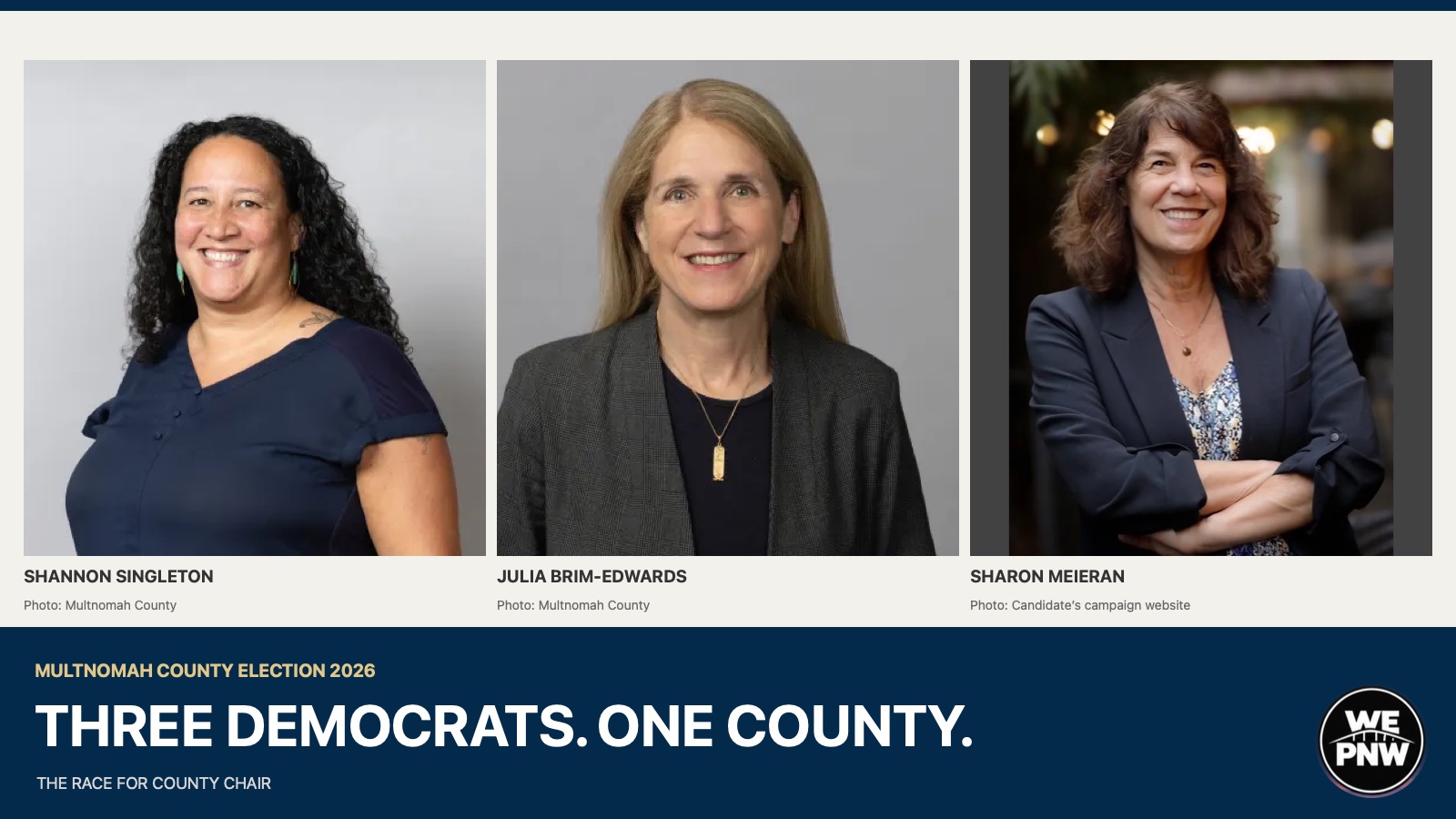
Three candidates are on the ballot:
Julia Brim-Edwards - a current county commissioner who previously served on the Portland Public Schools Board of Education.
Shannon Singleton - a current county commissioner with professional experience in housing, social work and mental health policy.
Sharon Meieran - an emergency physician and former county commissioner.
The election uses ranked-choice voting.
Multnomah County is also choosing a commissioner for District 2.
That race includes seven candidates: Bruce Broussard, Serena Cruz, Herman Greene, Nathan Ong Norris, Tony Robertson, Bri Williams and Nabil Zaghloul.
Multnomah County Candidate Filings
Why does county government matter?
Multnomah County plays a major role in public health, social services, housing-related programs and assistance for vulnerable residents.
County leadership influences budgeting, service delivery and policy implementation.
The outcome of these elections will determine who makes or oversees many of those decisions, although policy changes will still require subsequent official action.
Oregon chooses its governor
Unlike Washington, where the Southwest Washington congressional contest is a major regional focus, Oregon voters are also electing a governor this year.
Three candidates are on the statewide ballot:
Tina Kotek - the incumbent governor, nominated by the Democratic and Working Families parties.
Christine Drazan - the Republican and Libertarian nominee.
Brett Smith - the Pacific Green Party nominee.
Kotek and Drazan previously faced each other in the 2022 gubernatorial election.
Oregon's governor leads the executive branch, proposes budgets, signs or vetoes legislation, and oversees the implementation of state policy.
Housing, education, public safety, infrastructure and economic conditions are among the issues that can be affected by decisions made at the state level.
But a gubernatorial election does not, by itself, immediately change laws or state spending. Those changes depend on the governor's actions, the Legislature and other institutions.
Official Oregon Election Information
Oregon also elects a U.S. senator
Voters across Oregon are selecting one of the state's two U.S. senators.
The candidates are:
- Jeff Merkley - incumbent, Democratic and Working Families parties
- David Brock Smith - Republican Party
- Gary Lyndon Dye - Libertarian Party
- Chris Henry - Pacific Green and Progressive parties
Senators serve six-year terms, unlike House members, who face elections every two years.
The Senate participates in federal legislation, budget decisions, confirmation of many presidential appointments and other constitutional responsibilities.
Oregon U.S. Senate Candidate Guide
Five election facts worth knowing
1. No one is choosing a president today. But the elections could change the makeup of Congress for the next two years.
2. Portland has 33 candidates competing for six City Council seats. Only Districts 3 and 4 are electing councilors this year.
3. Clark County has two separate public safety funding questions. One covers infrastructure and borrowing, while the other addresses staffing and services.
4. Oregon has no statewide ballot measures in this election. Local measures, including Portland's Measure 26-267, still appear on ballots in the relevant jurisdictions.
5. Election night results are preliminary. Counting, verification and certification continue beyond November 3.
When does voting end?
Oregon and Washington both conduct their elections primarily by mail.
For official ballot drop boxes in both states, the deadline is 8:00 p.m. Pacific Time on Tuesday, November 3.
Mail ballots are subject to applicable postmark and receipt requirements.
In Vancouver, the Clark County Elections Office is located at:
1408 Franklin Street, Vancouver, WA
Oregon voters can find official voting instructions, ballot tracking information and drop box locations through the Secretary of State.
Oregon Secretary of State - Election Information
What happens after 8 p.m.?
Election offices will begin publishing unofficial results after voting closes.
But election night is not the end of the counting process.
Election officials continue processing eligible ballots, conducting required checks and completing certification procedures.
Clark County's certification is scheduled for November 24.
Multnomah County's certification is scheduled for November 30. Oregon's statewide certification is scheduled for December 10.
Early results may change as additional valid ballots are counted. WE PNW will distinguish official election data from candidate statements and campaign claims.
Multnomah County - November 3 General Election
So, what could actually change?
The answer depends on several elections taking place at different levels of government.
In Congress, the results could affect legislative priorities, oversight and federal spending decisions.
In Oregon, the governor's race will determine who leads the executive branch during the next term.
In Portland, voters will choose six councilors and decide whether to establish a new participatory budgeting process.
In Clark County, voters will decide whether to authorize borrowing for criminal justice infrastructure and a property tax increase for public safety services.
None of these outcomes guarantees an immediate change in housing costs, taxes, immigration law or the quality of public services. Meaningful changes generally require additional decisions, funding and implementation.
On November 3, Pacific Northwest voters are not choosing a single leader or deciding a single issue. They are making a series of decisions about representation, public spending and how government may operate in the years ahead.
That's why the midterms matter even to residents who rarely follow national politics.
WE PNW | NEWS | November 3, 2026
This article is based on official election materials from Oregon, Washington, Clark County, Multnomah County and the City of Portland, supplemented by publicly available candidate information. WE PNW does not endorse candidates, political parties or ballot measures in this report.
Information reflects the election as scheduled before polls close on November 3, 2026. Unofficial results and certified outcomes will be distinguished in subsequent coverage.