VANCOUVER, Wash. — October 30, 2026.
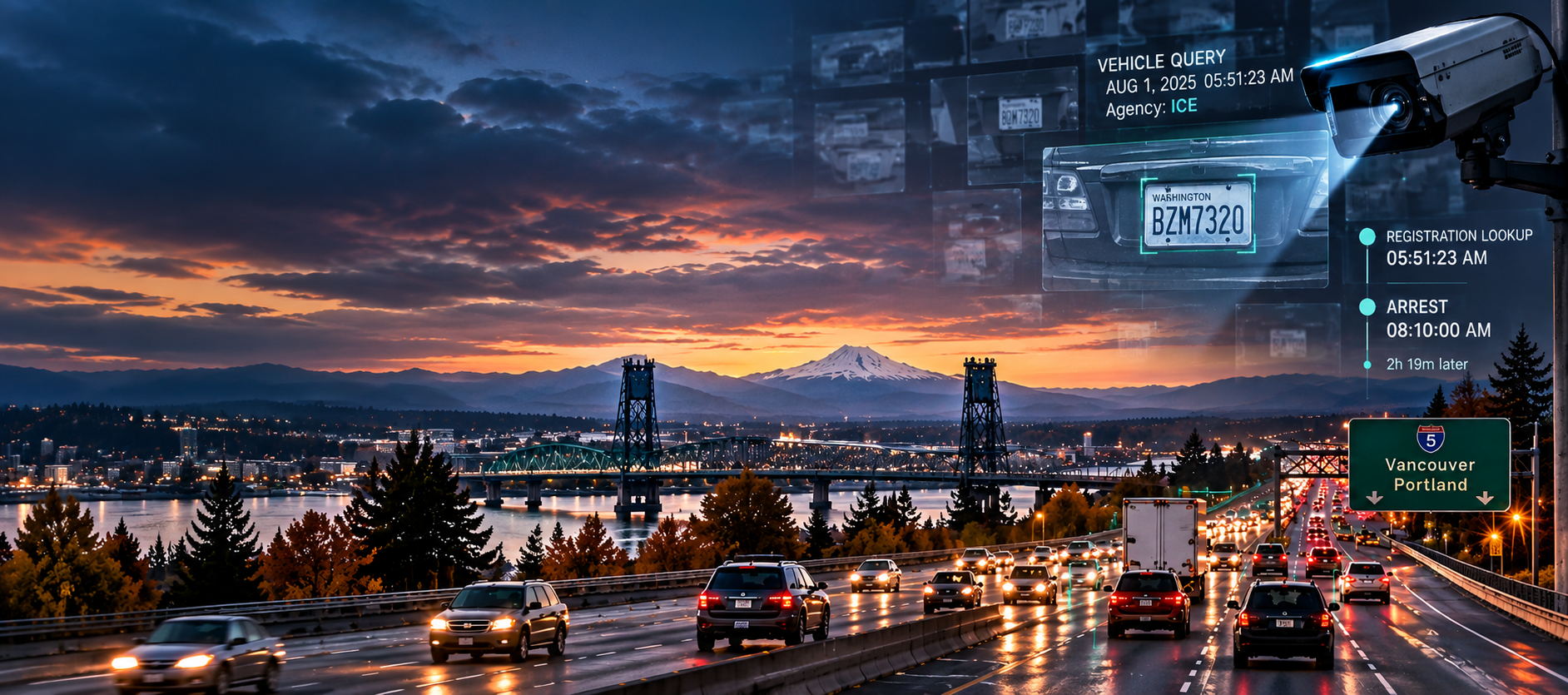
On August 1, 2025, at 5:51 a.m., an account associated with U.S. Immigration and Customs Enforcement (ICE) submitted a vehicle license plate query. At 8:10 a.m. that same day, a person whose vehicle registration information had been checked was arrested in Vancouver, Washington.
Just two hours and 19 minutes separated the two events.
This is one of seven cases identified by the University of Washington Center for Human Rights (UWCHR) in information provided directly to WE PNW in a written response dated October 29, 2026.
Three cases occurred in Vancouver, another in Battle Ground, and the remaining incidents in Woodland, Portland, and Gresham.
Researchers are examining how federal immigration agencies access vehicle registration information through Washington state's interagency data systems and how that information may be used in immigration enforcement operations.
In some of the documented cases, less than an hour separated a license plate query from an arrest. In others, several days passed.
However, the sequence of events alone does not establish that a license plate check revealed a person's location or directly led to an arrest. UWCHR researchers identified the connections by comparing available records.
The information provided to WE PNW adds specific local cases to a broader UWCHR investigation. According to the center's October 13, 2026 report, the U.S. Department of Homeland Security submitted more than one million queries involving Washington driver's license and vehicle registration data during the first five months of 2026.
That figure represents database queries, not one million people arrested.
Researchers also identified hundreds of immigration arrests they associated with vehicle information requests.
How extensively these practices have been used in Clark County, what role the queries played in individual arrests, and whether specific requests complied with state law remain questions requiring further investigation.
Three Cases in Vancouver
In its written response, UWCHR identified three incidents involving Vancouver, Washington.
August 1, 2025. According to the center, an ICE-associated account submitted a vehicle license plate query through the Nlets interagency network at 5:51 a.m. The individual was arrested at 8:10 a.m., approximately two hours and 19 minutes later.
January 6, 2026. Researchers reported that an account associated with U.S. Customs and Border Protection (CBP) checked a vehicle registration at 10:57 a.m. An arrest occurred approximately one hour later.
March 10, 2026. In a third case, researchers identified a vehicle registration query submitted through a CBP-associated account on March 4, six days before the arrest.
UWCHR also described an incident in Battle Ground dated December 2, 2025, involving a query through a CBP-associated account.
However, the information provided did not include the exact time of that query. As a result, the available description does not establish whether it preceded the arrest.
All four incidents were outlined in UWCHR's written response to WE PNW.
The newsroom has not yet obtained the complete underlying query logs and arrest records for those four cases.
It is also important to distinguish an agency-associated account from an individual officer. The account information does not establish who personally submitted the query or which officers carried out the arrest.
Likewise, identifying Vancouver or Battle Ground as the location of an incident does not establish that local police departments participated in the federal enforcement action.
How Federal Agencies Access Vehicle Information
Nlets is an interagency information-sharing network that allows law enforcement agencies and other authorized organizations to exchange requests and responses across multiple databases.
The network can facilitate access to driver's license records, vehicle registration information, and registered vehicle owner details.
Its functions are described on the official Nlets website.
In Washington state, these requests are routed through ACCESS, an information system administered by the Washington State Patrol.
According to UWCHR's research, federal personnel may use vehicle registration records to identify a registered owner and compare that information with records maintained in federal databases.
The mechanism is examined in the center's January 8, 2026 investigation, Roadside Assist.
A vehicle registration query, however, does not by itself demonstrate that an automated license plate recognition camera was used.
Nor does a registration lookup alone reveal a vehicle's real-time location.
The records primarily concern access to information about a vehicle and its registered owner, rather than necessarily indicating live surveillance of the vehicle's movements.
What a Published Query Log Shows
For one of the seven incidents — an arrest in Gresham, Oregon, on November 16, 2025 — UWCHR supplied a link to a publicly available document containing excerpts from Washington State Patrol records.
The second page shows a vehicle registration request submitted at 9:48:56 a.m. through an identifier that researchers associate with ICE.
A response from the Washington Department of Licensing appears with the same timestamp.
Personal identifying information has been redacted from the published record.
The log appears in a September 2026 UWCHR fact sheet.
In its written response to WE PNW, UWCHR reported that the arrest occurred at 10:30 a.m.
The published log excerpt, however, does not independently establish the time of the arrest. The connection between the query and the subsequent detention is based on the researchers' comparison of records.
The document therefore provides evidence of a registration query but does not, on its own, establish every circumstance surrounding the arrest.
Additional Cases Across the Region
The information provided to WE PNW also includes an incident in Woodland, Washington.
According to UWCHR, on June 27, 2026, a vehicle information query was submitted approximately 16 minutes before an arrest.
Another case occurred in Portland, Oregon, on December 2, 2025.
Researchers reported that two hours and 50 minutes separated the database query and the arrest. The vehicle involved had Washington license plates.
These cases illustrate how vehicle registration information maintained in Washington can be accessed in connection with federal enforcement operations occurring outside the state.
However, the timing of a query relative to an arrest does not establish that the registration information was the decisive factor in the enforcement action.
Additional case records would be needed to reach that conclusion.
More Than One Million Queries in Five Months
In its October 13, 2026 investigation, UWCHR presented broader findings about the exchange of driver and vehicle registration information between Washington state systems and federal agencies.
According to the researchers, they identified 356 arrest incidents between August 1, 2025, and October 13, 2026, that they were able to associate with vehicle information queries.
The report separately identifies 1,037,724 queries by the U.S. Department of Homeland Security involving Washington driver's license and vehicle registration data between January and May 2026.
These figures measure different things.
The more than one million queries represent requests submitted to information systems, not the number of individuals detained.
A single person or vehicle may be associated with multiple requests. Furthermore, a database query is not, by itself, evidence of unlawful conduct.
The arrest incidents and the total query volume also cover different periods.
Consequently, the figures cannot be used to calculate the percentage of database queries that resulted in immigration arrests.
What Washington State Law Says
Washington state law restricts the use of state government resources for certain purposes related to federal civil immigration enforcement.
Those restrictions are not absolute.
The law provides exceptions, including circumstances in which disclosure is required by law or a valid court order.
The relevant provisions appear in RCW 43.17.425.
Determining whether a particular information request complied with the law would require examining its purpose, the legal basis for access, and how the resulting data was used.
The fact that a federal agency obtained vehicle registration information does not, by itself, establish whether its actions were lawful or unlawful.
Why This Matters for Clark County Residents
The information supplied by UWCHR brings a local dimension to the broader debate over federal access to Washington's vehicle registration records.
The issue is no longer limited to statewide statistics. Researchers have identified specific incidents in Vancouver and Battle Ground, including dates of registration queries and subsequent arrests.
Significant questions remain unanswered.
It has not been established precisely what role the vehicle information played in each arrest. The available material also does not identify the individual personnel who submitted the queries or all other information sources federal agencies may have used.
Further examination would require underlying query logs, appropriately redacted arrest records, and documentation establishing the legal grounds for individual requests.
UWCHR's research illustrates how information systems originally developed to support interagency data sharing can also be used in connection with federal immigration enforcement.
For residents of Southwest Washington and the Portland metropolitan area, the issue extends beyond immigration policy. It raises questions about personal data, government authority, transparency, and public oversight.
WE PNW will continue reviewing documents related to these cases and reporting additional findings as they are verified.
WE PNW
Sources
- Written response from the University of Washington Center for Human Rights to WE PNW, October 29, 2026.
- UWCHR — DMV to DHS Pipeline, October 13, 2026
- UWCHR — Roadside Assist, January 8, 2026
- UWCHR — September 2026 fact sheet containing vehicle registration query logs
- Nlets — Official Overview of the Interagency Information Network
- Washington State Legislature — RCW 43.17.425