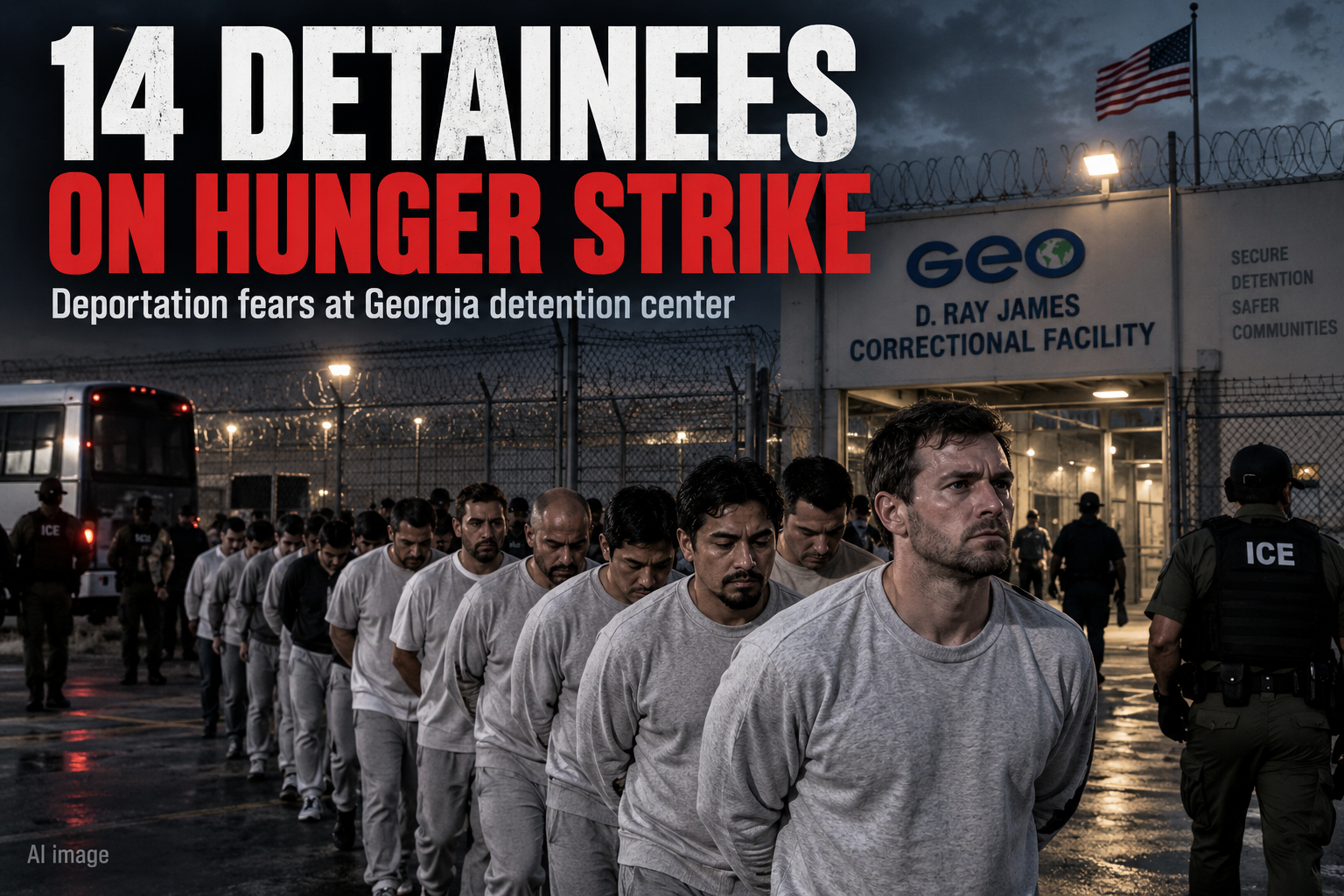
Fourteen Russian citizens held at the D. Ray James ICE Processing Center in Folkston, Georgia, signed a collective complaint about detention conditions. The document is dated September 14. The Insider, Agentstvo and other outlets obtained copies; four sources familiar with the situation confirmed its authenticity to Agentstvo. Meduza
Publicly identified signatories include Alexei Kovalko, Alexander Borovkov and Andrei Gerdyukov. The Insider also identifies Andrei Mikhailov as one of the Russians taking part in the hunger strike; his relatives said he was among four Russians placed in solitary confinement after the protest began. The Insider
The Insider published the full list of 14 signatories as an image of the original document. Because some handwritten surnames on the published copy are ambiguous, WE PNW will not reconstruct them from the image and risk misidentifying people. The Insider
What the Detainees Allege
The collective complaint lists problems that the detainees describe as systemic: inadequate medical and dental care, poor food and water, cold rooms, disrupted sleep, difficulties with telephone calls and mail, restricted access to documents needed for immigration proceedings, and humiliating treatment by staff. The Insider
The authors allege that these conditions effectively prevent people from fully defending their cases in immigration court.
The most widely discussed part of the complaint concerns remarks the detainees attribute to the facility’s warden.
They allege that he repeatedly told Russians they would not be living in the United States, and on one occasion said:
“Don’t worry, we’ll send you back to your cozy Gulag.”
The remark appears in published accounts of the collective complaint. WE PNW has not independently verified that the facility’s warden actually made it. Meduza
That distinction matters: multiple sources corroborate the existence of the complaint; the specific spoken remark remains an allegation by the detainees.
A Private Prison in the ICE System
The D. Ray James Processing Center is owned and operated by The GEO Group, one of the largest private companies managing correctional and immigration facilities in the United States.
In 2025, ICE activated GEO’s 1,868-bed facility in Folkston. The company projected approximately $66 million in additional annual revenue in its first full year of operations. GEO Group investor announcement
GEO states on its website that the center provides round-the-clock access to medical care, legal and family visits, a library, nutritionist-approved meals and recreation. Those company statements differ sharply from the conditions described by the collective complaint’s authors. GEO Group
That is precisely why the complaint requires independent scrutiny.
But even setting aside conditions in Folkston, a second question remains — potentially a much more serious one for the Russians held there.
What Happens After Deportation?
For someone from Russia, immigration detention may be a temporary stage in an American immigration case.
Deportation, however, is not necessarily the end of the story.
Someone who has publicly opposed the war, criticized the Russian authorities, attended demonstrations, given interviews or left a public digital record of their views is returning to a country where anti-war speech has already led to thousands of administrative and criminal cases.
OVD-Info’s anti-war persecution page shows an updated count of 293 new defendants since February 24, 2025. This is a separate counter from its historical totals. For the period from February 24, 2022, through July 24, 2025, the organization documented 1,181 defendants in anti-war criminal cases, 11,591 first-instance administrative cases involving “discrediting the army” and 20,103 detentions for anti-war positions. OVD-Info
These figures do not mean that everyone will face the same charge or receive the same sentence.
They mean something else:
Persecution for opposing the war in Russia is a documented state practice, rather than a hypothetical scenario.
From the United States to Six Years in a Penal Colony
One of the clearest examples emerged this week.
Leonid Melekhin, an activist and businessman from Perm, arrived in the United States in 2024 and sought political asylum.
He was held in immigration detention.
In 2025, his application did not result in asylum being granted, and he returned to Russia.
After returning, he faced criminal prosecution.
On October 5, 2026, a Russian court sentenced Melekhin to six years in a penal colony on charges of “justifying terrorism.” The case involved a Telegram post and an online comment; one post included an image with sharply anti-Putin wording. Meduza
The sequence is straightforward:
United States → asylum request → immigration detention → return to Russia → criminal case → six years in a penal colony.
This is no longer a prediction.
It happened.
Meduza also reports at least one other case of a Russian who sought asylum in the United States and faced criminal prosecution after returning: serviceman Artem Vovchenko, who was placed in pretrial detention after arriving in Russia on charges of abandoning his military unit. Meduza
The Kremlin Says There Are No Political Prisoners
On September 30, Kremlin spokesman Dmitry Peskov stated the Russian government’s position unequivocally:
“We categorically deny the existence of any political prisoners and consider framing the issue in this way entirely inappropriate.”
This was the Kremlin’s explanation for why, according to Peskov, releasing political prisoners in exchange for easing U.S. sanctions could not have been discussed in those terms. Interfax
Russian human rights defenders describe a very different picture.
OVD-Info maintains a daily updated database of people it considers subject to politically motivated criminal prosecution — for their professional work, religious beliefs, anti-war positions and other views that diverge from state policy. OVD-Info
For someone facing potential deportation, a dispute over the term “political prisoner” is therefore more than a debate about language.
The question is not what to call it.
The question is whether the person will be detained, face criminal charges and end up in a penal colony.
50 Public Cases: The Russia Seen by Human Rights Defenders
Below is a selection of 50 publicly known episodes discussed by OVD-Info, Meduza, The Insider and other human rights and independent sources. They differ in the severity of the allegations, procedural stage and legal circumstances. This is not a list of 50 people deported from the United States, nor a claim that all their cases are identical.
It illustrates the breadth of political and anti-war persecution.
- Leonid Melekhin — received six years in a penal colony after a stay in the United States and a return to Russia.
- Ariadna Litvinova — an anti-war activist detained over anti-war graffiti.
- Lida Moniava — faced criminal prosecution over anti-war posts; on October 6, Reuters reported that the case had been dropped, a rare instance of the authorities backing down. Reuters
- Lev Shlosberg — a Russian opposition politician repeatedly subjected to prosecution.
- Maxim Kruglov — an opposition politician prosecuted in connection with public statements about the war.
- Pavel Syutkin — an author and historian implicated in a case involving alleged military “false information.”
- Roman Melnichenko — a defendant in a case involving repeated “discrediting” of the army.
- Dmitry Purkin (“Grandfather Archimedes”) — prosecuted in absentia by Russian authorities.
- Sergei Demin — subjected to legal proceedings after a public picket with an anti-war sign.
- Artem Snegovsky — faced administrative proceedings under the law on “discrediting the army.”
- Ilya Remeslo — implicated in a criminal case involving alleged military “false information.”
- Ilya Prusikin — a Little Big musician who publicly opposed the war and is wanted by Russian authorities.
- Yuri Dud — a journalist facing proceedings in absentia by Russian authorities.
- Igor Eidman — a commentator and sociologist ordered arrested in absentia by a Russian court.
- Andrei Shabanov — a defendant in an anti-war case; OVD-Info reported an assault on him in a penal colony.
- Ilya Vasilyev — received a prison sentence in a military “false information” case over a Facebook post.
- Fazyl Valiakhmetov — a local historian convicted in a case that included an anti-war post.
- Andrei Edigarev — a politician from Udmurtia against whom new criminal proceedings were initiated.
- Arseny Turbin — a minor implicated in a politically sensitive criminal case; another case was opened against him in 2026. OVD-Info
- Darya Kozyreva — a St. Petersburg activist who served a sentence in an anti-war case. OVD-Info
- Vladimir Osipov — convicted over anti-war posts; died in a pretrial detention facility in 2026. OVD-Info
- Sergei Lintsov — convicted in a case involving “false information” about the army.
- Andrei Akuzin — an artist who faced criminal prosecution and died in pretrial detention.
- Vadim Selin — convicted on multiple criminal charges, including charges involving posts about the war.
- Roman Popkov — a journalist and activist facing criminal cases in absentia.
- Vladislav Gorin — a Meduza journalist wanted by Russian authorities.
- Igor Leonovich — faced criminal prosecution over transfers to organizations associated with Alexei Navalny’s Anti-Corruption Foundation.
- Nabi Balabekov — subjected to administrative detention for political activity.
- Darya Bunkova — subjected to administrative detention.
- Yulia Kuznetsova (Kharchenko) — a political candidate whose detention was reported by human rights defenders.
- Boris Miklyukov — faced administrative proceedings over a social media post.
- Vladimir Nekrasov — detained by Russian security agencies in a politically sensitive case.
- Sergei Derevyanko — detained at an airport and subsequently convicted in a criminal case.
- Olga Komleva — a RusNews journalist who received a lengthy sentence in a politically motivated case.
- Sergei Veselov — received a sentence of several years; the case involved politically sensitive public statements.
- Nikita Afanasyev — faced criminal prosecution after returning to Russia and received a lengthy sentence.
- Oleg Belousov — convicted in a military “false information” case.
- Azat Miftakhov — a mathematician and political prisoner who remained imprisoned in 2026.
- Sergei Maryin — a human rights defender facing criminal prosecution. OVD-Info
- Lyudmila Razumova — an artist and defendant in a politically motivated case.
- Tatyana M. — a resident of Khakassia subjected to legal proceedings after someone reported her remarks about the war.
- A resident of Beloretsk, name unpublished — faced army “discrediting” cases over social media comments.
- A resident of Simferopol, name unpublished — received an administrative penalty for a video classified as “discrediting the army.”
- Two couriers in Volgograd, names not publicly disclosed — detained after photographing the aftermath of a military incident.
- A 20-year-old woman from Belgorod region, name not publicly disclosed — faced an administrative case involving “extremist” symbols.
- Alexander Kynev — a Russian political scientist whose detention in 2026 was reported by human rights defenders.
- Scientists who signed an anti-war letter in 2022 — some received renewed summonses for questioning by security agencies in 2026.
- Nikolai Rybakov — the chairman of Yabloko, subjected to an administrative case over an anti-war inscription.
- Alexander Shramkov — subjected to persecution after a public political action.
- Alexander Grigoryev — became a defendant in a military “false information” case over posts about the war.
This selection is not comprehensive. OVD-Info’s database is updated daily, and the organization explicitly warns that the true scale of politically motivated persecution exceeds the cases already known. OVD-Info
A “Cozy Gulag”: A Joke or a Warning?
Here the story returns to Folkston.
Fourteen Russians allege that the facility’s warden promised to send them back to their “cozy Gulag.”
The specific remark has not yet been independently verified.
But even if it was never made, the question behind it remains.
What does it actually mean to “send back” someone who has publicly opposed the war?
Photographs from a demonstration will not disappear when the plane lands.
An interview will not disappear.
Social media accounts will not disappear.
Public criticism of the Russian authorities will not disappear.
Russian criminal cases in recent years show that digital posts, videos, comments, photographs, donations and public political activity can be used as prosecution evidence.
For some Russian asylum seekers, this is therefore more than moving from one country to another.
It may mean moving from American immigration detention into a Russian criminal case.
What Must America Consider?
WE PNW does not argue that every Russian citizen should automatically receive asylum in the United States.
Asylum applications must be assessed individually.
Facts must be checked.
People may be denied asylum if they do not meet the legal requirements.
But there is a question that the American system cannot treat as secondary:
What will happen to this particular person after deportation?
If someone has openly opposed the war in the United States, attended demonstrations, criticized Vladimir Putin, given public interviews or published anti-war statements, the risk of Russian criminal prosecution cannot be treated as abstract.
There are laws.
There are thousands of cases.
There are actual sentences.
There are people detained after returning.
And there is Leonid Melekhin.
He came to the United States and asked for protection.
Today he is serving a six-year sentence in a Russian penal colony.
That does not mean his case is identical to those of the fourteen Russians in Georgia.
But it shows why questions about deportation cannot end when the plane leaves U.S. territory.
The Central Question
Fourteen Russians in Folkston signed a complaint about detention conditions. According to The Insider, Russian detainees subsequently began a hunger strike.
Four were placed in solitary confinement after the protest began, according to The Insider. The Insider
They are contesting their right to remain in the United States within the American immigration system.
America has the right to consider those applications.
America has the right to examine the evidence.
America has the right to deny asylum when the law requires it.
But there is a question that cannot be replaced by bureaucratic procedure:
How humane is it to deport a Russian who has publicly opposed the war to a country where that public opposition can itself become part of a criminal case?
And if American authorities know that a person has opposed the war here, know that their name, face and statements are publicly available, and know about Russia’s practice of criminal prosecution for such actions — where does ordinary deportation end and the knowing transfer of a person to a system capable of imprisoning them for their political views begin?
The Kremlin says there are no political prisoners in Russia.
Russian human rights defenders document a different reality every day.
For someone put on a plane back to Russia, that dispute may end in something more than words.
It may end in a sentence.