Civil rights advocates are calling on Washington Gov. Bob Ferguson to strengthen restrictions on federal immigration agencies’ access to driver and vehicle registration records.
The renewed demands follow an October 13 report from the University of Washington Center for Human Rights, which documented continued federal access to state licensing information despite restrictions already put in place.
Ferguson's administration says it has blocked more than 174,000 federal search attempts since November 2025. Researchers and advocates argue that significant gaps remain.
For residents of Vancouver and Clark County, the dispute raises a local question: What happens to personal information collected by Washington state when federal agencies can access it through law enforcement data networks?
More Than One Million Searches in Five Months
According to the University of Washington report, agencies within the U.S. Department of Homeland Security (DHS) conducted 1,037,724 searches of Washington Department of Licensing (DOL) driver and vehicle information between January 1 and May 31, 2026.
That number represents database queries, not individual drivers. The same person or vehicle may have been searched multiple times.
Researchers also documented 356 immigration arrest incidents between August 1, 2025, and October 13, 2026, in which federal agents used vehicle registration queries before making arrests.
The researchers combined database records with reports of immigration enforcement activity to identify those incidents.
The figure is not a statewide total of immigration arrests. It reflects cases in which the researchers were able to document a connection to the vehicle-data system.
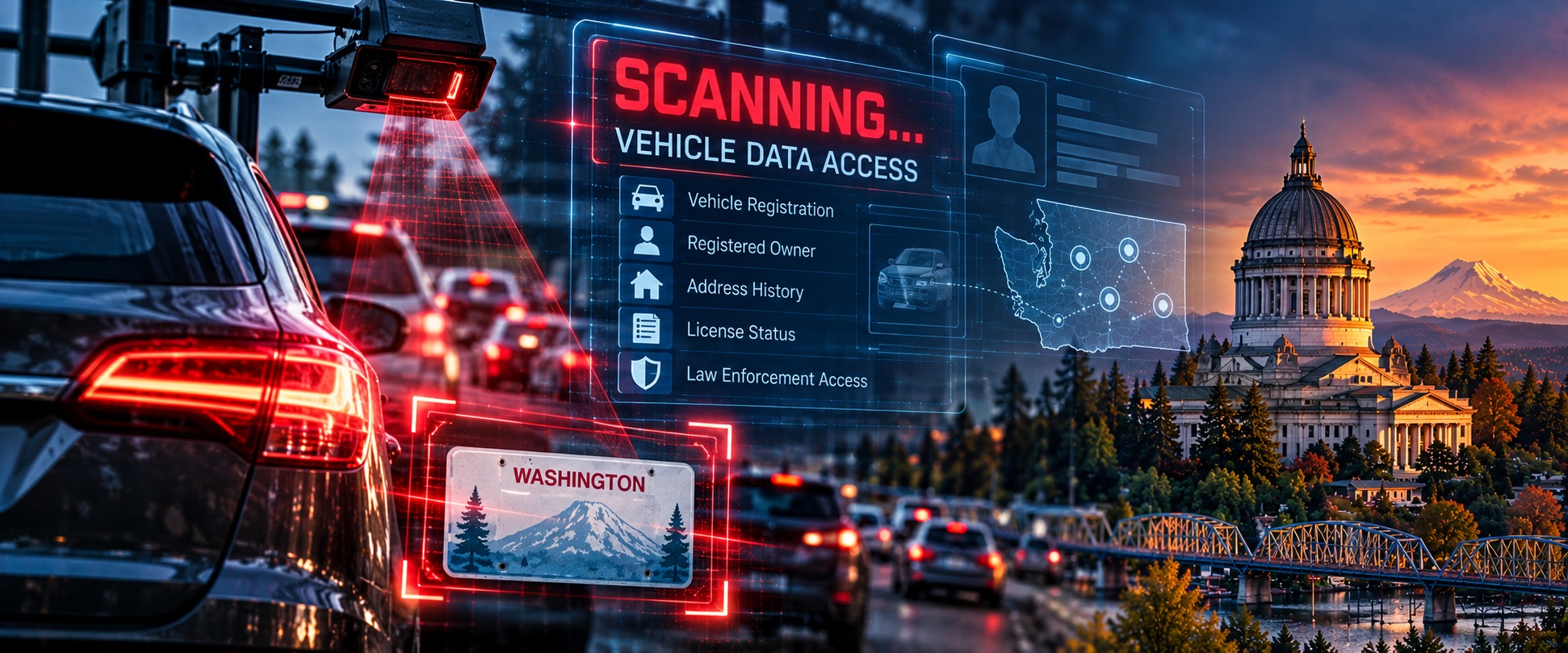
In some documented cases, federal officers checked a vehicle's license plate, obtained information identifying its registered owner, and compared that information with federal databases before taking enforcement action.
Washington has allowed eligible residents to obtain driver’s licenses regardless of immigration status since 1993. The controversy centers on whether information collected for licensing and vehicle registration should be accessible for federal civil immigration enforcement.
Source: University of Washington Center for Human Rights, October 13, 2026
How Federal Agencies Can Obtain Driver Information
The University of Washington identified four potential pathways through which state driver and vehicle information can reach federal immigration agencies.
Direct database access. Federal users previously had access to certain DOL systems. Washington has restricted that access, and researchers did not establish that the previous direct channel remained active after mid-2025.
Nlets, the interstate law enforcement network. Federal agencies can submit requests through a national information-sharing system connected to Washington State Patrol's ACCESS network. Researchers documented continued queries through this infrastructure, making it the central issue in the current dispute.
Commercial data brokers. Private companies can compile information from multiple sources and provide data services to government customers. The university identified this as a potential route but did not establish its use in the Washington arrest incidents examined.
State and local law enforcement agencies. Government agencies may lawfully obtain certain records and, under some circumstances, share information with other authorities. Researchers could not determine the extent to which this pathway was used in the Washington cases they reviewed.
The distinction matters: identifying four possible routes does not mean researchers confirmed that ICE currently uses all four in Washington.
The strongest documented evidence concerns continued access through Nlets and ACCESS.
Source: University of Washington — Stopping the DMV-to-DHS Data Pipeline
Ferguson Says Washington Has Already Blocked Thousands of Searches
Ferguson's administration says the state has taken substantial steps to restrict federal immigration agencies' access to licensing records.
Between November 2025 and October 12, 2026, Washington State Patrol blocked more than 174,000 federal search attempts, according to figures provided by the governor's office.
Those included approximately:
- 89,000 searches associated with U.S. Customs and Border Protection (CBP).
- 45,000 associated with Homeland Security Investigations (HSI).
- Nearly 40,000 associated with Immigration and Customs Enforcement (ICE).
Those figures cover a different time period and measure different activity from the university's count of more than one million searches. They should not be directly subtracted from or compared with the university total.
Ferguson says his administration has acted to limit federal access for civil immigration enforcement while preserving access necessary for legitimate public safety investigations, including human trafficking cases.
His spokesperson, Brionna Aho, said on October 27 that the administration is reviewing approaches used by other states, including whether judicial warrants could be required for certain immigration-related requests.
Advocates, however, say blocking individual federal user accounts is insufficient if other pathways remain available.
The dispute therefore centers on whether Washington's existing safeguards are effective enough — and what additional restrictions could be implemented without interfering with lawful criminal investigations.
Source: Washington State Standard, October 27, 2026
Why Advocates Say Washington's Law Is Not Enough
The controversy also involves the Keep Washington Working Act, a state law enacted in 2019.
The law limits the disclosure of certain nonpublic personal information by state and local government agencies for federal civil immigration enforcement, subject to legal exceptions.
University of Washington researchers argue that continued federal access to vehicle registration information raises questions about whether those protections are being effectively enforced.
They point to the possibility that restricting one agency's access does not necessarily prevent another federal user or information-sharing pathway from obtaining similar records.
The researchers' conclusions do not establish that every federal search violates state law. The legality of a particular request depends on its purpose, legal authority, and the rules governing the information being accessed.
For state officials, the challenge is determining how to restrict prohibited uses while maintaining access for authorized investigations.
What This Means for Vancouver and Clark County
The University of Washington study examines statewide practices. It does not provide a separate confirmed count of vehicle-data-related immigration arrests in Vancouver or Clark County.
That means its 356 documented incidents cannot be presented as Clark County statistics.
Local law enforcement agencies have policies addressing cooperation with federal civil immigration enforcement.
The Vancouver Police Department states that its officers do not investigate civil immigration violations or detain individuals solely on suspicion of such violations.
Clark County Sheriff's Office policy restricts the sharing of nonpublic information for federal civil immigration enforcement except where authorized or required by law.
On February 17, 2026, the Clark County Council adopted Resolution No. 2026-02-05, reaffirming the county's commitment to Washington law, including the Keep Washington Working Act.
The resolution also recognizes federal immigration enforcement as a federal responsibility and states that Clark County does not participate in civil immigration enforcement beyond what the law requires.
However, local police cooperation policies and federal access to statewide databases are separate issues.
A restriction on what a Vancouver police officer may share directly does not necessarily determine what information a federal agency can obtain through a state-managed network.
Likewise, the existence of a written policy does not establish whether any particular information-sharing incident has occurred.
The available public research does not establish how many immigration arrests in Clark County, if any, were preceded by the vehicle registration searches examined in the statewide study.
That remains an important unanswered local question.
Sources: Clark County Sheriff's Office policy and Clark County Council Resolution No. 2026-02-05.
A Privacy Question Beyond Immigration
Washington's driver and vehicle registration systems contain information about residents across the state.
The university's research also describes federal immigration agencies querying vehicle registration records associated with U.S. citizens.
That broadens the issue beyond immigration status.
It raises questions about when information submitted to a state agency for licensing purposes may be used by other government agencies, how those uses are monitored, and what safeguards exist against unauthorized disclosure.
Holding a Washington driver's license does not establish immigration status or prevent lawful federal enforcement. Nor does a database search alone prove unlawful conduct.
The debate is instead about the legal boundaries of information sharing, oversight, and accountability.
What Happens Next?
Civil rights organizations are seeking stronger legal and technical restrictions on federal access to Washington driver and vehicle records.
Ferguson's administration says it will continue reviewing existing protections while maintaining lawful access for certain criminal investigations.
One option under consideration involves judicial warrant requirements for specific requests connected to civil immigration enforcement. Such a requirement has not been universally implemented for all related queries in Washington.
For Southwest Washington residents, the outcome may affect how personal information collected by state agencies is accessed and monitored.
The central question remains: Can Washington effectively protect residents' personal data while preserving legitimate law enforcement access?
The answer will depend on future state decisions, how restrictions are enforced, and whether independent review can establish how the systems work in practice.